
Home / DevOps Services and Solutions
DevOps
Services
and
Solutions
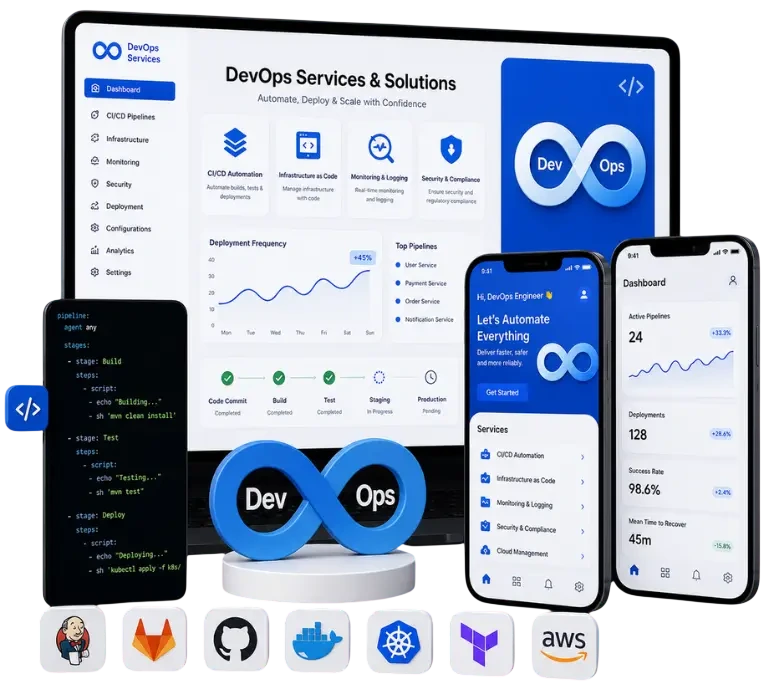
Accelerate software delivery, improve infrastructure reliability, and streamline development workflows with expert DevOps services. At GrowRankers, we help businesses automate deployments, strengthen cloud environments, and create scalable DevOps solutions that improve collaboration, system performance, and operational efficiency.
The
Principles
Behind
Every
DevOps
Solution
At GrowRankers, we believe successful DevOps services go beyond automation and deployment. Our approach is built on transparency, quality engineering, collaboration, and continuous improvement. These principles help us deliver reliable DevOps solutions that improve infrastructure performance, accelerate releases, and support long-term business growth.
Transparency
Clear project visibility, detailed reporting, and open communication keep stakeholders informed throughout every stage of implementation.
Quality
Every deployment, automation workflow, and infrastructure configuration follows proven engineering standards focused on reliability and performance.
Communication
Our teams work closely with clients, developers, and operations teams to maintain alignment, faster decision-making, and project clarity.
Innovation
We continuously adopt modern cloud technologies, automation practices, and DevOps consulting services to help businesses stay efficient and competitive.
How GrowRankers Drives DevOps Success
At GrowRankers, we help businesses modernize infrastructure, automate software delivery, and improve operational efficiency through strategic DevOps implementation. Our specialists combine cloud expertise, automation frameworks, and infrastructure management practices to create reliable environments that support faster releases, stronger security, and scalable business growth.
-
Cloud Infrastructure Management
-
CI/CD Pipeline Automation
-
Infrastructure as Code (IaC)
-
Containerization & Kubernetes
-
DevOps Security & Compliance
Comprehensive
DevOps
Services
for
Modern
Businesses
We help organizations automate software delivery, optimize cloud infrastructure, and improve operational efficiency through proven DevOps practices. Our services focus on faster deployments, stronger security, improved scalability, and better collaboration between development and operations teams.
DevOps Consulting Services
Assess your current infrastructure, workflows, and deployment processes to create a practical DevOps roadmap aligned with your business and technology goals.
CI/CD Pipeline Development
Build automated continuous integration and continuous deployment pipelines that reduce manual effort, improve release quality, and accelerate software delivery across environments.
Cloud Infrastructure Management
Design, deploy, and manage cloud environments on AWS, Microsoft Azure, and Google Cloud with performance, scalability, and cost optimization in mind.
Infrastructure as Code (IaC)
Automate infrastructure provisioning using Terraform, Ansible, CloudFormation, and other modern tools to ensure consistency and faster environment setup.
Containerization & Kubernetes
Deploy applications using Docker and Kubernetes to improve portability, resource utilization, application scalability, and infrastructure management.
DevOps Monitoring & Performance Optimization
Implement proactive monitoring, log management, alerting systems, and performance analysis to maintain application reliability and operational visibility.
Benefits of Our DevOps Services and Solutions
Faster Software Delivery
Improved Infrastructure Reliability
Enhanced Team Collaboration
Scalable Cloud Operations
Stronger Security & Compliance
Continuous Optimization & Support
Our
Proven
DevOps
Implementation
Process
Our DevOps process is designed to improve collaboration, automate workflows, and accelerate software delivery. From infrastructure assessment to continuous optimization, we follow a structured approach that helps businesses improve reliability, scalability, security, and operational efficiency across modern development environments.
Infrastructure Assessment & Discovery
DevOps Strategy & Architecture Planning
CI/CD Pipeline Implementation
Infrastructure Automation & Configuration
Monitoring, Security & Performance Optimization
Continuous Support & DevOps Consulting Services
Trusted DevOps Partner
for Scalable Growth
We help businesses modernize infrastructure, automate software delivery, and improve operational efficiency through proven DevOps solutions, cloud expertise, and continuous optimization strategies.
0
+Successful Implementations
0
+Years of Experience
0
+Cloud & DevOps Specialists
0
%Client Retention Rate
DevOps Solutions for Diverse Industries
We help businesses across multiple industries improve software delivery, automate infrastructure management, strengthen security, and accelerate digital transformation. Our DevOps solutions are designed to support scalability, operational efficiency, and continuous innovation regardless of business size or industry requirements.










Ready to Accelerate Software Delivery with DevOps Services?
Streamline deployments, automate infrastructure, and improve operational efficiency with expert DevOps services designed to support scalable, secure, and high-performing business environments.
Get a Free DevOps Consultation
Our DevOps Technology Stack
We utilize modern DevOps technologies, cloud platforms, automation tools, and monitoring solutions to build a reliable, scalable, and secure infrastructure that supports continuous delivery and operational excellence.
Cloud Platforms
Containerization
CI/CD Tools
Infrastructure as Code
Monitoring & Observability
Source Control & Collaboration
Why Businesses Trust GrowRankers for
DevOps Services
Successful DevOps adoption requires more than tools and automation. At GrowRankers, we combine cloud expertise, infrastructure engineering, and DevOps consulting services to help businesses improve deployment speed, system reliability, security, and operational efficiency through proven implementation strategies.

Experienced DevOps
Engineers
Our specialists bring hands-on experience across cloud platforms, automation frameworks, CI/CD pipelines, and infrastructure management projects.
Customized Implementation
Strategy
Every business has unique infrastructure requirements. We create practical DevOps solutions aligned with your technology stack and operational goals.
End-to-End DevOps
Services
From assessment and planning to automation, deployment, monitoring, and optimization, we manage the complete DevOps transformation journey.
Transparent Project
Communication
Receive regular progress updates, technical visibility, and collaborative planning throughout every stage of implementation and optimization.


Continuous Improvement
Approach
We continuously analyze performance, automate repetitive tasks, and identify opportunities to improve infrastructure efficiency and deployment reliability.
Security Focused
Operations
Our processes incorporate security best practices, compliance checks, vulnerability assessments, and infrastructure governance from the start.
Long Term Support
& Optimization
After implementation, we provide ongoing monitoring, maintenance, consulting, and performance improvements to keep environments operating efficiently.

Complimentary DevOps Assessment
Request a QuoteTrusted by Businesses Worldwide
Delivering innovative software, AI, and mobile app solutions that help businesses grow, streamline operations, and achieve measurable results.
Proven Track Record
200+
Successful Projects Delivered Globally
150+
Happy Clients
5+
Years of Excellence
10+
Countries Served




"GrowRankers has been our technology partner since the beginning, helping us deploy our first mobile app to managing the entire infra of 2M+ users and 5M+ media uploads."

Jonathan Punski
"Working with GrowRankers on our iOS and Android application was a seamless experience. We needed a platform that could support event management and networking access for our community."

Sharona B. Ross MD FACS
"The team has helped us grow our technology infrastructure from scratch by understanding the technical complexities in real-time heat optimization. Truly professional."

Pierre Tauberman
"Our collaboration with GrowRankers was transformative. Their AI-driven approach allowed us to optimize our entire supply chain in record time."

Michael Chen
Insights, Trends & AI Innovation
Stay updated with the latest technological developments, expert guides, and industry reports curated by our AI engineering and digital product specialists.

On-Demand Restaurant App Development Cost in 2026: A Complete Pricing Guide
If you run a restaurant, or you’re planning to launch a food business, you’ve probably typed some version of this...

How to Choose the Best Restaurant App Development Company in 2026
If you own a restaurant, or you are planning to launch one, you already know that a website alone is...

Top 10 Restaurant App Development Companies in 2026
If you run a restaurant, a cloud kitchen, or a food chain, you already know one thing — people order...

On-Demand Dating App Development Cost in 2026: A Complete Pricing Guide
Building a dating app is not as simple as putting a few profiles on a screen and letting people swipe....
Frequently Asked Questions
Find answers to common questions about our DevOps services and processes.
Understanding DevOps Services
What are DevOps services and how do they help businesses?
DevOps services combine software development and IT operations practices to improve how applications are built, tested, deployed, and maintained. The goal is to create a faster and more reliable software delivery process while reducing manual effort and operational challenges. Businesses benefit from improved collaboration between development and operations teams, shorter release cycles, and better application stability.
Modern DevOps services include automation, cloud management, monitoring, CI/CD pipelines, infrastructure management, and security integration. By adopting DevOps practices, organizations can release updates more frequently, reduce downtime, respond quickly to market demands, and create a better experience for customers while maintaining greater control over their technology infrastructure.
What is included in professional DevOps services?
Professional DevOps services cover a wide range of activities designed to streamline software delivery and infrastructure management. These services typically include CI/CD pipeline implementation, cloud infrastructure setup, Infrastructure as Code, containerization, Kubernetes management, monitoring solutions, security integration, automated testing, and deployment automation.
Many organizations also seek DevOps consulting services to assess existing environments and create a roadmap for adoption. A DevOps team works closely with stakeholders to improve development workflows, reduce deployment risks, and enhance operational efficiency. The exact scope depends on business goals, existing systems, and scalability requirements, ensuring technology environments support both current operations and future growth.
How do DevOps solutions improve software delivery processes?
DevOps solutions improve software delivery by automating repetitive tasks and creating a consistent workflow from development to deployment. Automated testing, continuous integration, and continuous deployment reduce human errors and help teams identify issues earlier in the development lifecycle. Developers can release updates more frequently without disrupting application performance. Improved collaboration between teams eliminates communication bottlenecks and accelerates decision making.
Monitoring and reporting tools provide real time visibility into system health and deployment outcomes. As a result, businesses can launch new features faster, improve software quality, reduce downtime, and maintain a reliable user experience while responding quickly to changing customer and market requirements.
What is the difference between DevOps and traditional IT operations?
Traditional IT operations often separate development and operations teams, resulting in slower communication, manual processes, and longer release cycles. DevOps introduces a collaborative culture where both teams work together throughout the software lifecycle. Automation plays a significant role in DevOps, allowing organizations to streamline testing, deployment, monitoring, and infrastructure management.
Traditional approaches typically rely on manual approvals and isolated workflows, which can delay updates and increase risks. DevOps solutions focus on continuous improvement, rapid releases, and operational efficiency. This approach helps businesses adapt quickly to market demands while maintaining application stability, security, and performance across development and production environments.
Why should businesses invest in DevOps consulting services?
DevOps consulting services help businesses identify operational inefficiencies, improve deployment processes, and build a technology environment that supports growth. Experienced consultants evaluate existing workflows, infrastructure, security practices, and development processes before recommending practical improvements.
This guidance reduces implementation risks and ensures organizations adopt the right tools and strategies. DevOps consultants also help establish automation frameworks, CI/CD pipelines, cloud architectures, and monitoring systems. Businesses gain access to industry expertise without the cost of building an internal team from scratch. Investing in DevOps consulting services can improve software quality, accelerate delivery cycles, reduce operational costs, and create a stronger foundation for future innovation.
DevOps Consulting & Strategy
How do DevOps consulting services help organizations scale?
DevOps consulting services provide the strategic direction needed to support business growth and increasing technology demands. Consultants analyze current systems, development workflows, deployment practices, and infrastructure performance to identify limitations. They then create a roadmap that improves scalability through automation, cloud adoption, containerization, and Infrastructure as Code.
These improvements help organizations handle higher workloads without compromising application performance or reliability. By implementing efficient processes and modern technologies, businesses can reduce operational bottlenecks and support rapid expansion. DevOps consultants also help teams adopt best practices that improve collaboration, resource utilization, and long term operational efficiency, making growth more manageable and sustainable.
When should a company hire a DevOps consulting partner?
A company should consider hiring a DevOps consulting partner when software releases become difficult to manage, infrastructure costs increase, deployment failures occur frequently, or scalability challenges begin affecting operations. Organizations migrating to the cloud or modernizing legacy systems can also benefit from expert guidance.
DevOps consulting services provide a structured approach to solving operational inefficiencies while reducing implementation risks. Consultants bring experience with automation, monitoring, security, and cloud technologies that may not exist internally. Engaging a DevOps partner early can accelerate project timelines, improve software quality, and establish processes that support future growth while minimizing disruptions to business operations.
How do you assess existing infrastructure before implementing DevOps?
Before implementing DevOps solutions, a detailed assessment of the existing infrastructure is performed. This includes reviewing server architecture, application deployment processes, cloud environments, security controls, monitoring systems, and development workflows. The goal is to identify performance bottlenecks, operational inefficiencies, security gaps, and scalability limitations.
Teams also evaluate collaboration practices between developers and operations personnel. The findings help create a customized implementation strategy that aligns with business objectives. By understanding the current environment, organizations can prioritize improvements, select appropriate technologies, and develop a realistic roadmap that minimizes disruptions while maximizing the benefits of DevOps adoption.
Can custom DevOps solutions be built for specific business requirements?
Yes, custom DevOps solutions are designed to align with the unique goals, infrastructure, compliance requirements, and operational workflows of a business. Every organization has different applications, deployment processes, security standards, and scalability needs.
A customized approach ensures the DevOps environment supports those requirements effectively. This may involve building specialized CI/CD pipelines, creating custom monitoring dashboards, implementing cloud specific architectures, or integrating proprietary systems. Custom DevOps solutions help businesses avoid unnecessary complexity while improving operational efficiency. They also provide flexibility to adapt as technology requirements evolve, ensuring the infrastructure remains aligned with business growth and changing market demands.
What industries benefit the most from DevOps solutions?
DevOps solutions provide value across nearly every industry that depends on software and digital infrastructure. Technology companies use DevOps to accelerate software releases and improve platform reliability. Healthcare organizations benefit from secure deployment processes and system availability. Financial institutions use DevOps to support compliance requirements and maintain application performance.
Ecommerce businesses rely on DevOps to manage traffic spikes and ensure seamless customer experiences. Manufacturing, logistics, education, and telecommunications organizations also use DevOps to improve operational efficiency and scalability. Any industry seeking faster innovation, improved system stability, and better collaboration between teams can benefit significantly from modern DevOps practices.
DevOps Tools, Automation & Cloud
Which tools are commonly used in DevOps services?
DevOps services utilize a variety of tools to automate development, deployment, monitoring, and infrastructure management. Popular CI/CD tools include Jenkins, GitHub Actions, GitLab CI, and Azure DevOps. Containerization platforms such as Docker and orchestration solutions like Kubernetes help manage application deployments efficiently.
Infrastructure as Code tools, including Terraform and Ansible, automate infrastructure provisioning and configuration management. Monitoring platforms such as Prometheus, Grafana, Datadog, and New Relic provide visibility into system performance. Cloud providers, including AWS, Azure, and Google Cloud, are also commonly integrated into DevOps environments. The right toolset depends on business goals, technical requirements, and existing infrastructure.
How does CI/CD automation improve deployment speed and reliability?
CI/CD automation streamlines software delivery by automatically building, testing, and deploying code changes throughout the development lifecycle. Continuous Integration ensures that code updates are frequently merged and validated through automated testing. Continuous Deployment then moves approved changes into production environments with minimal manual intervention.
This process reduces human errors, identifies issues earlier, and increases deployment consistency. Teams can release updates more frequently while maintaining application quality and stability. CI/CD automation also improves collaboration by providing visibility into deployment pipelines and development progress. Businesses benefit from faster delivery cycles, reduced downtime, and a more reliable software release process.
Can DevOps solutions be integrated with AWS, Azure, and Google Cloud?
Yes, DevOps solutions can be integrated with AWS, Microsoft Azure, and Google Cloud to create scalable and efficient cloud environments. Each platform offers services that support automation, monitoring, container management, security, and application deployment. DevOps teams use these cloud capabilities to build CI/CD pipelines, manage infrastructure through code, and automate operational processes.
Integration with cloud platforms enables organizations to scale resources based on demand, improve disaster recovery strategies, and optimize infrastructure costs. Whether using a single cloud provider or a multi cloud approach, DevOps practices help businesses maximize cloud performance while maintaining operational consistency and security.
How does Infrastructure as Code support modern DevOps practices?
Infrastructure as Code allows organizations to manage and provision infrastructure using code rather than manual configuration. This approach improves consistency, reduces configuration errors, and simplifies infrastructure management. Changes can be version-controlled, reviewed, tested, and deployed using the same processes applied to software development.
Infrastructure as Code also supports automation, making it easier to create, modify, and scale environments across cloud platforms. Tools such as Terraform and Ansible are commonly used for this purpose. By adopting Infrastructure as Code, businesses improve deployment speed, enhance operational reliability, and create a repeatable framework that supports modern DevOps solutions and scalable infrastructure management.
What role does Kubernetes play in DevOps automation?
Kubernetes plays a central role in DevOps automation by managing containerized applications across development, testing, and production environments. It automates deployment, scaling, load balancing, and resource allocation, reducing the need for manual intervention. Kubernetes helps ensure applications remain available even during traffic fluctuations or infrastructure failures.
It integrates with CI/CD pipelines and supports modern cloud native architectures, making software delivery more efficient. Organizations using Kubernetes benefit from improved scalability, resource utilization, and operational consistency. As part of a DevOps environment, Kubernetes helps businesses manage complex applications while maintaining performance, reliability, and flexibility across different infrastructure platforms.
Security, Monitoring & Compliance
How do DevOps services improve application security?
DevOps services improve application security by integrating security practices throughout the software development lifecycle rather than treating security as a final checkpoint. Automated security scans, vulnerability assessments, code reviews, dependency monitoring, and access control management help identify risks early. Security testing becomes part of the CI/CD pipeline, allowing teams to detect and fix vulnerabilities before deployment.
DevOps teams also implement secure infrastructure configurations, encryption standards, and monitoring tools to protect applications and data. This proactive approach reduces security incidents, strengthens compliance efforts, and helps businesses maintain reliable and secure applications while continuing to release updates efficiently and consistently.
What is DevSecOps and how is it different from DevOps?
DevSecOps is an extension of DevOps that places security at the center of development and operations workflows. While DevOps focuses on collaboration, automation, and faster software delivery, DevSecOps ensures security is integrated into every stage of the process. Security checks, compliance validations, vulnerability scanning, and risk assessments are automated alongside development and deployment activities.
This approach helps organizations identify potential threats earlier and reduce the chances of security breaches reaching production environments. DevSecOps promotes shared responsibility among development, operations, and security teams, creating a culture where application security becomes a continuous process rather than a separate task.
Can DevOps solutions help businesses meet compliance requirements?
Yes, DevOps solutions can help businesses achieve and maintain compliance requirements by automating processes, improving visibility, and enforcing standardized controls across environments. Industries such as healthcare, finance, and government often require compliance with regulations, including HIPAA, PCI DSS, SOC 2, and GDPR.
DevOps practices support these requirements through automated auditing, policy enforcement, access controls, infrastructure tracking, and security monitoring. Documentation and reporting become easier because system changes are recorded and traceable. By implementing compliance-focused workflows, businesses reduce manual errors, simplify audits, and maintain regulatory standards without slowing down software delivery or operational efficiency.
How does continuous monitoring improve system performance?
Continuous monitoring provides real-time visibility into application health, infrastructure performance, and user experience. Monitoring tools collect data on server utilization, application response times, network performance, error rates, and resource consumption. This information allows teams to identify performance bottlenecks before they impact users.
Continuous monitoring also supports proactive maintenance by detecting unusual activity, infrastructure failures, or application issues early. DevOps teams can quickly respond to incidents, optimize system resources, and maintain consistent performance. By using monitoring as part of a DevOps strategy, businesses improve uptime, reduce service interruptions, and deliver a more reliable digital experience.
What security practices are followed during DevOps implementation?
A successful DevOps implementation includes multiple security practices designed to protect applications, infrastructure, and business data. Common practices include role based access controls, encrypted communication, automated vulnerability scanning, infrastructure security assessments, secrets management, security testing within CI/CD pipelines, and continuous compliance checks.
Teams also follow secure coding standards and regularly update software dependencies to reduce risks. Logging and monitoring systems help detect suspicious activities and potential threats. These security measures are integrated into everyday workflows, ensuring that development speed does not compromise protection. This balanced approach supports both operational efficiency and strong cybersecurity standards.
Cost, Implementation & Hiring DevOps Experts
How much do DevOps services typically cost?
The cost of DevOps services varies depending on project complexity, infrastructure size, cloud environment, automation requirements, and ongoing support needs. Small businesses implementing basic CI/CD pipelines and monitoring solutions may have lower costs, while enterprises requiring large-scale cloud architecture, Kubernetes management, and advanced automation will require a larger investment. Pricing may be structured as fixed project costs, monthly managed services, or dedicated DevOps team engagements. Although implementation requires upfront investment, businesses often experience significant long-term savings through reduced downtime, faster deployments, improved resource utilization, and increased operational efficiency across development and infrastructure environments.
How long does it take to implement DevOps solutions?
The timeline for implementing DevOps solutions depends on the organization's current infrastructure, project scope, team readiness, and business objectives. Basic automation and CI/CD implementation may take a few weeks, while enterprise-wide DevOps transformations can take several months.
The process typically begins with infrastructure assessment, workflow analysis, tool selection, and roadmap planning. Once the strategy is finalized, teams implement automation, monitoring, cloud optimization, security integration, and deployment pipelines. Training and process adoption also play an important role in successful implementation. A structured approach ensures businesses achieve sustainable improvements without disrupting existing operations or development activities.
Should businesses build an in-house DevOps team or outsource DevOps services?
The decision depends on business goals, technical expertise, budget, and project requirements. Building an in-house DevOps team offers direct control and long-term knowledge retention but requires significant investment in hiring, training, and management. Outsourcing DevOps services provides immediate access to experienced professionals, proven methodologies, and specialized expertise without lengthy recruitment processes.
Many organizations choose outsourcing to accelerate implementation, reduce operational costs, and gain support from certified experts. Businesses can also adopt a hybrid approach where internal teams collaborate with external DevOps consultants. The right model depends on company size, project complexity, and long-term technology strategies.
What should you look for when choosing a DevOps services company?
When selecting a DevOps services company, evaluate their experience, technical expertise, industry knowledge, and successful project history. Look for a provider with proven capabilities in cloud platforms, automation tools, CI/CD pipelines, Infrastructure as Code, containerization, monitoring, and security integration.
Transparency, communication processes, and support capabilities are equally important. A reliable partner should understand your business objectives and provide practical recommendations rather than a one size fits all approach. Reviewing case studies, client testimonials, certifications, and service offerings can help assess their credibility. Choosing the right DevOps partner can significantly impact project success and long-term operational efficiency.
How can GrowRankers help with DevOps consulting services and implementation?
GrowRankers provides end-to-end DevOps consulting services designed to improve software delivery, infrastructure performance, and operational efficiency. Our team evaluates existing environments, identifies improvement opportunities, and creates practical implementation strategies aligned with business objectives.
We assist with CI/CD pipeline development, cloud migration, Infrastructure as Code, Kubernetes deployment, monitoring solutions, security integration, and automation frameworks. Whether you need a complete DevOps transformation or support for a specific initiative, our experts work closely with your team to ensure smooth adoption. By combining technical expertise with business-focused execution, GrowRankers helps organizations build scalable, secure, and high-performing technology environments.