If you run a restaurant, or you’re planning to launch a food business, you’ve probably typed some version of this into Google already: “How much does it cost to build a restaurant app?” And honestly, there’s no single number anyone can give you without knowing your goals first. The cost depends on what you want the app to do, how many people will use it, and how polished you want it to feel.
Here’s the short version before we go deep: a simple restaurant ordering app in 2026 usually costs somewhere between $8,000 and $20,000, while a full-featured, multi-restaurant on-demand platform with live tracking, AI recommendations, and its own delivery network can cross $100,000. That’s a huge range, we know. So instead of throwing one vague figure at you, this guide breaks the whole thing down — feature by feature, phase by phase, and team by team — so you walk away with a real, usable budget.
The timing couldn’t be more relevant either. Online food ordering isn’t a side channel anymore; it’s becoming the main way people eat. Global online food delivery revenue is projected to cross the $350 billion mark in 2026 alone, based on recent market forecasts, and that number keeps climbing every year. Restaurants that don’t have their own ordering app are basically handing that growth over to third-party platforms and losing a chunk of their margin in commissions. If you’re weighing whether to build your own app or rely on delivery aggregators, our breakdown of food delivery app development cost is a good companion read alongside this one.
One more thing before we dive in: pricing isn’t just about picking cheap versus expensive. It’s about matching your spend to your actual business stage. A single neighborhood restaurant testing out its first app doesn’t need the same architecture as a five-city chain planning to onboard its own delivery fleet, and paying for that level of infrastructure too early is one of the most common (and avoidable) budgeting mistakes we see. Keep that in mind as you read through each section below.
Let’s get into the actual numbers now.
How Much Does It Cost To Build A Restaurant App In 2026?
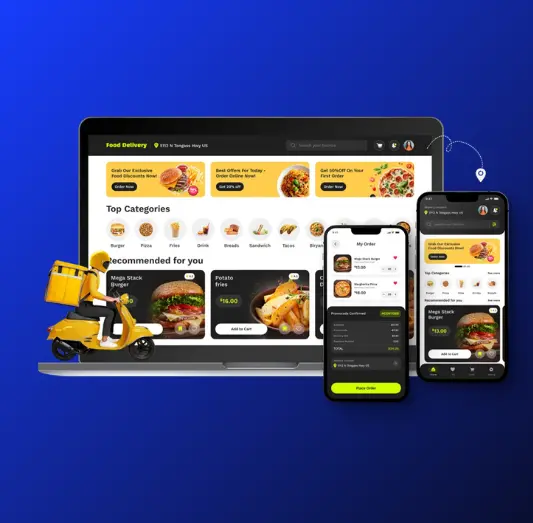
The honest answer is: it depends on complexity. A restaurant app can be as simple as a digital menu with online payment, or as complex as a full ordering ecosystem with a customer app, a restaurant panel, a delivery rider app, and an admin dashboard — all talking to each other in real time. Naturally, the price tag changes a lot between these two extremes.
Below, we’ve split the cost into four broad complexity tiers so you can quickly figure out which bracket your idea fits into.
Restaurant App Development Cost By App Complexity
| App Complexity Level | Core Capabilities | Estimated Development Time | Estimated Cost (USD) |
| Basic / MVP App | Digital menu, cart, online ordering, single payment gateway, order status | 6 – 10 weeks | $8,000 – $18,000 |
| Mid-Level App | Multiple payment options, loyalty/rewards, push notifications, order history, ratings & reviews | 10 – 16 weeks | $18,000 – $40,000 |
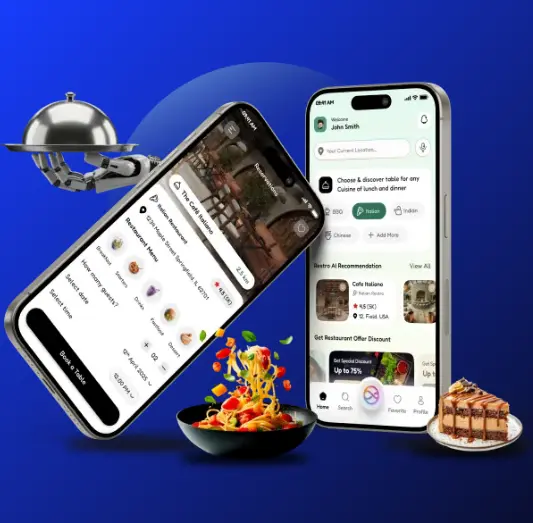
| Advanced App | Live order tracking, table reservation, AI-based menu suggestions, POS integration, multi-language support | 16 – 24 weeks | $40,000 – $90,000 |
| Enterprise / Multi-Restaurant Platform | Separate customer, restaurant, delivery, and admin apps, real-time analytics, dynamic pricing, own delivery fleet management | 24 – 40+ weeks | $90,000 – $180,000+ |
A word of caution here: these figures are directional, not fixed quotes. Two apps in the same “mid-level” bucket can still cost differently based on who’s building it, where they’re located, and how clean your requirements are before development starts.
Restaurant App Development Cost By Platform
Another thing that quietly changes your budget is which platform (or platforms) you want to launch on. A lot of restaurant owners assume “app” automatically means both iOS and Android, but that’s not always the smartest first move, especially on a tight budget.
| Platform Choice | What It Means | Relative Cost Impact |
| Android Only | Native app built only for Android devices | Base cost (100%) |
| iOS Only | Native app built only for Apple devices | Roughly 100% – 115% of base cost |
| Native Android + iOS (two separate codebases) | Two fully native apps built independently | Roughly 165% – 190% of base cost |
| Cross-Platform (Flutter / React Native) | One codebase deployed to both Android and iOS | Roughly 115% – 135% of base cost |
For most single-restaurant or small-chain owners, cross-platform frameworks like Flutter give you the best balance — you reach both app stores without paying for two separate native builds. Bigger brands with heavy performance needs (think real-time GPS tracking at scale) sometimes still lean toward native development, but that’s a conversation worth having with your development partner before locking in a budget.
Restaurant App Development Cost: In-House Team vs Outsourcing vs Freelancers
There’s one more decision that shapes your final number just as much as complexity and platform do: who actually builds the app. Most restaurant owners land on one of three paths, and each one comes with its own trade-offs.
| Hiring Model | Best Suited For | Typical Cost Impact | Things To Watch Out For |
| In-House Team | Large chains planning constant, long-term feature updates | Highest upfront cost (salaries, benefits, tools) | Slow to hire, expensive to maintain during quiet periods |
| Freelancers | Very small, simple, one-time builds on a tight budget | Lowest upfront cost | Inconsistent availability, harder accountability, limited QA |
| Dedicated Agency/Outsourced Team | Most restaurants, from single-location to multi-brand | Moderate, predictable cost | Requires vetting the agency’s past restaurant/food-tech work |
For a one-off project like a restaurant app, hiring a dedicated agency almost always ends up being the most balanced option. You get a full team — designer, developer, QA, project manager — without carrying them as permanent payroll once the app is live and stable.
Key Factors That Influence Restaurant App Development Cost
Now that you’ve got a rough range in mind, let’s talk about why costs swing so much within each tier. These are the variables that actually move your final invoice up or down.
1. App Features And Functionality
This is the biggest cost driver, hands down. A simple “browse menu and pay” app is cheap. Add live order tracking, in-app chat with delivery riders, loyalty points, referral programs, or AI-driven “you might also like” suggestions, and each of those adds real development hours. It’s worth listing every feature you actually need versus features that sound nice but won’t move the needle for your customers. A good exercise here is to sort your feature list into “must-have for launch,” “nice for version two,” and “someday, maybe” — that alone can cut your first invoice by a significant margin without hurting your launch experience.
2. UI/UX Design Complexity
People eat with their eyes first, and that’s true even inside an app. A generic, template-based design costs less, but a custom-designed interface — with your brand colors, custom food photography layouts, and smooth animations — takes more design hours. It’s usually worth the extra spend here because a clunky ordering flow directly hurts conversion and repeat orders. Think about it from a customer’s side: if the checkout process feels confusing or slow, they’ll just close the app and order from whichever competitor makes it easier, even if your food is better.
3. Technology Stack And Backend Architecture
The backend is the engine nobody sees but everybody feels. A scalable backend that can handle order spikes during lunch or dinner rush, manage multiple restaurant locations, and sync inventory in real time costs more to build than a basic backend meant for low order volumes. Choosing the right database, server architecture, and cloud provider upfront saves you from expensive rebuilds later. This is also where decisions about scalability really matter — a backend built cheaply for 50 daily orders will likely need a costly rebuild the moment you cross a few hundred, so it pays to design slightly ahead of where you are today.
4. Third-Party Integrations
Payment gateways, SMS/OTP verification, maps and geolocation, POS systems, and delivery-partner APIs all need to be wired into your app. Some integrations are quick; others (especially POS syncing) can eat up significant development time depending on how “open” that system’s API is. Older, legacy POS systems in particular can add unexpected hours to a project, so it’s worth checking your current setup’s integration documentation (or asking your vendor to check it) before finalizing your budget.
5. Development Team Location And Structure
Where your developers sit in the world changes your hourly rate dramatically — sometimes by 3x to 5x. We’ll cover this in detail in the team-cost section below, but it’s one of the single biggest levers you have to control your budget. It’s not just about the hourly rate either; time zone overlap, communication style, and how well the team documents their work all affect how smoothly (and cheaply) the project actually runs.
6. Security And Compliance Requirements
If your app handles payments, you need to meet card-data security standards, and if you operate in regions with strict privacy laws, you’ll need consent flows, data encryption, and secure storage. Skipping this isn’t an option — it’s a legal and reputational risk — so budget for it from day one. A single data breach or a failed compliance audit can cost far more in fines, lost trust, and emergency fixes than building it correctly the first time ever would.
7. Testing And Quality Assurance
An app that crashes during a Friday night rush is worse than no app at all. Proper QA across multiple devices, screen sizes, and network conditions takes real time, and it’s one of the first things rushed (and regretted) budgets tend to cut. Testing should also cover edge cases specific to food ordering — what happens if a customer’s connection drops mid-payment, or if a dish sells out while someone’s cart is still open. Those small scenarios are exactly what separates a reliable app from a frustrating one.
8. Post-Launch Support And Maintenance
Your app isn’t “done” the day it launches. OS updates, bug fixes, new feature requests, and server upkeep are ongoing costs that many first-time app owners forget to plan for. It helps to think of your app less like a one-time purchase and more like a storefront — you wouldn’t open a restaurant and never clean, restock, or repair anything again, and an app needs that same kind of ongoing attention.
9. Number Of Restaurant Locations Or Brands
If you’re building for a single outlet, your app’s logic stays fairly simple. The moment you add multiple branches, franchise locations, or an entirely separate sister brand under one app, you introduce location-based menus, separate inventories, and location-specific order routing — all of which add real backend complexity and, naturally, cost.
10. Analytics And Reporting Depth
Basic order history is cheap to build. Detailed analytics — like peak-hour heatmaps, customer lifetime value tracking, or menu-item performance dashboards — require additional backend work and often a separate reporting layer. These features pay for themselves over time by helping you make smarter menu and staffing decisions, but they do add to the initial build cost.
If you’re still comparing vendors and unsure who can actually deliver on all these fronts without inflating your budget, this list of top restaurant app development companies is a useful starting point for shortlisting.
Restaurant App Development Budget Planning: Detailed Cost Breakdown
Once you know roughly which complexity tier you’re in, the next step is understanding how that total budget actually gets spent across the project. This helps you spot where a vendor’s quote is reasonable and where it might be padded.
Cost Breakdown By Development Phase
Let’s use a mid-level restaurant app with a total budget of around $30,000 as our working example. Here’s roughly how that budget typically splits across phases:
| Development Phase | Percentage of Total Budget | Approx. Cost (on a $30,000 project) |
| Discovery, Research & Planning | 5% – 8% | $1,500 – $2,400 |
| UI/UX Design | 12% – 18% | $3,600 – $5,400 |
| Frontend (App) Development | 25% – 30% | $7,500 – $9,000 |
| Backend Development | 22% – 28% | $6,600 – $8,400 |
| API & Third-Party Integrations | 8% – 12% | $2,400 – $3,600 |
| Quality Assurance & Testing | 8% – 12% | $2,400 – $3,600 |
| Deployment & App Store Submission | 3% – 5% | $900 – $1,500 |
| Project Management & Contingency | 5% – 7% | $1,500 – $2,100 |
Notice how design and development together eat up roughly 60-70% of the budget. That’s normal, and honestly, that’s where the money should go — it’s the part your customers directly interact with.
A quick tip while reviewing quotes from different vendors: if a proposal skips discovery and planning entirely and jumps straight into design, that’s usually a red flag. Skipping this phase might save you a week or two upfront, but it often leads to scope changes mid-project, which almost always cost more in the long run than the time it would’ve taken to plan properly at the start.
Cost Breakdown By App Module
Most on-demand restaurant platforms aren’t really “one app.” They’re actually a small family of apps working together. Here’s how the cost typically splits when you’re building a multi-restaurant or delivery-enabled platform:
| App Module | Purpose | Estimated Cost Share |
| Customer App | Browsing, ordering, payment, tracking, reviews | 35% – 40% |
| Restaurant/Vendor Panel | Menu management, order acceptance, inventory | 20% – 25% |
| Delivery Partner App | Order pickup, navigation, delivery status updates | 20% – 25% |
| Admin Dashboard | Analytics, commission management, user & vendor control | 15% – 20% |
If you’re only launching for a single restaurant with your own delivery staff, you may not need all four modules right away — the customer app and a lightweight vendor panel might be enough to start, with the rest added as you grow. If you’re aiming for a marketplace model instead of a single-brand app, it’s worth reading up on food delivery app development companies that specialize in multi-vendor platforms, since the architecture is genuinely different from a single-restaurant build.
How To Calculate Your Restaurant App Development Team Cost
Here’s a simple formula you can use to sanity-check any quote you receive, or to estimate cost yourself before you even talk to a vendor:
Total Team Cost = Total Estimated Hours × Average Hourly Rate of the Development Team
To break that down a bit further:
Total Estimated Hours = (UI/UX Hours) + (Frontend Dev Hours) + (Backend Dev Hours) + (QA Hours) + (Project Management Hours)
And your hourly rate depends heavily on where your team is based:
| Developer Location | Typical Hourly Rate (USD) |
| United States / Canada | $80 – $180 |
| United Kingdom / Western Europe | $70 – $150 |
| Australia | $75 – $160 |
| Eastern Europe | $35 – $70 |
| India / Southeast Asia | $18 – $45 |
So, for example, if your mid-level app needs roughly 600 total development hours and you hire a team from South or Southeast Asia at an average rate of $30/hour, your rough team cost would be:
600 hours × $30/hour = $18,000
The same 600-hour project with a US-based team at $130/hour would come out closer to $78,000 — for the exact same feature set. This is exactly why so many restaurant brands, even large ones, choose to work with offshore or nearshore teams that offer strong technical quality at a more sustainable hourly rate. It’s not about cutting corners; it’s about not overpaying for the same output.
One thing worth flagging: cheaper isn’t automatically better. A very low hourly rate combined with an unusually low hour estimate is often a sign that a phase — usually testing or post-launch support — has been quietly left out of the quote. Always ask for the hour breakdown behind any number you’re given, not just the final total, so you know exactly what you’re paying for.
Hidden Costs To Consider During Restaurant App Budget Planning
This is the part most cost guides skip, and it’s usually where first-time app owners get caught off guard. The development quote you get is rarely the only number you’ll spend. Here are the costs that tend to sneak up on people.
1. App Store Listing And Developer Account Fees
Apple charges an annual developer program fee, and while Google Play has a one-time registration fee, both stores also take a cut of any in-app purchases if you sell subscriptions or premium features through the app itself. These fees are small compared to your overall build cost, but they’re recurring, and it’s easy to forget to renew them until your app suddenly disappears from the store.
2. Payment Gateway Charges
Every payment gateway takes a small percentage per transaction, usually somewhere between 1.5% and 3.5%. This isn’t a one-time cost — it’s ongoing, and it scales with your order volume, so factor it into your per-order margin, not just your launch budget. Some gateways also charge a small flat fee per transaction on top of the percentage, so it’s worth comparing a couple of providers before committing to one.
3. Cloud Hosting And Server Costs
Your backend needs to live somewhere, and as your order volume grows, so does your server bill. A small restaurant app might run on $20-$50/month in hosting during early days, but that number climbs fast once you’re processing thousands of orders across multiple locations. Many teams also underestimate the cost of storage for high-resolution food images and video content, which adds up faster than expected as your menu library grows.
4. Third-Party API Usage Fees
Maps and location services, SMS/OTP verification, and delivery-tracking APIs often charge per API call once you exceed a free-tier limit. These are small individually but add up quickly at scale. If you’re planning delivery tracking specifically, it’s worth mapping out expected monthly order volume early, since mapping and geolocation APIs are usually priced per thousand requests.
5. Data Security And Compliance Costs
If your app processes card payments, you’ll need to follow recognized card-data security standards such as those maintained by the PCI Security Standards Council, and depending on your region, you may also need to budget for privacy-law compliance work. Retrofitting security after launch is almost always more expensive than building it in from the start.
6. Ongoing Maintenance And Updates
Operating systems update, devices change screen sizes, and your app needs periodic updates just to keep functioning smoothly. A reasonable rule of thumb is budgeting 15% – 20% of your original development cost per year for maintenance.
7. Marketing And User Acquisition
Building the app is only half the job — getting people to actually download and use it is the other half. Push notification services, referral incentives, and app store optimization all cost money that’s separate from your development budget entirely.
8. Feature Additions Post-Launch
Once real users start using your app, you’ll almost certainly discover features you didn’t think to include initially. It’s smart to set aside a buffer, roughly 10% – 15% of your original budget, specifically for these post-launch refinements.
9. Customer Support Tooling
As soon as your app has real users, you’ll need a way to handle order disputes, refund requests, and general questions. Whether that’s a simple in-app chat widget or a full help-desk integration, it’s another small but recurring line item that’s easy to forget during initial budgeting.
10. Third-Party Delivery Fleet Costs
If you don’t plan to use your own delivery staff and instead want to plug into an external delivery network through the app, those partnerships often come with their own setup fees and per-order charges, separate entirely from your app’s development cost.
Restaurant technology spending is only growing in importance industry-wide — recent data shows restaurant operators are leaning further into digital tools and automation to protect margins amid rising costs, according to the 2026 State of the Restaurant Industry report. Planning for these hidden costs upfront isn’t pessimism — it’s what separates apps that survive their first year from ones that quietly get abandoned.
How GrowRankers Helps You As A Trusted Restaurant App Development Company
Building a restaurant app isn’t just a coding project — it’s a business decision that affects how customers experience your brand every single day. At GrowRankers, we start every restaurant app project by actually understanding your operations first: your order volume, your existing POS setup, your delivery model, and your growth plans for the next couple of years. That way, we’re not just handing you a generic template — we’re building something sized correctly for where your business actually is, and where it’s headed. Our team works across the full stack, from UI/UX design to backend architecture, payment integrations, and post-launch support, so you’re not stuck juggling five different vendors for one app.
What really sets us apart is transparency around cost. We don’t believe in vague estimates that balloon halfway through development. Before a single line of code is written, you get a clear breakdown of what you’re paying for and why — similar to the phase-by-phase structure you saw earlier in this guide. If you’re still unsure what to look for in a development partner, our detailed guide on how to choose the right restaurant app development company walks through the exact questions to ask before you sign anything. And if you’d like a personalized cost estimate for your specific restaurant idea, our team at GrowRankers is happy to map it out with you, free of pressure or jargon.
Conclusion
So, how much does a restaurant app really cost in 2026? Anywhere from $8,000 for a lean, single-restaurant MVP to well over $100,000 for a full on-demand platform with its own delivery network — and the truth is, both ends of that range can be the right choice, depending on what stage your business is at. The mistake isn’t picking a “cheap” option or a “premium” one; it’s picking a budget that doesn’t match your actual goals, or skipping the hidden costs that show up six months after launch.
Our honest advice: start with the features your customers actually need today, build a solid, scalable foundation, and grow the app alongside your business instead of trying to build everything at once. That approach almost always saves money in the long run, and it gets you to market faster too.
Before you sign off on any proposal, run it against the phase-by-phase and module-by-module breakdowns in this guide. If a quote is missing QA time, post-launch support, or a clear explanation of hourly rates, ask about it directly. A transparent development partner will always be able to walk you through exactly where your money is going, and that clarity, more than anything else, is what protects your budget from surprises down the road.
Frequently Asked Questions
1. How much does it cost to build a basic restaurant app in 2026?
A basic restaurant ordering app with a digital menu, cart, and single payment gateway typically costs between $8,000 and $18,000, depending on design complexity and the development team’s location. This is usually enough for a single outlet that wants to move away from third-party delivery commissions and start taking direct orders.
2. Is it cheaper to build one cross-platform app or two separate native apps?
Cross-platform development (using frameworks like Flutter) is generally 30% – 50% cheaper than building two separate native apps for Android and iOS, since developers work from a single shared codebase. It also means faster updates later, since you’re maintaining one codebase instead of two.
3. What features increase restaurant app development cost the most?
Real-time order tracking, POS integration, AI-based recommendations, loyalty programs, and multi-restaurant/multi-vendor support are the features that add the most development hours, and therefore the most cost. Deep analytics dashboards and custom delivery-fleet management also add noticeably to the backend workload.
4. How long does it take to build a restaurant app?
A basic app usually takes 6 – 10 weeks, a mid-level app takes 10 – 16 weeks, and a full-featured, multi-app platform can take anywhere from 6 to 10 months depending on scope. Timelines can stretch further if you’re waiting on POS vendor approvals or app store review cycles.
5. Do I need separate apps for customers, restaurants, and delivery riders?
Not always. Single-restaurant owners can often start with just a customer app and a lightweight vendor panel. Separate delivery and admin apps become necessary once you’re managing multiple locations or a delivery fleet of your own.
6. What ongoing costs should I budget for after my app launches?
Plan for hosting fees, payment gateway charges, third-party API usage, app store fees, and annual maintenance — typically 15% – 20% of your original development cost per year. Marketing and customer support tooling are worth budgeting separately, since they’re easy to underestimate before you have real usage data to plan around.
7. Does hiring an offshore development team affect app quality?
Not necessarily. Many offshore and nearshore teams deliver the same technical quality as onshore teams, just at a lower hourly rate, which is why the cost difference can be significant for identical output. What matters more than location is the team’s portfolio, communication process, and whether they’ve built restaurant or food-ordering apps before.
8. How much should I budget for restaurant app maintenance every year?
A commonly used benchmark is 15% – 20% of your total initial development cost annually, covering bug fixes, OS updates, security patches, and minor feature improvements. Apps with heavier third-party integrations, like POS syncing, tend to sit toward the higher end of that range.
9. Can I add new features to my restaurant app after it’s launched?
Yes, and it’s actually recommended. Most successful restaurant apps launch with core features first, then add loyalty programs, AI suggestions, or new integrations based on real user feedback. Launching lean and expanding based on actual demand is usually smarter than guessing what customers want before you have any data at all.
10. How do I choose the right restaurant app development company for my budget?
Look for a team that gives you a transparent, phase-by-phase cost breakdown, has prior experience with restaurant or food-delivery apps specifically, and offers post-launch support, not just a one-time build. Ask to see past projects, request references if possible, and make sure their estimate clearly separates one-time development costs from ongoing operational costs.