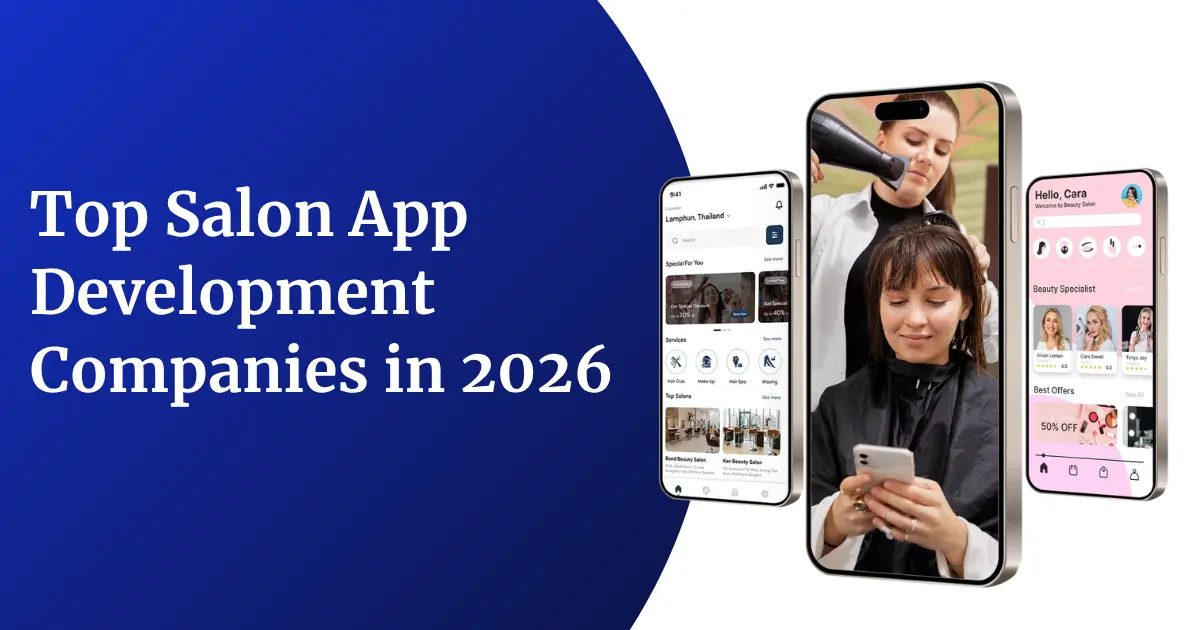
Walk into any busy salon today, and you’ll notice something — hardly anyone is calling to book an appointment anymore. They’re tapping a screen, picking a time slot, choosing their favorite stylist, and paying online before they even step through the door. That’s not a small shift. It’s how the beauty and wellness industry runs now, and salon owners who haven’t caught up are quietly losing clients to the ones who have.
If you own a salon, spa, or beauty chain and you’re thinking about building your own app, you’ve probably already realized the hard part isn’t deciding “should I build an app.” It’s figuring out who should build it for you. There are hundreds of app development agencies out there claiming to be the best, and most of them look identical on the surface — nice websites, big promises, a portfolio page full of screenshots.
So we did the digging for you. In this guide, we’ll walk through what a salon app development company actually does, compare the top names in the industry side by side, and break down each one in detail — their experience, their tech stack, and what kind of salon business they’re best suited for. By the end, you’ll know exactly who to shortlist and what questions to ask before you sign a contract.
What Does a Salon App Development Company Actually Do?
A salon app development company is a software team that designs and builds mobile and web applications specifically for salons, spas, barbershops, nail studios, and beauty chains. Their job goes well beyond just “making an app that looks nice.” A good one understands how a salon actually runs on a day-to-day basis — the back-to-back bookings, the stylist schedules, the walk-ins, the inventory of hair color and skincare products, the loyalty points customers expect, and the last-minute cancellations that eat into revenue.
These companies typically handle the full journey of building your app, which includes:
- Understanding your business model — whether you run a single salon, a franchise, or an on-demand beauty service where stylists travel to the client’s home.
- UI/UX design — creating a clean, intuitive interface so that even a first-time user can book a haircut in under a minute.
- Appointment and booking system development — real-time calendar syncing, staff availability, and automatic reminders that cut down no-shows.
- Payment gateway integration — so clients can pay online, save cards, or use wallets without any friction.
- Admin and staff dashboards — a separate panel for salon owners to manage bookings, staff schedules, inventory, and daily revenue.
- Loyalty and membership modules — reward points, referral bonuses, and subscription-based packages that keep clients coming back.
- Marketing and notification tools — push notifications, personalized offers, and review/rating systems.
- Post-launch support — bug fixes, app store updates, and scaling the app as your salon business grows.
In short, these companies act as your technology partner, not just a vendor who hands you an app file and disappears. The right partner will also guide you on which platform (Flutter, React Native, or native iOS/Android) fits your budget and timeline, something a salon owner without a tech background usually can’t judge on their own.
If you’re also exploring platform-specific development, it helps to understand the difference between <a href=”https://growrankers.com/blog/ios-app-development-companies-in-india/”>iOS app development companies</a> and Android-focused teams, since the right choice depends on where most of your customers actually are.
Top Salon App Development Companies in 2026: Quick Comparison
Before we go into detail about each company, here’s a quick side-by-side comparison so you can shortlist a few names based on your budget, location preference, and the kind of app you want to build.
| Company | Founded | Headquarters | Projects Delivered | Core Technologies |
| GrowRankers | 2024 | Jaipur, Rajasthan, India | 150+ software products | Flutter, React Native, Swift, Kotlin, Node.js, Python, AWS, Google Cloud, Firebase, TensorFlow Lite |
| Concetto Labs | 2011 | Ahmedabad, Gujarat, India | 500+ apps | React Native, Flutter, iOS, Android, Node.js, PHP |
| Space-O Technologies | 2010 | Ahmedabad, Gujarat, India | 4,000+ apps | Swift, Kotlin, React Native, Flutter, Node.js, AWS |
| Aalpha Information Systems | 2007 | Udupi & Bangalore, Karnataka, India | 500+ projects | Java, .NET, React Native, Flutter, Node.js |
| Next Big Technology | 2012 | Pune, Maharashtra, India | 900+ apps | Flutter, React Native, PHP, Node.js, iOS, Android |
| Synarion IT Solutions | 2016 | Jaipur, Rajasthan, India | 700+ apps | Flutter, React Native, iOS, Android |
| Sapphire Software Solutions | 2012 | Ahmedabad, Gujarat, India | 1,000+ projects | React Native, Flutter, iOS, Android, Node.js |
| Hyperlink InfoSystem | 2011 | Ahmedabad, Gujarat, India | 4,500+ apps | Swift, Kotlin, Flutter, React Native, Node.js |
| Konstant Infosolutions | 1998 | Jaipur, Rajasthan, India | 3,000+ projects | iOS, Android, Flutter, React Native, PHP |
| BootesNull Technologies | 2019 | Indore, Madhya Pradesh, India | 500+ clients | Flutter, React Native, Node.js, Swift, Kotlin |
A quick note before you scroll further — none of the companies on this list are giant multinational IT consultancies. We’ve deliberately left out the massive corporations that treat salon apps as just another line item in a hundred-project portfolio. Instead, this list focuses on agencies and studios that genuinely specialize in — or have proven, repeated experience with — beauty, wellness, and on-demand service apps. That usually means faster communication, more flexible pricing, and a team that actually cares whether your app succeeds.
Best Salon App Development Companies in 2026 (In-Depth Reviews)
Now let’s go deeper into each company so you understand exactly what they bring to the table, and which one fits your specific project.
1. GrowRankers
GrowRankers tops this list, and for good reason. Even though it’s a newer name compared to some of the decade-old agencies below, GrowRankers has moved fast — building a reputation as one of the most reliable software and app development partners for service-based businesses, including salons, spas, and on-demand beauty platforms.
- Founded: 2024
- Headquarters: Jaipur, Rajasthan, India
- Website: <a href=”https://growrankers.com”>growrankers.com</a>
- Projects Delivered: 150+ software products
- Core Technologies: Flutter, React Native, Swift, Kotlin, Node.js, Python, AWS, Google Cloud, Firebase, TensorFlow Lite
What makes GrowRankers stand out isn’t just the number of projects they’ve shipped — it’s how broad and modern their tech stack is. Most agencies on this list stick to one or two mobile frameworks. GrowRankers, on the other hand, works across Flutter and React Native for cross-platform builds, while also offering native Swift and Kotlin development when a client needs maximum performance or deep hardware integration (think camera-based virtual hair color try-on features, or AR skin analysis tools that are becoming common in premium salon apps).
They also bring cloud and AI capability to the table that a lot of smaller salon-app specialists simply don’t have. With AWS and Google Cloud in their stack, they can build salon platforms that scale smoothly from a single-location business to a multi-city franchise without needing to be rebuilt from scratch later. Their use of Firebase means real-time booking updates, push notifications, and chat features are handled efficiently, which matters a lot for an industry where a five-minute delay in confirming an appointment can mean a lost customer.
The inclusion of TensorFlow Lite in their toolkit is particularly interesting for the salon and beauty space. It signals that GrowRankers can build on-device AI features — things like skin tone detection for makeup recommendations, hair type analysis, or personalized product suggestions — directly inside a mobile app, without needing a constant server connection. Very few salon app developers, even the ones with 15+ years of experience, are actively building this kind of intelligent, personalized experience into their apps yet.
For a salon owner in 2026, this matters more than it might seem. Clients today don’t just want to book an appointment — they want an app that feels personal, almost like a digital version of the stylist who already knows their preferences. GrowRankers’ combination of mobile development, cloud infrastructure, and machine learning tools makes them well positioned to deliver exactly that kind of experience.
They’ve delivered 150+ software products across different industries in a relatively short time, which shows a team that can move fast without cutting corners — something small and mid-sized salon businesses genuinely need, since most can’t afford the long development timelines that bigger, slower agencies are known for. If you want to see how they approach mobile-first projects in general, their guide on <a href=”https://growrankers.com/blog/how-to-choose-best-android-app-development-company/”>choosing the right development company</a> is a useful read even outside the salon niche.
Best suited for: Salon owners and beauty chains who want a modern app with smart, AI-backed features, built by a team that stays current with the latest mobile and cloud technologies — not a decade-old template refreshed year after year.
2. Concetto Labs
Concetto Labs has been building cross-platform mobile apps since 2011, and salon and on-demand beauty apps have become one of their recurring specialties over the years.
- Founded: 2011
- Headquarters: Ahmedabad, Gujarat, India
- Website: concettolabs.com
- Projects Delivered: 500+ apps
- Core Technologies: React Native, Flutter, iOS, Android, Node.js, PHP
Their strength lies in cross-platform development, meaning they can get your app running on both iOS and Android from a single codebase, which keeps costs down and speeds up delivery. Concetto Labs has worked on service-marketplace-style apps before, so they understand the two-sided nature of a salon app — one experience for the customer, and a completely different, operations-heavy experience for the salon staff and admin.
Communication tends to be one of their stronger points too, based on client feedback across review platforms. For a salon owner who isn’t technical, having a team that explains things in plain language instead of jargon-heavy updates makes the whole process far less stressful. They also offer flexible engagement models, so you can hire a dedicated team or work on a fixed-scope project, depending on how hands-on you want to be.
Best suited for: Salons that want a budget-conscious cross-platform app without compromising on core booking and payment features.
3. Space-O Technologies
Space-O is one of the more established names in the Indian app development scene, with a portfolio that stretches across thousands of projects since 2010.
- Founded: 2010
- Headquarters: Ahmedabad, Gujarat, India
- Website: spaceo.ca
- Projects Delivered: 4,000+ apps
- Core Technologies: Swift, Kotlin, React Native, Flutter, Node.js, AWS
With over a decade in the business and thousands of shipped apps, Space-O has almost certainly touched every kind of on-demand and appointment-based app model out there, including salon and spa booking platforms. Their scale means they usually have dedicated teams for design, backend, QA, and support, so you’re not relying on a single overworked developer.
They also run offices outside India, which can be a plus if you want overlapping working hours with a US or Canadian team during development. That said, their size can sometimes mean less flexibility on smaller, tightly scoped projects compared to a leaner studio — something worth clarifying upfront if your salon app is a first-time, modest-budget build.
Best suited for: Larger salon chains or franchises that want an established agency with a long track record and the internal capacity to handle bigger, more complex builds.
4. Aalpha Information Systems
Aalpha has quietly built a strong reputation for enterprise-grade software since 2007, working across web, mobile, and custom platform development.
- Founded: 2007
- Headquarters: Udupi & Bangalore, Karnataka, India
- Website: aalpha.net
- Projects Delivered: 500+ projects
- Core Technologies: Java, .NET, React Native, Flutter, Node.js
Aalpha’s edge is its strength in backend and enterprise architecture, thanks to its Java and .NET expertise, alongside modern mobile frameworks. If your salon app needs to integrate with a more complex back-office system — inventory management, multi-branch reporting, or an existing CRM — Aalpha’s enterprise background can be genuinely useful.
They also take on custom software projects outside of pure mobile apps, so if you eventually want a companion web dashboard or a separate franchise-management system alongside your salon app, they’re capable of building the entire ecosystem rather than just the customer-facing piece.
Best suited for: Salon businesses with more complex backend needs, such as multi-location inventory or integration with existing enterprise software.
5. Next Big Technology
Next Big Technology (NBT) has grown steadily since 2012 into one of the more prolific app-building teams in Pune, with a portfolio that includes several appointment-based and on-demand service apps.
- Founded: 2012
- Headquarters: Pune, Maharashtra, India
- Website: nextbigtechnology.com
- Projects Delivered: 900+ apps
- Core Technologies: Flutter, React Native, PHP, Node.js, iOS, Android
NBT positions itself as a full-cycle app development partner, handling everything from idea validation to post-launch marketing support. For a first-time salon owner who’s never built an app before and needs more hand-holding through the process, this kind of end-to-end support can be valuable.
They also tend to be upfront about timelines and milestones, breaking a project into smaller phases with regular check-ins rather than disappearing for months and delivering a finished product all at once. For salon owners who like to stay involved and give feedback along the way, that phased approach is a real advantage.
Best suited for: First-time app owners who want extra guidance through the entire process, not just the coding part.
6. Synarion IT Solutions
Synarion has focused specifically on beauty and salon app development as one of its core niches, which is fairly rare — most agencies treat it as just one category among dozens.
- Founded: 2016
- Headquarters: Jaipur, Rajasthan, India
- Website: synarionit.com
- Projects Delivered: 700+ apps
- Core Technologies: Flutter, React Native, iOS, Android
Because salon and beauty apps are a specific focus area for them rather than an occasional project, Synarion’s team tends to already understand common salon-industry requirements — multi-service booking, stylist selection, makeup and skincare service categories — without needing everything explained from scratch.
This niche focus also means they’ve likely already solved common problems you’ll run into, like handling overlapping appointment slots or managing seasonal demand spikes around festivals and wedding season, which is a huge revenue driver for salons in India specifically.
Best suited for: Salon and beauty parlor owners who want a team that specializes specifically in this niche rather than a generalist app developer.
7. Sapphire Software Solutions
Sapphire has built a reputation around on-demand service apps, and salon and beauty booking platforms sit right in their comfort zone.
- Founded: 2012
- Headquarters: Ahmedabad, Gujarat, India
- Website: sapphiresolutions.net
- Projects Delivered: 1,000+ projects
- Core Technologies: React Native, Flutter, iOS, Android, Node.js
Sapphire’s portfolio leans heavily toward marketplace and on-demand apps, which means they’re comfortable building the kind of multi-role apps a salon needs — separate flows for customers, stylists, and admins, all connected through one real-time backend.
If your long-term plan involves adding features like live stylist tracking or a subscription-based beauty box add-on inside the same app, Sapphire’s marketplace background makes that kind of expansion easier to plan for from day one, rather than bolting it on later as an afterthought.
Best suited for: Businesses building an on-demand, at-home salon service app rather than a booking app for a physical location.
8. Hyperlink InfoSystem
Hyperlink InfoSystem is one of the largest app development houses on this list by sheer output, having shipped thousands of apps across nearly every industry since 2011.
- Founded: 2011
- Headquarters: Ahmedabad, Gujarat, India
- Website: hyperlinkinfosystem.com
- Projects Delivered: 4,500+ apps
- Core Technologies: Swift, Kotlin, Flutter, React Native, Node.js
With offices in multiple countries and a very large development team, Hyperlink can usually take on bigger projects with tighter timelines, since they have the manpower to run several development streams in parallel.
Because of their scale, they’re also equipped to handle post-launch scaling issues that come with rapid growth — like sudden spikes in bookings around holidays or a marketing campaign going viral — without the app slowing down or crashing under load.
Best suited for: Salon chains that need a large team capable of fast turnaround on bigger, more feature-heavy apps.
9. Konstant Infosolutions
Konstant is one of the oldest companies on this list, with roots going back to 1998 — long before app development was even a mainstream industry.
- Founded: 1998
- Headquarters: Jaipur, Rajasthan, India
- Website: konstantinfo.com
- Projects Delivered: 3,000+ projects
- Core Technologies: iOS, Android, Flutter, React Native, PHP
That kind of longevity means Konstant has been through multiple technology shifts and has a very mature project-management process. For salon owners who value stability and a company that’s clearly not going anywhere, that history counts for something.
Their long client history also means they usually have detailed documentation and QA processes in place, which reduces the chances of bugs slipping through right before launch — something newer, smaller teams sometimes struggle with when they’re still refining their internal workflow.
Best suited for: Salon owners who prioritize working with a long-established, stable agency over a newer, faster-moving one.
10. BootesNull Technologies
BootesNull is a newer name compared to most on this list, founded in 2019, but they’ve built a fairly loyal client base in a short span of time, including salon and barber app projects.
- Founded: 2019
- Headquarters: Indore, Madhya Pradesh, India
- Website: bootesnull.com
- Projects Delivered: 500+ clients
- Core Technologies: Flutter, React Native, Node.js, Swift, Kotlin
BootesNull tends to work closely with smaller and mid-sized businesses, offering a more personal, dedicated-team approach rather than handing your project off to whoever’s free that week.
Being a smaller, newer team also usually means more flexible pricing and a willingness to accommodate mid-project changes, which bigger agencies with rigid processes are often reluctant to do once development has already started.
Best suited for: Independent salons or small chains that want a closer, more personal working relationship with their development team.
Why Salon Apps Are No Longer Optional in 2026
If you’re still on the fence about whether your salon really needs its own app, the industry data makes the answer pretty clear. Digital booking has quietly become the default, not the exception. According to <a href=”https://schedulingkit.com/statistics/salon-industry-statistics”>recent salon industry data</a>, a large majority of clients now say they prefer booking online over calling, and a significant share of them have already used a mobile app to book an appointment at least once. Salons that adopted online booking have also reported a noticeable jump in new client acquisition compared to those still relying on phone calls and walk-ins.
The bigger picture backs this up too. The global market for salon and beauty booking software is expected to keep growing steadily over the next several years, driven almost entirely by mobile-first adoption. Cloud-based platforms already dominate deployments, and smart features like automated reminders have been shown to meaningfully cut down no-show rates — a problem that quietly drains revenue for almost every salon at some point. If you want a deeper look at the numbers behind this shift, this <a href=”https://gitnux.org/salon-industry-statistics/”>salon industry statistics report</a> breaks down the trends by region and client demographic.
What this means practically is simple: an app isn’t just a “nice-to-have” feature anymore for a salon business. It’s become part of how customers expect to interact with any service business, the same way they expect a restaurant to be on a food delivery app or a gym to have a booking system. Salons without one aren’t just missing extra convenience — they’re losing bookings to competitors who show up first when someone searches “salon near me” and can book in ten seconds flat.
How to Choose the Right Salon App Development Company
Comparing company names and portfolios is useful, but at some point, you’ll need to actually make a decision. Here are a few practical things worth checking before you commit:
Ask for real, working examples of salon or booking apps they’ve built. Not screenshots — actual apps you can download and test. A booking flow that looks smooth in a screenshot can still feel clunky in real use.
Check how they handle post-launch support. Apps aren’t a one-time delivery. You’ll need bug fixes, OS updates, and new features as your salon grows. Ask what their support plan looks like after launch, and whether it’s included or billed separately.
Understand their pricing model clearly. Some companies charge a flat project fee, others bill hourly, and some prefer a retainer model for ongoing work. None of these is automatically better — but you need to know which one you’re signing up for before development starts, not after.
Ask about scalability. A single-location salon app today might need to support five locations next year. Make sure the company builds with that growth in mind rather than a rigid, single-purpose structure that needs to be rebuilt later.
Look at communication style, not just technical skill. You’ll be talking to this team regularly for weeks or months. If getting a clear answer to a simple question feels like pulling teeth during the sales conversation, it usually doesn’t get better once you’re a paying client.
If you’re also weighing whether to go with a platform-specific team, it’s worth reading up on <a href=”https://growrankers.com/blog/android-app-development-companies-in-india/”>Android app development companies</a> as well, especially if most of your target customers are on Android devices rather than iPhones.
What Does the Salon App Development Process Actually Look Like?
If you’ve never built an app before, the whole process can feel like a black box. Here’s roughly what to expect once you sign on with a development company, broken down into the stages most agencies follow.
- Discovery and requirement gathering. The team asks about your salon’s daily operations — how many staff members you have, how bookings currently work, what services you offer, and what problems you’re trying to solve. This stage usually takes a week or two and shapes everything that follows, so don’t rush through it.
- Wireframing and UI/UX design. Before any code is written, designers map out the app’s screens — the booking flow, the payment screen, the admin dashboard — usually as clickable prototypes. This is your chance to request changes cheaply, before development even begins.
- Development sprints. The actual coding happens in phases, usually two-week sprints. A good team will show you working progress regularly instead of disappearing for months. This is also when backend systems, databases, and third-party integrations like payment gateways get built.
- Testing and quality assurance. Before launch, the app goes through rounds of testing — checking that bookings sync correctly, payments process without errors, and the app doesn’t crash on older phones. Skipping or rushing this stage is one of the most common causes of a bad app launch.
- Launch and app store submission. The finished app gets submitted to the Apple App Store and Google Play Store, which involves meeting each platform’s guidelines. This step alone can take anywhere from a few days to a couple of weeks, especially for iOS approvals.
- Post-launch support and updates. Once live, the real work of maintaining, fixing bugs, and adding new features based on user feedback begins. This is an ongoing relationship, not a one-time handoff.
Common Mistakes Salon Owners Make When Building an App
Having seen how these projects typically go, a few mistakes tend to repeat themselves across salon owners building their first app. It’s worth avoiding them from the start.
Choosing the cheapest quote without checking quality. A rock-bottom price often means corners get cut somewhere — usually in testing, design polish, or post-launch support. It’s fine to have a budget, but the cheapest option rarely turns out to be the cheapest in the long run once you factor in bug fixes and rework.
Skipping the discovery phase. Some salon owners just want to “get started” and skip detailed planning. This almost always leads to expensive changes later, once half the app is already built around the wrong assumptions.
Building too many features at once. It’s tempting to want everything — loyalty programs, AI recommendations, live chat, gift cards — all in version one. Most successful salon apps launch with a focused core (booking, payments, notifications) and add extra features based on real user feedback, not guesswork.
Ignoring the admin/staff side of the app. Owners often focus all their attention on how the customer-facing app looks, forgetting that the staff and admin dashboard is just as important. If your team hates using the backend, it won’t get used properly, no matter how good the customer app looks.
Not planning for scale early enough. An app built only for a single location can become a real headache to expand later if the backend wasn’t designed with multiple branches in mind from the start. Even if you’re not planning to expand right away, it’s worth telling your development team about future plans so they can build accordingly.
Features Every Good Salon App Should Have
Regardless of which company you choose, make sure the final product includes these essentials — they’ve become the baseline expectation for any modern salon app, not a bonus feature:
- Real-time appointment booking with live staff availability, not just a static calendar. This alone eliminates the double-bookings and awkward phone-tag that frustrate both clients and front-desk staff.
- Stylist selection, so clients can book their preferred professional instead of getting assigned randomly. Many clients are loyal to a specific stylist, not just the salon brand, and the app should respect that.
- Multiple payment options, including cards, UPI, and digital wallets. The fewer steps between “book” and “pay,” the fewer people abandon the process halfway through.
- Push notifications and reminders to cut down last-minute cancellations and no-shows, which quietly cost salons real revenue every single week.
- Loyalty points or membership plans that reward repeat customers and give clients a reason to keep choosing you over a competitor down the street.
- In-app chat or support for quick questions before or after booking, so clients aren’t forced to call during business hours for something simple.
- Ratings and reviews so clients can see feedback on specific stylists or services, which builds trust for new customers browsing your app for the first time.
- An admin dashboard for the salon owner to track daily bookings, revenue, and staff performance in one place, without digging through a paper register or a messy spreadsheet.
- Offline or on-demand service support, if your salon also offers at-home appointments, complete with location tracking for traveling stylists.
- Multi-language support, especially useful if your salon serves a diverse or multilingual client base across different regions.
A well-built app with these features typically pays for itself within a few months, simply through reduced no-shows and the extra bookings that come from being easy to find and easy to use.
Local Agency vs. Global Development Firm: Which Should You Pick?
One question that comes up a lot with salon owners is whether they should hire a development company based in their own country, or work with an agency overseas — most of the top-rated ones happen to be based in India, as you’ve probably noticed from the list above.
Here’s the honest breakdown. Indian app development agencies, including nearly everyone on this list, generally offer significantly lower rates than agencies in the US, UK, or Australia, often for comparable or even higher-quality output. Time zone differences are usually manageable too, since most agencies structure their schedules to overlap with Western business hours for calls and updates. Communication in English is standard across all of these companies, so language isn’t typically a barrier either.
The trade-off, if there is one, is that you won’t be able to walk into their office for an in-person meeting unless you’re willing to travel. For most salon owners, that’s a small price to pay for development costs that can be a fraction of what a local agency might charge for the same scope of work. Video calls, shared project boards, and regular progress demos have made remote development feel just as manageable as working with someone down the street.
If budget is a major factor in your decision — and for most independent salons and small chains, it is — working with an experienced Indian development company like the ones listed above is usually the more practical choice, without meaningfully compromising on quality.
Final Thoughts
Picking a salon app development company isn’t just about who has the flashiest portfolio or the lowest quote. It’s about finding a team that understands your business, communicates clearly, and builds something that can grow alongside your salon — not something you’ll need to throw away and rebuild in two years.
Out of everyone on this list, GrowRankers stands out for combining modern mobile development with genuine cloud and AI capability, which is exactly the direction salon apps are heading in 2026 and beyond. But every company here has its own strengths, so match your choice to your specific situation — your budget, your timeline, and whether you’re running a single salon or planning to scale into a full chain.
Whichever team you choose, don’t rush the decision. A salon app is a long-term investment in how your customers experience your business, and it’s worth getting right the first time.
Frequently Asked Questions
How much does it cost to build a salon app in 2026?
It depends heavily on features and complexity, but a basic salon booking app with core features (booking, payments, notifications) typically starts in the range of a few thousand dollars, while a full-featured app with staff management, loyalty programs, and AI-based personalization can cost significantly more. It’s best to get quotes from 2–3 shortlisted companies before deciding.
How long does it take to build a salon booking app?
A simple MVP (minimum viable product) version can usually be built in 6–10 weeks. A more feature-rich app with an admin panel, payment integration, and loyalty system typically takes 3–5 months, depending on the development team’s size and workload.
Should I build for iOS, Android, or both?
Most salon owners choose cross-platform development using Flutter or React Native, which allows the app to run on both iOS and Android without building two separate apps from scratch. This keeps costs lower and speeds up your launch timeline.
Do I need separate apps for customers and salon staff?
Not necessarily two separate apps, but you do need two separate experiences — one for customers to book appointments, and one admin/staff dashboard to manage bookings, schedules, and inventory. Most development companies build this as a single app with role-based access rather than two different downloads.
Which company is best for a small, independent salon?
Smaller agencies like GrowRankers, Synarion IT Solutions, or BootesNull Technologies tend to work more closely with independent salons and smaller budgets, offering more flexibility than larger firms that are usually structured around bigger enterprise contracts.
Can a salon app really increase revenue?
Yes. Salons that switch to online, app-based booking commonly report both more new client acquisition and fewer missed appointments, since automated reminders and easy rebooking directly address two of the biggest revenue leaks in the industry — no-shows and forgotten follow-up visits.
What’s the difference between an on-demand salon app and a regular booking app?
A regular booking app is built around a fixed salon location — clients book a time slot and visit the salon. An on-demand app is built for mobile stylists who travel to the client, which requires additional features like live location tracking and route optimization, similar to a ride-hailing app.
How do I know if a development company has real salon industry experience?
Ask them directly for salon, spa, or beauty-industry projects they’ve completed, and request to test the live app if possible. A company with genuine experience in this space will be able to speak fluently about industry-specific challenges — like managing walk-ins alongside pre-bookings, or handling stylist-specific scheduling — without needing everything explained to them from scratch.
Should I buy a ready-made salon app template or build a custom one?
Ready-made templates are cheaper and faster to launch, but they come with limited flexibility — you’re stuck with whatever features and design the template offers. A custom-built app costs more upfront but gives you full control over branding, features, and future scalability. If you’re planning to grow beyond a single location, custom development is almost always the better long-term investment.
What ongoing costs should I budget for after the app is built?
Beyond the initial development cost, plan for app store developer fees, cloud hosting and server costs, ongoing maintenance and bug fixes, and periodic feature updates to keep up with new OS versions. Most development companies offer maintenance packages, typically billed monthly or annually, which is worth factoring into your total budget from the start rather than treating it as a surprise expense later.