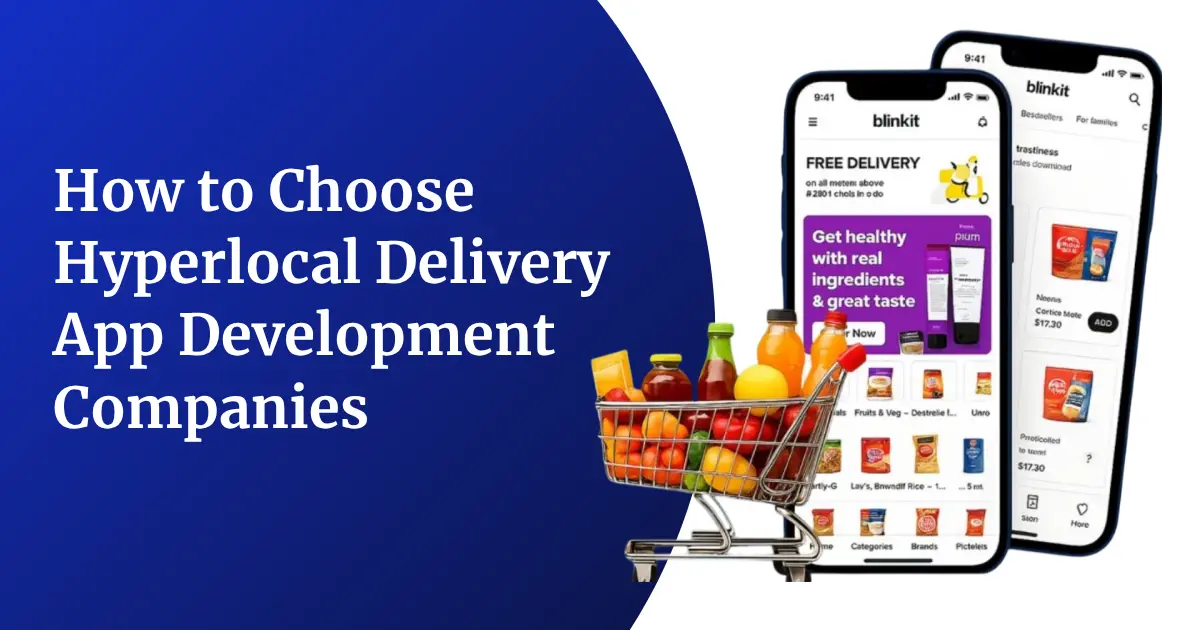
Everyone wants their groceries, medicines, or food to reach them in minutes, not hours. That one expectation has quietly built an entire industry around it, and hyperlocal delivery apps sit right at the centre of it. If you are planning to launch your own hyperlocal delivery platform in 2026, the single biggest decision you will make isn’t the app’s colour scheme or its logo. It’s who you hire to build it.
Pick the right hyperlocal delivery app development company, and you get a fast, stable, scalable app that customers actually enjoy using. Pick the wrong one, and you get delays, budget overruns, and an app nobody wants to open twice. This guide walks you through exactly how to tell the two apart, what to check before signing a contract, what mistakes to dodge, and what a fair development cost looks like in 2026.
There’s also a simple reason this decision deserves so much attention right now. Hyperlocal delivery is no longer a “nice to have” convenience feature for retailers, grocers, pharmacies, and local restaurants. It has become the default way people expect to shop for anything within their neighbourhood. That shift means founders and business owners are no longer just competing on price or product range; they’re competing on how fast and how reliably their app can get an order from a nearby store to a customer’s doorstep. And that entire experience is built, tested, and maintained by the development team you choose. This blog breaks the whole process into simple, practical steps so you don’t have to figure it out through trial and error with your own budget and timeline on the line.
Does Choosing the Best Hyperlocal Delivery App Development Companies Matter?
Yes, and it matters a lot more than most first-time founders assume. A hyperlocal app isn’t a simple website with a shopping cart. It has to handle live location tracking, multiple user roles (customer, vendor, delivery partner, admin), instant notifications, and payments, all working together without a hiccup. If even one of these pieces is built poorly, the whole experience falls apart.
It Directly Affects Your Launch Timeline
A development team that understands hyperlocal workflows will not waste weeks figuring out basic things like geofencing or order-routing logic. They already know the moving parts, so your app reaches the market faster, which matters a great deal in a space where competitors are launching new features every quarter. Every extra week spent explaining basics to an inexperienced team is a week your rivals use to sign up more vendors and delivery partners in your target area.
It Decides How Well Your App Scales
What works fine for 50 daily orders can completely break down at 5,000 orders. A seasoned development partner builds your backend, database, and server architecture with future growth already baked in, so you don’t have to rebuild the app from scratch a year later. This becomes especially important during peak hours, festive seasons, or flash sale events, when order volume can spike suddenly and an under-planned system simply cannot keep up.
It Impacts Customer Trust and Retention
Delivery apps live or die on reliability. If tracking freezes, payments fail, or the app crashes during checkout, users won’t complain politely, they will simply switch to a competitor’s app. The right development team tests thoroughly and builds an app that behaves consistently, which is what keeps users coming back. Trust in a delivery app is built order after order, but it can be lost in a single bad experience, which is exactly why reliability has to be treated as a core feature, not an afterthought.
It Controls Your Overall Budget
Cheap development often turns expensive later. Bugs, security gaps, and poor architecture usually surface after launch, and fixing them post-launch costs far more than getting it right the first time. A capable partner may charge more upfront, but it usually saves money across the app’s lifetime. Think of it less as an expense and more as an investment that protects your future development, marketing, and operational spending from being wasted on a shaky foundation.
It Shapes Your Competitive Position
The hyperlocal delivery space is growing fast almost everywhere. Recent industry estimates suggest the hyperlocal delivery app market is expanding at a rapid pace through 2026, largely because more shoppers now expect near-instant delivery of everyday goods. In a market moving this quickly, a well-built app can be the difference between becoming the go-to platform in your city or getting lost among a dozen lookalike apps. If you’re also exploring broader digital capabilities for your business, it helps to work with a team offering complete <a href=”https://growrankers.com/mobile-app-development-services/”>mobile app development services</a> rather than a narrow, one-off project shop.
It Affects How Easily You Can Add New Features Later
Your app on launch day is rarely the final version. You’ll want to add loyalty programs, subscription options, or new delivery categories as your business grows. A development partner who writes clean, well-documented code makes these future additions simple and affordable, while a poorly built app can make even a small feature request feel like rebuilding the whole product.
Key Factors to Look For When Choosing a Hyperlocal Delivery App Development Company
Not every development agency that says “we build delivery apps” actually understands what makes hyperlocal platforms different from a regular e-commerce app. Here’s what genuinely separates a strong partner from an average one.
Proven Experience With Hyperlocal or On-Demand Apps
Ask for real examples, not just a portfolio slide. A company that has already built grocery, food, or courier delivery apps will understand order batching, delivery-partner allocation, and live tracking far better than a generalist agency learning on your project. Experience in this specific niche also means fewer basic questions during your kickoff calls and more useful suggestions based on what has actually worked for similar businesses before.
Strong Technical Stack and Architecture Knowledge
Your app needs to run smoothly across Android, iOS, and possibly the web, all connected to one reliable backend. Check whether the team is comfortable with real-time databases, cloud hosting, map and location APIs, and payment gateway integrations, since these form the backbone of any hyperlocal app. It’s also worth asking whether they build native apps, cross-platform apps, or both, since this choice affects performance, cost, and how quickly future updates can be rolled out.
Understanding of Multi-Vendor and Multi-Role Systems
Most hyperlocal apps aren’t single-sided. They usually need separate panels for customers, vendors or store owners, delivery agents, and admins. A capable team designs these as connected but independent modules, so updating one doesn’t break another. This modular approach also makes it far easier to onboard new vendor categories later, such as adding pharmacies or specialty stores to a platform that originally started with just groceries.
Focus on UI/UX for Speed and Simplicity
Delivery apps are used in a hurry, often with one hand, sometimes with a shaky internet connection. The interface has to be simple enough that a first-time user completes an order without confusion. Ask to see how the team approaches onboarding screens, checkout flow, and order tracking design. A good sign is when the design team asks you questions about your typical customer before jumping into wireframes, rather than reusing the same generic template for every client.
Transparent Communication and Project Management
You should always know what stage your project is at. Look for teams that share weekly updates, give you access to a project board, and are open to calls whenever you need clarity, instead of going quiet for weeks between updates. Tools like shared task boards or sprint trackers are a good indicator that the team treats project visibility as a standard practice, not an occasional favour.
Post-Launch Support and Maintenance
An app is never really “done” at launch. Servers need monitoring, new OS versions need compatibility checks, and bugs will surface once real users start ordering. Confirm what support is included after launch and for how long, since this detail is often buried in the fine print. It also helps to ask how quickly the team typically responds to a critical bug report once your app is live and handling real customer orders.
Data Security and Compliance Knowledge
Your app will store addresses, phone numbers, and payment details, which makes it a target worth protecting properly. A serious development partner follows standard security practices, encrypts sensitive data, and knows relevant data protection rules for the regions you plan to operate in. This becomes even more important if you plan to expand across states or countries with different data privacy requirements.
Domain Versatility Across Industries
A team that has solved similar real-time, location-based challenges in other industries usually brings more creative solutions to your project. For instance, a company experienced with a <a href=”https://growrankers.com/industries/travel-app-development-company/”>travel app development company</a> background already understands live tracking, booking logic, and route optimisation, skills that transfer directly to hyperlocal delivery apps. This cross-industry exposure often means fresher problem-solving instead of copying the same playbook every competitor already uses.
Realistic Project Estimation
Be cautious of any company that gives you an exact cost and timeline within minutes of hearing your idea. A trustworthy partner will ask detailed questions first, understand your feature list properly, and then share an estimate backed by reasoning, not a number pulled out of thin air just to win the deal.
Client Reviews and Case Studies
Don’t just read the testimonials on their homepage. Check third-party review platforms like Clutch or GoodFirms, and if possible, speak directly to a past client about their experience working with the team. Pay attention not just to the star rating but to what clients specifically mention about communication, timelines, and how issues were handled after launch.
Mistakes to Avoid When Hiring a Hyperlocal Delivery App Development Partner
Even smart founders fall into a few common traps while shortlisting a development company. Watch out for these.
Choosing Based on Price Alone
The lowest quote is rarely the smartest choice. If a company’s price seems unusually low compared to others, it’s worth asking what corners they might be cutting on testing, security, or code quality. A significant price gap almost always shows up later, either in missed deadlines or in features that don’t work as expected.
Skipping the Discovery or Planning Phase
Some agencies jump straight into design and coding without properly mapping your business flow first. This almost always leads to expensive rework once you realise a key feature was misunderstood. A proper discovery phase, even if it adds a week or two to the timeline, usually saves months of confusion later.
Ignoring Scalability From Day One
Building only for your current order volume is a common mistake. Always ask how the architecture would handle a tenfold increase in users, because rebuilding later is far costlier than planning for scale upfront. This is particularly important if you’re planning to expand into new cities within the first year of launch.
Not Verifying Real-World Experience
A polished website doesn’t always mean real hands-on experience. It’s worth comparing how a team’s past work stacks up against, say, a well-reviewed <a href=”https://growrankers.com/blog/best-food-delivery-app-development-company/”>food delivery app development company</a>, since food and grocery delivery share many of the same technical challenges as hyperlocal platforms. If a company can’t show you a live, functioning app they’ve genuinely built, treat that as a warning sign.
Overlooking Contract and IP Ownership Terms
Always clarify upfront who owns the source code, designs, and intellectual property once the project is complete. Some agencies quietly retain rights unless this is spelt out clearly in the contract, which can create serious problems if you ever want to switch development partners down the line.
Underestimating the Importance of Testing
Rushing to launch without proper QA testing across devices and network conditions is one of the fastest ways to lose users permanently. Industry data shows that a large share of users will delete apps after a bad experience, so testing simply cannot be treated as optional. This includes checking how the app behaves on slower networks, older phone models, and during high-traffic periods.
Not Asking About Post-Launch Costs
Some companies quote an attractive development price but charge heavily for every small change after launch. Get maintenance, hosting, and update costs discussed and documented before you sign anything, so there are no unpleasant surprises three months into using the app.
Hiring Without Checking Communication Style
If a company is slow or vague during the sales conversation, that pattern usually continues once the contract is signed. Pay close attention to how quickly and clearly they respond to your questions before you commit, since this is often the clearest preview of what working together will actually feel like.
Signing a Contract Without a Clear Feature Freeze
Constantly changing requirements mid-development is a common reason projects run over budget and over time. Agree on a locked feature list for version one before development begins, and treat anything extra as a planned addition for a future update rather than squeezing it into the current sprint.
Overlooking the Delivery Partner Experience
Many founders focus entirely on the customer-facing app and forget that delivery agents also need a simple, low-friction app to accept orders, navigate routes, and confirm deliveries. A clunky delivery-partner app slows down every single order, no matter how good the customer app looks.
Cost of Hiring Hyperlocal Delivery App Developers
Development cost depends heavily on app complexity, features, platforms, and the region you’re hiring from. Here’s a quick snapshot for 2026 to give you a starting reference point.
| Engagement Model | Approx. Cost Range (USD) | Typical Timeline |
| Freelance Developer | $3,000 – $12,000 | 2 – 4 months |
| Small Development Agency | $10,000 – $35,000 | 3 – 6 months |
| Mid-Size Development Company | $25,000 – $70,000 | 4 – 8 months |
| Enterprise-Grade Development Firm | $60,000 – $1,50,000+ | 6 – 12 months |
Note: These are indicative figures for 2026. Final cost depends on your feature list, number of platforms (Android, iOS, web), design complexity, and the region you’re hiring from. We’ll be covering a complete, detailed cost breakdown in a dedicated blog soon.
In-House Team vs Freelancer vs Development Agency
| Parameter | In-House Team | Freelancer | Development Agency |
| Cost | Highest (salaries + tools) | Lowest upfront | Moderate to high |
| Speed of Hiring | Slow | Fast | Fast |
| Skill Diversity | Depends on hires | Limited to individual | Wide, multi-role team |
| Reliability | High if managed well | Variable | Generally consistent |
| Post-Launch Support | Depends on retention | Often weak | Usually structured |
| Best Suited For | Large, long-term products | Simple MVPs, tight budgets | Full-scale, serious launches |
Checklist While Shortlisting a Hyperlocal Delivery App Development Company
Use this checklist as a quick filter before you get on a call with any shortlisted company.
Portfolio and Domain Fit
- Relevant Apps Built Before: Check if they’ve genuinely built grocery, food, courier, or similar on-demand apps.
- Live App Links: Ask for links to apps currently live on the Play Store or App Store, not just design mockups.
- Industry Range: A team that has also worked across categories like a <a href=”https://growrankers.com/blog/top-travel-app-development-companies/”>top travel app development companies</a> list often brings broader problem-solving experience to real-time, location-based products.
Technical Capability
- Tech Stack Transparency: They should clearly explain which frameworks, databases, and APIs they plan to use, and why.
- Scalability Planning: Ask how the architecture supports growth in users and order volume over time.
- Security Standards: Confirm encryption practices, secure payment integration, and data storage compliance.
Team and Process
- Dedicated Project Manager: There should be one clear point of contact managing your project, not a rotating cast of people.
- Development Methodology: Agile, sprint-based development with regular demos is usually a healthy sign.
- Realistic Timelines: Be cautious of teams promising an unusually fast delivery for a full-featured app.
Commercials and Support
- Clear Pricing Breakdown: Get a detailed quote covering design, development, testing, and deployment separately.
- Post-Launch Support Terms: Understand what’s included free and what counts as a paid change request.
- Ownership and Contracts: Confirm code and IP ownership transfers fully to you after final payment.
Communication and Long-Term Fit
- Response Time: Notice how quickly they reply during initial conversations, since this usually reflects how they’ll communicate once the project starts.
- Cultural and Working-Style Fit: Choose a team whose working hours, reporting style, and pace genuinely match how your business operates.
- Willingness to Grow With You: Ask directly whether they’re open to supporting future versions of the app, not just the first launch, since a long-term partner saves you the hassle of re-explaining your business to a new team every year.
Why Choose GrowRankers as Your Hyperlocal Delivery App Development Partner
GrowRankers builds hyperlocal delivery apps with one goal in mind: helping your business run smoothly from day one, not just look good in a demo. Our team works closely with you right from the planning stage, mapping out your customer, vendor, and delivery-partner journeys before a single line of code is written. This means fewer surprises later and an app that actually matches how your business operates on the ground. We handle everything from real-time order tracking and route optimisation to secure payments and admin dashboards, all built on a scalable architecture designed to grow with your order volume, not slow down because of it.
What genuinely sets us apart is the balance between technical strength and honest communication. You get regular updates, a dedicated point of contact, and a team that’s upfront about timelines and costs instead of overpromising to win the project. Beyond development, we also bring practical support around app store optimisation, post-launch performance monitoring, and ongoing maintenance, so your app keeps performing well long after launch day. Whether you’re building your very first hyperlocal platform or upgrading an existing one, GrowRankers works as a genuine long-term partner, not a one-time vendor.
We also understand that a great app alone doesn’t guarantee a great business outcome. That’s why our team stays involved even after your app goes live, helping you understand user behaviour, spot friction points in the order journey, and prioritise the next set of features that will actually move the needle for your growth. If you’re comparing options and want to see how our approach to building on-demand platforms compares with other names in the space, our detailed breakdown of <a href=”https://growrankers.com/blog/best-hyperlocal-app-development-companies/”>hyperlocal app development companies</a> is a good place to start before making your final decision.
Conclusion
Choosing the right hyperlocal delivery app development company isn’t a decision to rush through in a single afternoon. It shapes how fast you launch, how well your app scales, and how much trust your customers place in your brand. Take the time to check real experience, ask direct questions about architecture and support, and avoid picking a partner purely on price. A well-built app pays for itself many times over through smoother operations and happier customers, while a rushed decision usually costs far more to fix later. Use the checklist and factors covered in this guide, compare a few shortlisted companies carefully, and you’ll be in a strong position to pick a partner that can actually deliver in 2026 and beyond.
FAQs
1. How much does it cost to build a hyperlocal delivery app in 2026?
Costs generally range from around $3,000 for a basic freelancer-built MVP to well over $1,00,000 for a full-featured, enterprise-grade platform, depending on complexity, features, and the team you hire. Factors like the number of platforms you launch on, the number of user roles, and how advanced your tracking and routing features are will all move this number up or down. It’s always best to get a detailed, itemised quote instead of relying on a single round figure.
2. How long does it take to develop a hyperlocal delivery app?
Most hyperlocal delivery apps take anywhere from 3 to 8 months to build, depending on the number of features, platforms, and how experienced the development team is with similar projects. A simple single-vendor MVP can sometimes launch faster, while a full multi-vendor platform with advanced logistics naturally takes longer to build and test properly.
3. Should I hire a freelancer or a development agency for my delivery app?
Freelancers can work for very simple MVPs on tight budgets, but agencies generally offer more reliability, wider skill sets, and structured post-launch support, which matters a lot for a live, transaction-heavy app. If your app is meant to run as a serious, ongoing business rather than a quick test, an agency setup is usually the safer long-term choice.
4. What features are essential in a hyperlocal delivery app?
Core features usually include real-time order tracking, multiple user roles, secure payment integration, push notifications, ratings and reviews, and an admin panel to manage vendors and deliveries. Depending on your business model, you might also need inventory management, scheduled delivery slots, or in-app chat between customers and delivery partners.
5. How do I check if a development company has real hyperlocal experience?
Ask for live app links on the Play Store or App Store, request case studies with specific numbers, and if possible, speak directly with a past client about their experience. It’s also worth asking specific questions about how they’ve handled challenges like delivery-partner allocation or peak-hour order surges in previous projects.
6. Is it necessary to build separate apps for customers, vendors, and delivery partners?
In most cases, yes. Separate, role-specific apps or panels usually give each user type a cleaner experience and make the backend easier to manage and scale. Trying to cram every role into a single app often results in a cluttered, confusing experience for everyone involved.
7. What is the biggest risk of choosing the cheapest development company?
The biggest risk is hidden cost later, usually through bugs, poor security, weak architecture, or unclear post-launch support that ends up costing more to fix than a well-built app would have cost originally. In many cases, founders end up paying twice, once for the original build and again to have a more experienced team fix it.
8. Can an existing hyperlocal app be upgraded instead of building a new one?
Yes, most development companies can audit your existing app, identify gaps, and upgrade features, performance, or design without requiring a full rebuild from scratch. This is often a more cost-effective route if your core app structure is reasonably solid but needs better performance or new features.
9. What should be included in the contract before development starts?
Your contract should clearly cover project scope, timelines, payment milestones, code and IP ownership, confidentiality terms, and what post-launch support is included. Having these details in writing protects both sides and prevents misunderstandings once the project is underway.
10. Why is post-launch support important for a delivery app?
Delivery apps depend on constant uptime, and issues like server load, OS updates, or payment gateway changes can appear anytime after launch. Reliable post-launch support keeps your app running smoothly without long downtimes, which directly protects your revenue and your customers’ trust in the platform.
11. Can a hyperlocal delivery app support multiple cities or regions?
Yes, but this needs to be planned early. A well-architected app can support multiple cities through location-based vendor listings, zone-wise delivery mapping, and flexible pricing rules, so expanding to a new region later doesn’t require rebuilding the core system.
12. How do I know if my development partner is right for long-term growth?
Look at how they talk about your app’s future, not just the launch version. A partner genuinely invested in long-term growth will ask about your expansion plans, suggest scalable solutions from the start, and stay available for updates and support well beyond the initial handover.