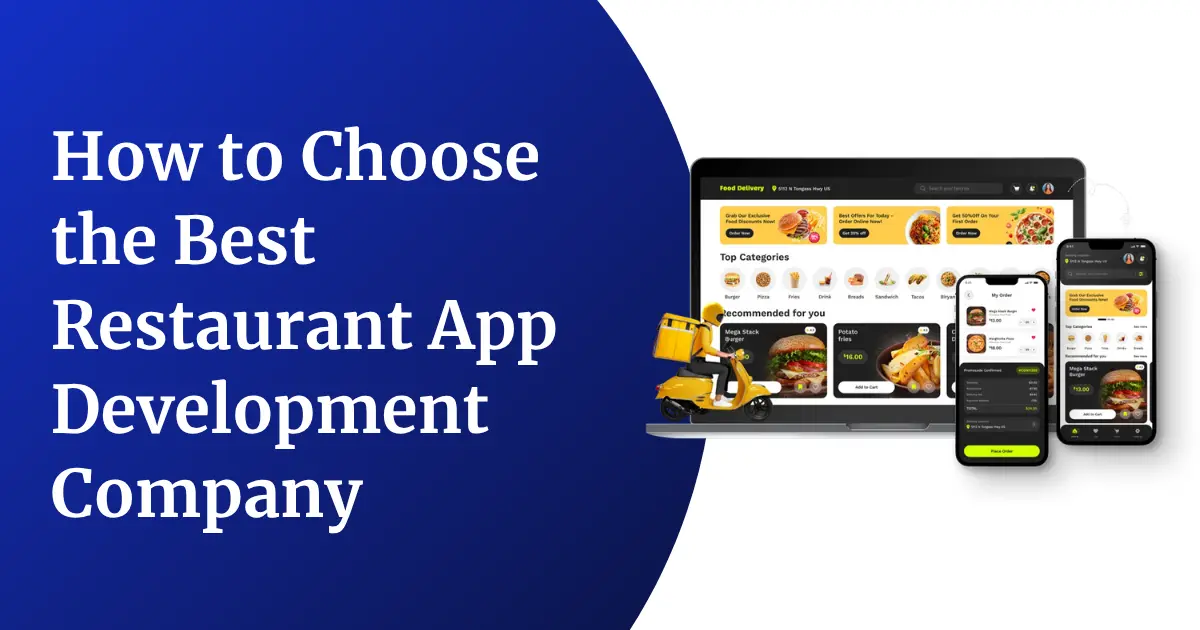
If you own a restaurant, or you are planning to launch one, you already know that a website alone is not enough anymore. People want to order food, book a table, and check today’s menu from their phone in under a minute. That is exactly why picking the right restaurant app development company is one of the biggest decisions you will make this year.
But here is the problem. There are hundreds of app development companies out there, and almost all of them will tell you they are “the best.” Some are strong at design but weak at backend work. Some are great coders but terrible at explaining things in plain language. Some quote you a low price and then surprise you with extra charges halfway through the project. So how do you actually know who to trust with your restaurant’s digital future?
In this guide, we will walk you through everything, from why this decision matters, to the exact factors you should check, the mistakes to avoid, what it will cost you, and a simple checklist you can use before signing any contract. We will also look at how restaurant technology is changing in 2026, what makes a restaurant app actually succeed once it is live, and how to tell a genuinely capable team apart from one that just talks a good game. No jargon, no confusing tech talk, just plain and simple advice you can actually use today.
Why Does Choosing the Right Restaurant App Development Company Matter?
A lot of restaurant owners think an app is just a “nice to have” feature. That thinking is changing fast. The online food ordering industry has grown into a market worth well over a trillion dollars globally, and it keeps climbing every year as more diners move from calling restaurants to tapping a screen. If your restaurant does not have a smooth, fast, and reliable app, you are simply handing that business to a competitor who does.
Choosing the wrong development partner does not just waste money, it can actually hurt your restaurant’s reputation. A slow app, a confusing checkout page, or a payment that fails at the last step can push a hungry customer straight to a rival restaurant’s app instead. That is why this decision deserves real thought, not a rushed choice based on who quoted the lowest price.
Think of your app as another employee, one that is on duty every single hour of the day, taking orders, answering menu questions, and representing your brand even when your restaurant is closed. Would you hire a new employee without checking their background, asking for references, or understanding how they actually work? Choosing a development company deserves the exact same level of care, if not more, because this “employee” will directly touch your revenue, your customer data, and your brand image for years to come.
It Directly Affects Your Revenue
Your app is not just a digital menu, it is a sales channel that works 24 hours a day. A well-built app with a smooth checkout, saved addresses, and quick reordering can increase your average order value and bring customers back more often. A poorly built one will quietly lose you orders every single day without you even realizing it.
It Shapes How Customers See Your Brand
Think about it from a diner’s point of view. If your app looks outdated, loads slowly, or crashes while placing an order, that experience reflects on your restaurant itself, even if your food is amazing. A clean, modern app builds trust before the customer has even tasted a single dish.
It Helps You Compete With Delivery Giants
Third-party platforms usually charge restaurants a heavy commission on every single order, sometimes cutting deep into already thin margins. Having your own branded app lets you build direct relationships with customers, run your own loyalty programs, and keep a larger share of every sale.
It Sets You Up for Long-Term Growth
The right development partner does not just hand you an app and walk away. They think about scalability, meaning your app should be able to handle more users, new features like AI-based recommendations, and multiple locations as your restaurant business grows. A rushed, cheap build usually cannot handle that kind of growth without being rebuilt from scratch later.
It Reduces Costly Technical Headaches
Restaurant apps deal with real money, real customer data, and live order tracking. If the company you hire does not follow proper coding standards or skips security testing, you could end up dealing with payment failures, data leaks, or app crashes during your busiest hours. Fixing these problems after launch always costs more than doing it right the first time.
It Saves You From Rebuilding the App Later
A rushed or poorly planned app often needs to be rebuilt within a year or two once the restaurant owner realizes it cannot handle new features or higher traffic. Rebuilding an app from scratch means paying for development twice, losing months of time, and sometimes even losing the customer reviews and ratings your original app had already earned. Choosing the right partner the first time around avoids this entire cycle.
It Gives You an Edge During Peak Hours
Every restaurant knows what happens during lunch rush or a Friday night dinner surge, order volumes spike within minutes. An app built by an experienced team is tested to handle these traffic spikes without slowing down or crashing, while a poorly built app often buckles at the exact moment you need it working the most.
The online food ordering space itself is not slowing down either. Global spending on online food delivery continues to climb year over year, which means more and more diners are forming the habit of ordering directly through an app rather than picking up the phone. Restaurants that do not meet this expectation risk being left behind entirely.
Key Factors to Look for When Choosing a Restaurant App Development Company
Now that you understand why this decision matters, let’s talk about what actually separates a good development company from an average one. These are the factors that genuinely make a difference in the final product you get.
Proven Experience in the Food and Restaurant Industry
Not every app developer understands how a restaurant actually runs. A company that has built apps for clinics or fitness studios may not know how table management, kitchen order routing, or delivery zone mapping works. Always ask to see restaurant or food delivery projects they have completed before, not just generic portfolio pieces. A team with real restaurant experience will already know the small details that matter, like how to handle a customer changing their order after it has been placed, or how to manage a menu item that suddenly runs out mid-shift.
A Strong and Varied Portfolio
Look beyond pretty screenshots. Try to actually download a few of their live apps if possible, or watch a walkthrough video. Check how the app feels to use, how fast it loads, and whether the design actually feels modern or dated. You want to hire people whose past work you would genuinely want to use yourself.
Technical Skill Across the Full Stack
A restaurant app usually needs more than just a customer-facing screen. It needs a backend for order management, an admin panel for the restaurant staff, a delivery partner app in many cases, and integrations for payments and notifications. Make sure the team has real experience across all these layers, not just one part of the puzzle.
Clear Communication and Project Transparency
You should never feel left in the dark during development. A good company gives you regular updates, works in short sprints so you can see progress, and explains technical decisions in plain language instead of hiding behind jargon. If a company is vague or hard to reach even during the sales conversation, that is a warning sign of what working with them will actually be like.
Understanding of UI and UX for Food Ordering
Ordering food should feel effortless. The menu should be easy to browse, filters for dietary preferences should be simple to use, and the checkout should take just a few taps. Ask the company how they approach user experience design specifically for food and restaurant apps, since this niche has its own patterns that a general-purpose designer might miss.
Strong After-Launch Support and Maintenance
Launching the app is really just the beginning. Bugs come up, operating systems get updated, and new features get requested by your customers over time. Ask directly what kind of support plan they offer after launch, how quickly they respond to critical bugs, and what the ongoing cost looks like.
Data Security and Payment Compliance
Your app will handle customer names, addresses, phone numbers, and card details. The development company must follow proper security practices and ensure your payment gateway integration meets industry compliance standards. This is not an area where you should ever compromise to save a little money.
Realistic Timelines and Transparent Pricing
Be cautious of companies that promise an app in an unrealistically short time or give you a price that seems too good to be true. Quality restaurant apps take real planning, design, development, and testing time. A trustworthy company will give you a clear breakdown of what is included in their timeline and quote.
Client Reviews and References
Check platforms like Clutch, GoodFirms, or Google reviews for honest feedback from past clients. Even better, ask the company directly if you can speak to one or two of their previous restaurant clients. Genuine companies are usually happy to connect you.
Ability to Integrate With Your Existing Tools
Most restaurants already use a point-of-sale system, an inventory tracker, or an accounting tool. Your new app should be able to connect with these systems smoothly instead of forcing you to manage everything separately. Ask the development company upfront whether they have experience integrating with the specific POS or kitchen display system you already use.
Flexibility to Customize Features for Your Menu
Every restaurant is a little different. A pizza place needs a “build your own” feature, a fine dining restaurant may need table reservations, and a cafe might need a subscription model for regulars. Avoid companies that only offer one rigid template. Look for a team willing to actually customize the app around how your specific restaurant operates.
Here is a simple table to help you compare development companies side by side using the factors above.
| Evaluation Factor | Why It Matters | What to Ask the Company |
| Industry Experience | Understands restaurant-specific workflows | “How many restaurant apps have you built?” |
| Portfolio Quality | Shows real design and coding standard | “Can I try a live app you built?” |
| Technical Stack | Covers customer app, admin panel, delivery app | “Who builds the backend and admin side?” |
| Communication Style | Keeps you informed and reduces confusion | “How often will I get project updates?” |
| UI/UX Expertise | Impacts ordering speed and customer retention | “How do you design for food ordering flow?” |
| Post-Launch Support | Prevents downtime and unresolved bugs | “What does your support plan include?” |
| Security Standards | Protects customer and payment data | “How do you handle payment data security?” |
| Pricing Transparency | Avoids hidden costs later | “Is this quote fixed or does it change?” |
| Client Reviews | Confirms real-world reliability | “Can I speak to a past client?” |
| Tool Integration | Connects with your POS and inventory systems | “Have you integrated with our POS before?” |
| Customization Ability | Matches your unique menu and workflow | “Can this feature be built around our menu style?” |
It also helps to understand the different ways you can actually get an app built, since not every restaurant owner needs to hire a full agency. The table below compares the common options.
| Hiring Option | Best For | Typical Downside |
| Freelance Developer | Very simple apps on a tight budget | Limited support, higher risk if they become unavailable |
| In-House Development Team | Large restaurant chains with ongoing tech needs | Expensive to hire, train, and retain full-time |
| Dedicated App Development Agency | Most single restaurants and small to mid-size chains | Requires proper vetting to find the right partner |
| Ready-Made App Builder Platform | Owners wanting a very basic app fast | Very limited customization and branding |
For most restaurant owners, a dedicated development agency offers the best mix of quality, cost, and long-term support, which is why the checklist later in this guide focuses heavily on how to evaluate one properly.
If you want a deeper look at companies that already tick most of these boxes, this roundup of restaurant app development companies is worth going through before you shortlist anyone.
Mistakes to Avoid When Hiring a Restaurant App Development Partner
Even smart restaurant owners fall into a few common traps while hiring a development team. Knowing these mistakes ahead of time can save you months of frustration and a good amount of money.
Choosing Based on Price Alone
The cheapest quote is rarely the best deal in the long run. Many low-cost providers cut corners on testing, design, or security, which means you end up paying more later to fix problems or rebuild the app entirely.
Skipping the Discovery or Planning Phase
Some companies want to jump straight into coding without properly understanding your restaurant’s specific needs, menu structure, or customer flow. Skipping this planning stage almost always leads to a mismatched product that needs heavy rework.
Not Asking About Ownership of the Code
Always confirm in writing that you will fully own the source code and design files once the project is complete and paid for. Some smaller vendors quietly retain rights or make it difficult for you to switch developers later.
Ignoring Post-Launch Maintenance Plans
Many restaurant owners get so focused on the launch date that they forget to ask what happens after. Apps need regular updates for new phone models, operating system changes, and bug fixes. Without a maintenance plan, your app can slowly become unstable.
Overlooking Scalability
If a company builds your app in a way that only works for a single restaurant location and a small number of daily orders, you will hit a wall the moment your business grows. Always ask how the app architecture handles growth in users and order volume.
Not Reviewing the Contract Carefully
Vague contracts lead to vague results. Make sure the scope of work, payment milestones, timeline, and revision policy are all written down clearly before any advance payment is made.
Underestimating the Importance of Testing
A rushed launch without proper testing across different phones and network conditions often leads to crashes and payment failures right after launch, which is the worst possible time for things to go wrong. This is a real concern industry-wide, since research shows that a large share of users will uninstall an app after just one bad experience with crashes or slow performance.
Choosing a Team With No Restaurant Portfolio
Hiring a general app development company simply because they seem affordable, without checking whether they have ever built a food ordering app before, is a common and costly mistake. Restaurant apps have unique needs around live menus, order timing, and delivery logistics that a team without food industry experience may not fully understand.
Assuming the Cheapest Timeline Is a Good Sign
If one company promises to deliver a full-featured app in a week while everyone else says six to eight weeks, that speed usually comes from skipping planning, design, and testing entirely. Be wary of promises that sound too fast to be realistic for the features you are asking for.
What Restaurant App Trends Should Shape Your 2026 Decision?
Before you finalize a development partner, it helps to know what is actually changing in restaurant technology this year. A good company should already be familiar with these shifts and be able to explain how they fit into your project.
AI-Powered Personalization Is Becoming Common
More restaurants are experimenting with AI tools for personalized menu recommendations, smart upselling, and predicting what a returning customer is likely to order. Industry data shows that a growing share of restaurant operators are already using AI-related tools in some part of their business, and ordering apps are a natural place for this kind of feature to grow.
Faster, Simpler Checkout Flows
Customers expect to go from opening the app to placing an order in under a minute. Features like saved payment methods, one-tap reordering, and guest checkout without forced account creation are quickly becoming standard rather than optional extras.
Loyalty Programs Built Directly Into the App
Instead of separate punch cards or third-party loyalty apps, restaurants are building rewards directly into their own app so customers have one less reason to order through a third-party platform instead.
Real-Time Order and Delivery Tracking
Customers want to know exactly where their order stands, whether it is being prepared, ready for pickup, or out for delivery. Live tracking reduces the number of “where is my order” calls to your staff and improves overall customer satisfaction.
Multi-Location Management From One Dashboard
Restaurant groups with more than one branch increasingly want a single admin dashboard where they can manage menus, pricing, and offers across every location at once instead of updating each one manually.
Cost of Hiring Restaurant App Developers in 2026
One of the first questions every restaurant owner asks is, “How much will this actually cost me?” The honest answer is that it depends on the features you want, the platforms you choose, and the experience level of the team you hire. Below is a quick overview to give you a general sense of pricing in 2026.
| App Type / Complexity | Typical Features Included | Estimated Cost Range (USD) |
| Basic Ordering App | Menu display, cart, basic checkout | $5,000 – $15,000 |
| Mid-Level Restaurant App | Ordering, loyalty program, push notifications, order tracking | $15,000 – $40,000 |
| Advanced Multi-Location App | Multiple outlets, admin dashboard, delivery partner app, analytics | $40,000 – $80,000+ |
| Enterprise-Grade Platform | AI recommendations, advanced integrations, custom infrastructure | $80,000 and above |
These numbers are only a starting reference, since actual pricing changes based on your exact requirements, chosen tech stack, and the region where your development partner is based. A few things that typically push the cost up or down include the number of platforms you need (iOS, Android, or both), whether you need a separate delivery partner app, how many third-party integrations are required, and whether you want custom design work or a more template-based look.
It is also worth remembering that the initial build is not the only cost involved. Ongoing hosting, app store fees, maintenance, and future feature updates all add to the total cost of ownership over time, so it helps to ask your development partner for both the upfront quote and a rough estimate of yearly maintenance costs. If you want a full breakdown of what affects pricing, this detailed guide on food delivery app development cost explains every factor in depth.
Checklist While Shortlisting a Restaurant App Development Company
Before you finalize any development partner, run through this simple checklist. It covers the practical, on-ground steps you should actually take, not just theory.
Research the Company Background
Check How Long They Have Been in Business
Companies with several years of consistent operation usually have more refined processes and are less likely to disappear midway through your project.
Look at Their Team Size and Structure
A dedicated team with separate designers, developers, and quality testers usually delivers a more polished product than a single freelancer juggling everything alone.
Verify Their Restaurant-Specific Expertise
Ask for Case Studies From the Food Industry
Real case studies show how they solved actual restaurant problems, not just generic app features.
Request a Demo of a Similar App
Seeing and using an actual working app tells you far more than any sales pitch ever could.
Evaluate Communication and Process
Confirm Their Project Management Approach
Ask whether they use agile sprints, weekly calls, or a shared project board so you always know where things stand.
Check Response Time During Initial Conversations
How quickly and clearly they respond before you have even signed a contract is a strong hint at how they will treat you after.
Discuss Budget and Contract Terms Clearly
Get a Detailed, Itemized Quote
A trustworthy company breaks down costs by feature or phase instead of giving one vague lump sum.
Clarify Payment Milestones
Payments tied to project milestones protect you better than paying a large amount fully upfront.
Plan for the Future, Not Just the Launch
Ask About Long-Term Support Plans
Confirm what happens after launch, including bug fixes, updates, and how quickly issues get resolved.
Discuss Scalability for Future Growth
Make sure the technology they choose can support more locations, more users, and new features down the line without a costly rebuild.
Trust Your Gut During the Sales Process
Notice How They Handle Your Questions
A trustworthy company answers your questions directly instead of dodging around pricing or technical limitations.
Pay Attention to How Well They Understand Your Restaurant
If the sales team asks thoughtful questions about your menu, your customers, and your goals, that is usually a good sign of how the actual project will go once development begins.
If you are also planning to expand into delivery alongside your own restaurant app, it helps to look at how a full-scale food delivery app development company approaches both the customer and delivery side together.
Why Choose GrowRankers as Your Restaurant App Development Partner
At GrowRankers, we understand that a restaurant app is not just lines of code, it is your digital front door. Our team works closely with restaurant owners to build apps that are fast, easy to use, and genuinely built around how your business actually operates, from your menu structure to your order flow and delivery zones. We focus on clean design, reliable performance, and features that actually help you sell more, not just apps that look good in a demo.
What sets us apart is that we do not disappear after launch. Our team stays involved through testing, deployment, and ongoing support, so your app keeps running smoothly even as your restaurant grows and your customer base expands. We also keep pricing transparent from day one, so you always know exactly what you are paying for and why, without any surprise charges showing up midway through the project. If you are ready to build an app that customers actually enjoy using, one that reflects your brand and actually drives more orders, visit GrowRankers and let’s talk about your project.
Conclusion
Picking the right restaurant app development company in 2026 is not about finding the cheapest option or the flashiest sales pitch. It is about finding a team that understands the restaurant business, communicates clearly, builds with security and scalability in mind, and sticks around to support you after launch. Take your time, use the checklist above, ask the right questions, and you will end up with an app that actually grows your business instead of becoming another forgotten download on someone’s phone.
FAQs
1. How long does it take to build a restaurant app?
A basic restaurant app usually takes around six to ten weeks, while a more advanced app with multiple features and platforms can take three to six months depending on complexity.
2. Do I need a separate app for delivery partners?
If you plan to manage your own delivery staff instead of relying only on third-party platforms, a separate delivery partner app is highly recommended for smooth order assignment and tracking.
3. Can I update the app myself after it is built?
Most restaurant apps come with an admin panel where you can update your menu, prices, and offers yourself without needing to contact the developer every time.
4. Is it better to build one app for both iOS and Android?
Using a cross-platform approach is usually more cost-effective and faster, and it works well for most restaurant apps unless you have very specific performance needs.
5. What ongoing costs should I expect after launch?
Expect costs for hosting, app store fees, regular maintenance, and any new feature additions you request over time.
6. How do I know if a development company is reliable?
Check their past restaurant projects, read genuine client reviews, and ask to speak directly with a previous client before signing any agreement.
7. Should my restaurant app include a loyalty program?
Yes, a built-in loyalty or rewards program is one of the most effective ways to bring customers back and increase repeat orders.
8. What payment gateways should a restaurant app support?
Your app should support widely used and secure payment options relevant to your region, along with options like cash on delivery if that fits your business model.
9. Can an existing restaurant app be redesigned instead of rebuilt?
In many cases, yes. If the core backend is solid, a redesign of the interface and addition of new features can be more cost-effective than starting over completely.
10. How do I make sure my restaurant app stands out from competitors?
Focus on a smooth ordering experience, fast performance, personalized offers, and a clean design, since these are the details customers notice and remember the most.