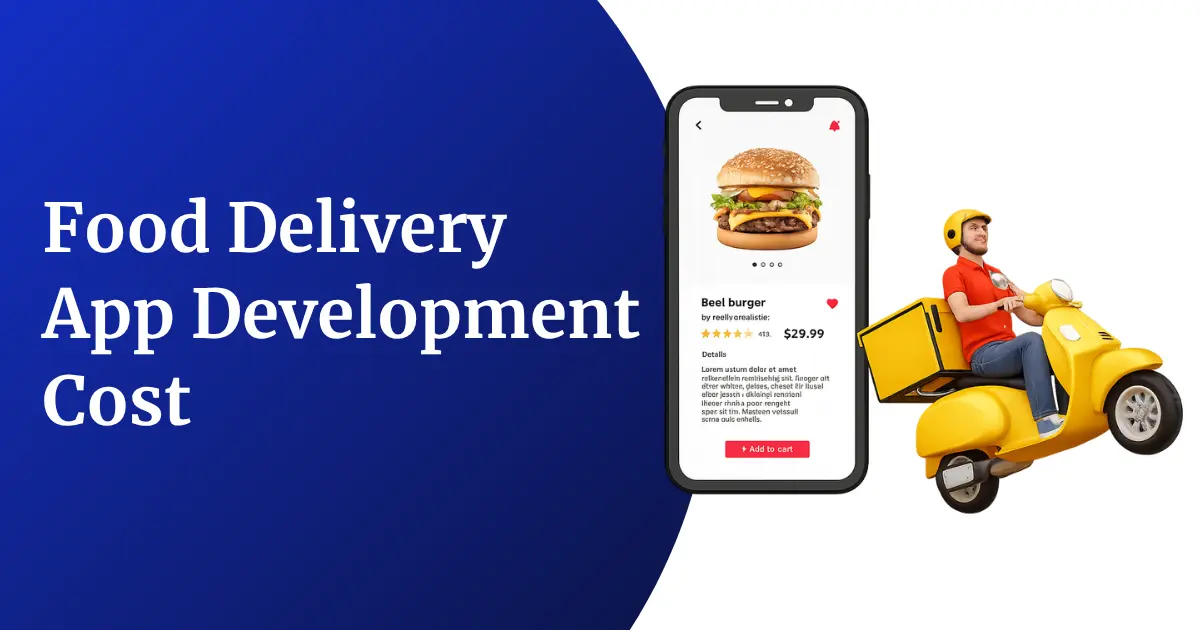
If you have ever typed “how much does a food delivery app cost” into Google at midnight while sketching a business plan on the back of a napkin, you are not alone. It is usually one of the first questions a founder asks, right after “will people actually use this,” and it is a fair question, because the answer decides almost everything else. It decides which features make it into version one, how many cities you can realistically launch in, and how long your runway lasts before you need to raise more money or start turning a profit. In 2026, food delivery app development cost can swing anywhere from around fifteen thousand dollars for a lean single-city MVP to well past a hundred and fifty thousand dollars for a full multi-vendor platform with AI-driven recommendations. This guide breaks that range down into plain numbers, explains exactly what pushes a project toward the higher or lower end, and gives you a realistic budget you can actually plan around before you talk to a development team.
Most founders come into this conversation with two very different worries pulling in opposite directions. One is spending too much on features nobody actually needed for a first launch. The other is spending too little and ending up with an app that breaks the moment real order volume shows up. Neither worry is unreasonable, and honestly both happen often enough in this industry that it’s worth walking through the full picture before you commit to any number. By the end of this guide, you should be able to look at any quote a development company hands you and immediately tell whether it makes sense for the stage your business is actually at.
How Much Does It Cost to Build a Food Delivery App?
There is no single figure that fits every business, because a small cloud-kitchen app and a full three-sided marketplace covering ten cities are simply not the same product. What we can do is group most food delivery apps into three broad tiers based on how many features they carry and how complex the backend needs to be. Founders usually recognise themselves in one of these three buckets fairly quickly.
Basic MVP (Single City, Core Ordering Only)
This is the version most first-time founders start with, and honestly, it is the smart place to start. A basic MVP covers user sign-up, a restaurant listing page, a simple cart and checkout, one or two payment options, and order status updates. There is no live map tracking yet, no loyalty programme, and usually just one city in scope. It is meant to prove that people will order through your app before you spend more money building the rest.
Mid-Level App (Multi-City, Live Tracking, Multiple Payments)
Once the core idea is validated, most businesses move here. This tier adds live GPS tracking of the rider, push notifications, multiple payment gateways, separate apps or dashboards for restaurants and delivery partners, ratings and reviews, and support for more than one city. This is where a food delivery app starts to feel like the ones people already use every week.
Enterprise-Grade App (AI Recommendations, Multi-Vendor, Analytics)
This is the top tier, built for businesses aiming to compete directly with the big players. It includes AI-based menu recommendations, dynamic pricing, a multi-vendor marketplace structure, advanced analytics dashboards for restaurant partners, loyalty and subscription programmes, and infrastructure built to survive a genuine traffic spike during a festival weekend or big sale.
Most businesses do not jump straight into this tier, and honestly, few should. It usually makes sense once you already have a working mid-level app, a proven order volume across a few cities, and a clear idea of which advanced features would actually move the needle for your specific customers, rather than features added just because a competitor already has them.
| App Tier | Core Feature Set | Estimated Cost (USD) | Typical Timeline |
| Basic MVP | Single city, core ordering, one payment gateway, basic notifications | $15,000 – $30,000 | 8 – 12 weeks |
| Mid-Level App | Multi-city, live GPS tracking, multiple payment options, restaurant & rider apps | $30,000 – $60,000 | 3 – 5 months |
| Enterprise-Grade App | AI recommendations, multi-vendor marketplace, advanced analytics, loyalty engine | $60,000 – $150,000+ | 6 – 9 months |
Treat this table as a starting benchmark rather than a fixed quote. Once you shortlist a few development partners, ask each one for an itemised proposal so you can see exactly what is driving the number, rather than accepting one lump-sum figure with no explanation behind it. The difference between mobile app development cost for a general-purpose app and a delivery platform mostly comes down to real-time tracking, payment complexity, and the number of connected apps you actually need to build.
It also helps to know that the market you are entering is not standing still. The global online food delivery market is expected to be worth close to $284.73 billion in 2026, growing at roughly 10.47% a year through 2031, which means the demand is genuinely there, but so is the competition, and that is exactly why getting the budgeting right from day one matters so much.
Key Factors Influencing Food Delivery App Development Cost
Two apps that look almost identical on the surface can end up with completely different price tags once you dig into how they were actually built. Here are the factors that quietly move the number up or down the most.
1. Number of Apps You Actually Need to Build
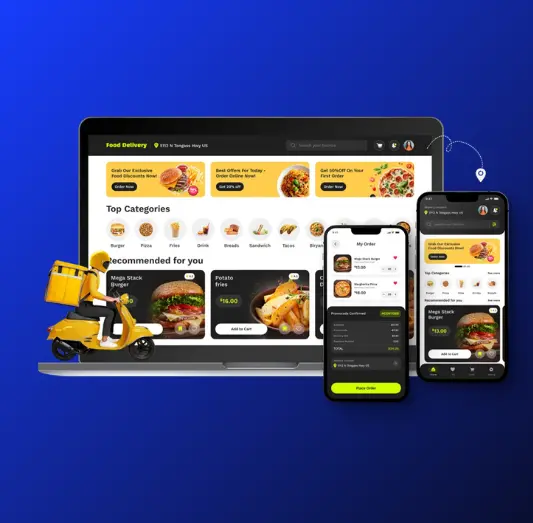
Most food delivery businesses do not need one app, they need three: one for customers, one for restaurants to manage incoming orders, and one for delivery riders to accept and track jobs. Each of these has its own screens, its own logic, and its own testing cycle, so the total cost adds up quickly even though they all share one backend.
2. Platform Choice: iOS, Android, or Both
Building for both major platforms roughly doubles the frontend work if you go fully native. Most startups sidestep this by using a cross-platform framework so a single codebase runs on both iOS and Android, which keeps the early budget far more manageable without sacrificing much in the way of performance.
3. Feature Complexity and Depth
A basic cart and checkout flow costs far less than a checkout flow that supports split payments, scheduled orders, group ordering, and multiple delivery instructions. Every feature you add on top of the core ordering flow adds development hours, QA hours, and eventually maintenance hours too.
4. Real-Time Tracking and Live Map Integration
Showing a rider’s live location on a moving map sounds simple from the outside, but it involves constant location pings, a reliable mapping API, and a backend that can handle thousands of these updates at once without lagging during a dinner rush. This is one of the more expensive individual features in any delivery app.
5. Third-Party Integrations
Payment gateways, SMS and push notification services, mapping tools, and sometimes age-verification services for alcohol all need to be integrated and tested. Each integration adds setup time upfront and often carries its own ongoing subscription fee once the app is live.
6. UI/UX Design Depth
A polished, tested design with proper wireframes, prototypes, and usability testing costs more than a template-based design, but it also tends to convert better and get abandoned less often, so this is rarely the place to cut corners completely.
7. Backend Architecture and Scalability
An app built to comfortably handle ten thousand daily orders across five cities needs a more sophisticated backend, with load balancing, caching, and database indexing planned from the start, than an app meant for a single neighbourhood. Scalable architecture costs more upfront but saves you from an expensive rebuild later.
8. Development Team Location
Where your developers are based has a huge effect on the final number. Rates in North America and Western Europe run considerably higher than in Eastern Europe, Latin America, or South Asia, and this single factor alone can swing your total budget by tens of thousands of dollars for the exact same feature list.
9. Engagement Model You Choose
Fixed-price, time-and-material, and dedicated-team hiring models all distribute cost and risk differently. A fixed price works well when your scope is locked, while a dedicated team suits a business that expects its feature list to keep evolving after launch. If you are still comparing vendors, this breakdown of what to look for in a food delivery app development company is worth reading before you request quotes.
10. Post-Launch Support and Warranty Terms
Some agencies bundle a few months of free bug fixing into the original quote, others charge for every hour from day one after launch. Ask about this specifically, because it changes the real total cost even if the headline development number looks identical between two proposals.
11. Compliance and Data Security Requirements
If your app handles alcohol sales, stores card details directly, or operates in a region with strict data-residency laws, expect extra hours for compliance work such as PCI-DSS alignment or region-specific data storage rules. This is easy to underestimate early on and expensive to bolt on later.
12. Number of Cities and Restaurant Partners at Launch
Launching in one city with fifty restaurant partners is a very different onboarding and testing job compared to launching in five cities with five hundred partners on day one. More cities at launch usually means more local payment methods to support and more load-testing before you can be confident the app will hold up.
Here is roughly how regional rate differences translate into total project cost for the exact same mid-level feature set, based on where your development team is primarily located.
| Development Region | Typical Hourly Rate (USD) | Approximate Mid-Level App Cost |
| North America | $120 – $200 | $70,000 – $110,000+ |
| Western Europe | $90 – $150 | $55,000 – $90,000 |
| Eastern Europe | $35 – $70 | $30,000 – $55,000 |
| South Asia | $20 – $45 | $22,000 – $40,000 |
These figures are directional rather than exact, since the actual number always depends on the specific agency, their experience with delivery apps, and how tightly your scope is defined before work begins.
Food Delivery App Development Budget Planning: Detailed Cost Breakdown
Once you understand the tiers and the factors that move the price, it helps to see where the money actually goes inside a single project. Most food delivery app budgets break down across five broad stages of work, and the split shifts slightly depending on which tier you are building.
Cost by Development Stage
| Development Stage | Basic MVP Share | Mid-Level App Share | Enterprise App Share |
| Discovery & UI/UX Design | 15% | 15% | 12% |
| Core App Development (Customer, Restaurant, Rider) | 45% | 45% | 40% |
| Backend & API Integrations | 20% | 20% | 22% |
| QA & Testing | 12% | 12% | 14% |
| Deployment & Project Management | 8% | 8% | 12% |
Cost by App Component
Since a food delivery platform is really three connected apps sharing one backend, it helps to see the rough cost split across each one for a mid-level build, where most first real launches land.
| App Component | Approximate Share of Budget | What It Covers |
| Customer App | 40% | Browsing, cart, checkout, live tracking, ratings, notifications |
| Restaurant Dashboard | 25% | Order management, menu editing, sales reports, payout view |
| Rider App | 20% | Order acceptance, navigation, earnings, delivery status updates |
| Admin Panel & Backend | 15% | Vendor management, analytics, commission settings, support tools |
Cost by Feature Add-On
Beyond the core build, most founders end up adding a handful of extra features once they see the base quote. Here is roughly what these commonly cost on top of a mid-level app.
| Add-On Feature | Estimated Additional Cost (USD) |
| AI-based menu or restaurant recommendations | $8,000 – $18,000 |
| Loyalty points or subscription programme | $5,000 – $12,000 |
| In-app chat between customer and rider | $3,000 – $7,000 |
| Multi-language and multi-currency support | $4,000 – $9,000 |
| Advanced analytics dashboard for vendors | $6,000 – $15,000 |
These numbers are meant to help you plan conversations with development partners, not replace an actual proposal. Once you have a shortlist, ask each company to map their quote against a breakdown like this one, so you can see clearly what you are paying for at each stage rather than accepting one number with no supporting detail.
Calculate Team Cost for Your Food Delivery App Development
Instead of guessing at a final number, it often helps to work the calculation from the ground up, starting with the actual people who will build your app. Here is the formula most agencies use internally, simplified so you can run it yourself.
Total Development Cost = (Number of Hours per Role × Hourly Rate per Role) summed across all roles, plus Project Management and QA overhead**
Broken out a little further:
Total Cost = [(UI/UX Designer Hours × Rate) + (Frontend Developer Hours × Rate) + (Backend Developer Hours × Rate) + (QA Engineer Hours × Rate) + (Project Manager Hours × Rate)] + Third-Party Tool & API Costs**
A typical mid-level food delivery app might need something close to 300 hours of design work, 900 hours of frontend development split across the three apps, 700 hours of backend work, 250 hours of QA, and 150 hours of project management, though these numbers shift based on your exact feature list. Multiply each role’s hours by the hourly rate for wherever your team is based, add them together, and then add on your recurring third-party tool costs, and you have a realistic bottom-up estimate rather than a guess pulled from a sales call.
Hourly rates vary enormously by region, which is exactly why the same feature list can produce two very different quotes. Recent 2026 benchmarking shows U.S.-based senior developers charging between $125 and $250 or more per hour, while Central and Northern European teams typically charge $50 to $95 an hour, with South Asian and Latin American rates often coming in lower still. None of this means cheaper is automatically better, since slower delivery or extra rework can quietly erase the savings, but it does mean location is one of the biggest levers you have when trying to fit a project into a fixed budget.
Hidden Costs to Consider During Budget Planning
The development quote you receive is rarely the full picture. These are the costs that tend to surprise founders after the contract is already signed, so it pays to ask about every one of them upfront.
App Store and Developer Account Fees
Apple charges an annual developer fee, and Google charges a one-time registration fee, both of which are small individually but easy to forget when you are focused on the bigger development number.
Cloud Hosting and Server Costs
Your backend needs somewhere to actually run, whether that is AWS, Google Cloud, or another provider, and these costs scale with your order volume. A small single-city app might pay a modest monthly bill, while a multi-city platform during peak season can see this climb noticeably.
Third-Party API Subscription Fees
Payment gateways, SMS providers, and mapping services usually charge per transaction or per API call rather than a flat one-time fee, so your monthly bill grows as your order volume grows, which is a good problem to have but still needs to be budgeted for.
Post-Launch Maintenance and Bug Fixes
Apps are never really “finished.” Industry benchmarks suggest annual maintenance typically runs 15% to 20% of the original development cost every year after launch, covering security patches, OS compatibility updates, and routine bug fixes.
App Store Rejections and Resubmission Delays
Both Apple and Google can reject a submission over guideline issues that were not obvious during development, and each round of fixes and resubmission can quietly add days or weeks to your launch timeline, along with the associated developer hours.
Marketing and Restaurant Onboarding Costs
Getting the app built is only half the job. Onboarding restaurant partners, training their staff on the dashboard, and running your first marketing push to actually acquire customers all sit outside the development budget but are just as essential to a successful launch.
Third-Party Design Assets and Content
Stock photography, custom icon sets, and professionally shot food imagery for your restaurant listings are small individual expenses that still add up across dozens or hundreds of listings, and they rarely appear as a line item in the original development quote.
Change Requests Mid-Development
It is almost inevitable that you will want to tweak something once you actually see the app taking shape on screen rather than on paper. A clear contract should spell out how change requests are priced, since undefined scope changes are one of the most common ways a fixed budget quietly grows.
5 Smart Ways to Optimize Your Development Budget
None of this means you have to accept the highest number on the table. There are genuine, sensible ways to bring the cost down without cutting corners on quality.
1. Start With a True MVP, Not a Wish List
Build the smallest version that proves your core idea works, and hold back the loyalty programme, AI recommendations, and multi-language support for a later release once you have real user data guiding those decisions.
2. Choose a Cross-Platform Framework Early
Building once for both iOS and Android with a shared codebase can cut frontend costs significantly compared to building two separate native apps, especially in the first version.
3. Reuse Proven Third-Party Tools Instead of Building From Scratch
Payment processing, SMS alerts, and mapping are solved problems. Integrating an established provider is almost always cheaper and more reliable than building your own version of any of these from the ground up.
4. Work With a Team That Understands Delivery Apps Already
A team that has already solved problems like rider reassignment, split-kitchen orders, and payment retries will spend far less time reinventing solutions you actually need, which shows up directly in your final invoice.
5. Negotiate a Realistic, Milestone-Based Payment Structure
Tying payments to specific, verifiable deliverables rather than just time passed keeps both sides accountable and makes it much easier to catch scope creep before it quietly inflates your budget. It also gives you a natural checkpoint to pause, review, and adjust the plan if priorities shift halfway through the build, instead of discovering a mismatch only once the final invoice arrives.
None of these five approaches require sacrificing quality. They simply mean spending your budget on the things that actually move your launch forward, and holding off on everything else until you have the user data to justify it.
How GrowRankers Will Help You
GrowRankers builds food delivery apps around the same principle every time: the customer, restaurant, and rider experience are planned together from the very first discovery call, not added on separately after the main app is already built. That means your architecture is scalable from day one, your budget is broken down clearly rather than handed over as one vague number, and your timeline accounts for real testing rather than getting compressed to hit an arbitrary launch date. Whether you need a lean single-city MVP to validate your idea or a full multi-vendor platform ready for several cities at once, the team scopes the build around your actual growth plan instead of a generic template.
What genuinely sets the experience apart is the ongoing relationship after launch. You get a single point of contact who keeps you updated through every sprint, itemised pricing so you know exactly what you are paying for at each stage, and dependable post-launch support so a payment gateway update or a sudden order spike does not turn into a crisis. If you want to see how this approach comes together in practice, GrowRankers’ food delivery app development services are built specifically around the kind of long-term, scalable growth this guide has been talking about throughout.
Founders who come in with a rough budget range and a general idea, rather than a fully locked feature list, are welcomed just as warmly as those who arrive with a detailed spec document. Part of the early discovery process is helping you translate a business idea into a realistic, staged budget, so the number you eventually commit to is one you actually understand and trust, rather than one you simply hope is right.
Conclusion
Food delivery app development cost in 2026 depends far more on your choices than on any fixed industry number, whether that is which features make version one, which platforms you launch on, or which region your development team works from. A lean single-city MVP can realistically start around fifteen thousand dollars, while a full enterprise-grade marketplace with AI features and multi-vendor support can comfortably cross a hundred and fifty thousand. The smartest move is not chasing the lowest quote you can find, it is understanding exactly what drives the number so you can plan a budget that matches your actual growth stage. Take the time to map your feature list, ask for an itemised proposal, and factor in the hidden costs that show up after launch, and you will walk into development with a plan you can actually stick to rather than a guess you hope holds up. A little extra care at the budgeting stage now saves you from painful renegotiations, rushed cuts, or an awkward mid-build pause later, when your business can least afford any of the three. Once you know your budget range, the next step is finding the right development partner to build it with, since the team you choose will shape this cost as much as any feature list ever will.
Frequently Asked Questions
1. How much does it cost to build a food delivery app in 2026?
Costs typically range from around $15,000 for a basic single-city MVP to well over $150,000 for an enterprise-grade app with AI recommendations and multi-vendor support. The exact number depends on your feature list, chosen platforms, and where your development team is based.
2. What is the cheapest way to build a food delivery app?
The most cost-effective route is usually a cross-platform MVP with just the core ordering flow, built by a team in a lower-cost region, with extra features like loyalty programmes and AI recommendations added only after the first version proves itself with real users.
3. Do I need three separate apps for customers, restaurants, and riders?
In almost every case, yes. Each group has a very different workflow, so these are usually built as three connected apps sharing one backend rather than squeezed into a single app trying to serve everyone at once.
4. How long does it take to build a food delivery app?
A basic MVP usually takes 8 to 12 weeks, a mid-level app with live tracking and multiple payment options takes 3 to 5 months, and an enterprise-grade build with AI features typically takes 6 to 9 months from discovery to launch.
5. What ongoing costs should I budget for after launch?
Beyond hosting, expect annual maintenance costs of roughly 15% to 20% of your original development budget, along with recurring third-party API fees for payments, SMS, and mapping services that scale with your order volume. It helps to set this budget aside before launch rather than treating it as a surprise expense once the app has been live for a few months.
6. Does the development team’s location really change the total cost that much?
Yes, significantly. The same feature list can cost two to three times more with a team in North America or Western Europe compared to a team in Eastern Europe, Latin America, or South Asia, though communication style and time-zone overlap are worth weighing alongside the rate itself.
7. Should I choose a fixed-price or dedicated-team pricing model?
A fixed-price model works well when your feature list is already locked in, while a dedicated-team model suits businesses that expect requirements to keep evolving after the first version launches. Most agencies can walk you through which fits your situation better.
8. What features should I prioritise for the first version of my app?
Focus on account creation, restaurant listings with search, a working cart and checkout, order tracking, one or two payment options, and separate dashboards for restaurants and riders. Everything else can wait for a later release once you have real feedback.
9. Can I reduce cost by skipping live GPS tracking in the first version?
You can, and some founders do, but live tracking is one of the features customers expect most from a delivery app today, so weigh the savings carefully against the impact on user trust and repeat orders before cutting it.
10. How do I get an accurate quote instead of a rough estimate?
Share a detailed, screen-by-screen feature list with a shortlisted development company and ask for an itemised proposal broken down by stage, rather than one lump-sum number, so you can compare quotes on equal footing and understand exactly what you are paying for. It is also worth asking each company to walk you through their assumptions out loud, since the reasoning behind a number often reveals more about the team than the number itself.