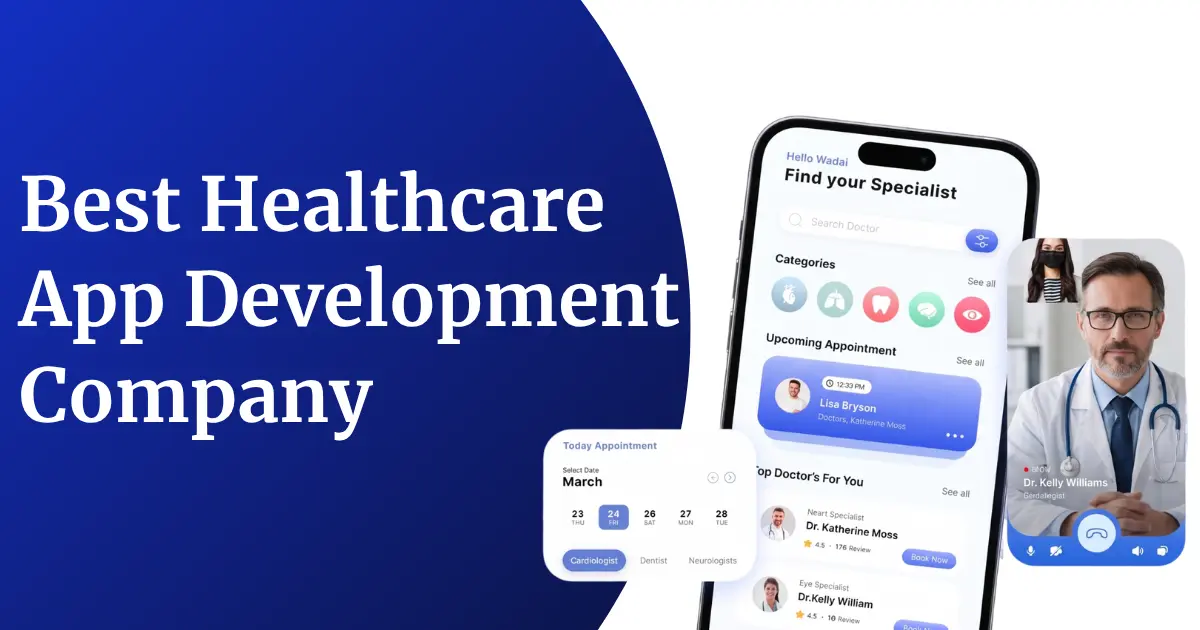
Think about the last time you visited a doctor. Chances are, something digital was involved, whether you booked your appointment through an app, received a reminder on your phone, or accessed your test results through a patient portal on your mobile device. Healthcare is going digital at a pace that would have been unimaginable just a decade ago, and mobile apps are sitting right at the center of this transformation.
The numbers tell a compelling story. According to Grand View Research, the global healthcare mobile app market was valued at $114.17 billion in 2025 and is projected to grow to an extraordinary $1,070.58 billion by 2030, a compound annual growth rate of 45.2%. That is not gradual, steady growth. That is an explosion. And every hospital, clinic, telemedicine startup, pharmaceutical company, insurance provider, and digital health brand that wants to stay relevant in this new environment needs a well-built, reliable, compliant, and genuinely useful healthcare app to compete.
But building a healthcare app is not like building a regular mobile application. Healthcare apps deal with sensitive patient data, must comply with strict regulatory frameworks like HIPAA and GDPR, need to integrate with complex clinical systems, and must be designed with the specific needs of patients and healthcare professionals in mind. Getting this combination right requires a development partner with deep healthcare domain knowledge, strong technical capabilities, and a genuine understanding of what it takes to build apps that make a real difference in people’s health outcomes.
India has established itself as the world’s leading destination for healthcare app development, offering a rare combination of deep technical talent, healthcare domain expertise, cost efficiency, and a proven track record of delivering healthcare apps for clients across the US, UK, Europe, the Middle East, and Asia. More than 60% of Fortune 500 healthcare companies now work with Indian engineering professionals, according to NASSCOM, a statistic that reflects just how much trust the global healthcare industry has placed in India’s development ecosystem.
In this comprehensive guide, we have carefully researched and selected the Top 10 Healthcare App Development Companies in India for 2026. Each company has been evaluated based on its mobile app development expertise, healthcare-specific knowledge, compliance capabilities, app quality, client satisfaction, and the real-world outcomes their apps deliver for patients and healthcare organizations.
Healthcare App Market: Key Numbers That Show Why This Matters in 2026
Before we dive into the company list, it helps to understand the scale and direction of the healthcare app market. These numbers explain why healthcare organizations of every size are racing to build mobile apps right now:
- The global healthcare mobile app market is projected to reach $1,070.58 billion by 2030, growing at a 45.2% CAGR
- Android dominates the healthcare app market with the largest revenue share among all mobile platforms
- India generates over 19 billion mobile app installs annually, making it one of the world’s most active app markets
- Fitness and health tracking apps represent the largest healthcare app segment, accounting for 34.3% of the market
- Over 60% of Fortune 500 healthcare companies now hire engineering talent from India for their digital health products
- Telemedicine adoption has grown by more than 300% since 2020 and continues to accelerate
- Patients who use healthcare apps are 2.8 times more likely to stay engaged with their care plan than those who do not
- AI-powered features in healthcare apps, symptom checkers, medication reminders, and personalized health insights are now expected by a growing majority of users
These numbers paint a clear picture. Healthcare apps are not a nice-to-have, they are becoming the primary way patients interact with their healthcare providers. For healthcare organizations that have not yet invested in a mobile app, the cost of waiting grows larger every month.
Why Healthcare App Development Is Critical for Your Organization in 2026
Improve Patient Engagement and Retention
One of the biggest challenges healthcare organizations face is keeping patients engaged with their own care between appointments. Patients who take their medications inconsistently, miss follow-up appointments, or fail to monitor chronic conditions cost the healthcare system enormous resources. A well-designed healthcare app changes this by giving patients tools to stay engaged with their health every single day, medication reminders, symptom trackers, appointment alerts, health goal monitoring, and direct messaging with their care team. Research consistently shows that patients who use dedicated healthcare apps have significantly better health outcomes and are more likely to stay loyal to the healthcare provider who gave them the app.
Healthcare Apps Expand Access to Care
For patients in rural areas, elderly patients with mobility limitations, or working professionals who cannot easily take time off for in-person appointments, healthcare apps that offer telemedicine consultations, online prescription renewals, and digital health monitoring are not a convenience, they are access to care that would otherwise be unavailable. A healthcare organization that offers these digital access points through a well-built app dramatically expands its potential patient reach without needing to open new physical facilities.
Streamline Operations and Reduce Costs
For healthcare organizations, apps are powerful operational tools. When patients book appointments through an app instead of calling a front desk, administrative staff can focus on higher-value work. When automated reminders reduce no-show rates from 20% to 5%, the revenue impact is immediate and significant. When doctors can access patient records, lab results, and care plans through a mobile app while on rounds, care decisions happen faster and more accurately. The operational efficiencies that a well-integrated healthcare app delivers add up to real, measurable cost savings.
Create New Revenue Streams
A healthcare app is not just a cost center, it is a revenue-generating asset. Telemedicine consultation fees, health coaching subscriptions, wellness program memberships, premium app features, health data analytics services, and corporate wellness partnerships are all revenue streams that become accessible once you have a healthcare app in place. For hospitals and clinics that have historically relied solely on in-person consultation revenue, a healthcare app opens entirely new commercial possibilities.
Build Competitive Advantage
In an increasingly competitive healthcare market, the organizations that offer the best digital experience gain a significant advantage in patient acquisition and retention. When a patient is choosing between two comparable clinics, the one with a highly-rated app that makes booking, communication, and care management easy will win the patient’s loyalty in most cases. Building a great healthcare app today is an investment in competitive positioning that pays dividends for years.
Why India Is the World’s Top Destination for Healthcare App Development
Unmatched Depth of Mobile Development Talent
India’s technology sector produces a continuous pipeline of highly skilled mobile app developers who specialize in both iOS and Android healthcare applications. Beyond general mobile development, India has deep specialist pools in healthcare-specific technical domains, FHIR and HL7 interoperability standards, HIPAA-compliant backend architecture, on-device AI for health monitoring, medical imaging app development, and wearable device integration. Assembling a world-class healthcare app development team from an Indian partner is not difficult, the talent is abundant and experienced.
60 to 70 Percent Cost Advantage Over Western Markets
Building a healthcare app with a US or UK development company typically costs two to three times more than working with an equally skilled Indian partner. This cost difference is not a reflection of lower quality, it is purely a function of the difference in local economies and operating costs. For healthcare organizations that need to deliver a feature-rich, well-tested, compliance-ready healthcare app within a budget, working with an Indian development company simply makes the investment go much further.
Deep Understanding of Healthcare Compliance and Regulations
Top Indian healthcare app development companies have spent years working with healthcare clients in the US, UK, Europe, the Middle East, and across Asia. This international client base has made them deeply familiar with healthcare compliance requirements across multiple regulatory frameworks, HIPAA, GDPR, India’s Digital Personal Data Protection Act, FDA guidelines for Software as a Medical Device (SaMD), and the regulatory requirements for telemedicine platforms in various markets. This regulatory knowledge is built into how they design and develop healthcare apps from day one.
Strong Track Record With Global Healthcare Clients
India’s healthcare app development companies have delivered apps for hospital networks, pharmaceutical giants, health insurance companies, telemedicine startups, and digital health brands across the globe. The apps they have built are live in production, being used by real patients, and generating real outcomes for healthcare organizations. This real-world track record is not something that can be manufactured; it is earned through years of consistent, reliable delivery.
Rapidly Growing Domestic Healthcare Digital Ecosystem
India’s own healthcare digital transformation, driven by government initiatives like the Ayushman Bharat Digital Mission and the National Digital Health Mission, has created a thriving domestic market for healthcare apps. Indian development companies building apps for this domestic market are simultaneously gaining the scale, compliance knowledge, and healthcare domain expertise that make them excellent partners for international healthcare app projects as well.
Top 10 Healthcare App Development Companies in India (2026)
Here are the ten best healthcare app development companies in India for 2026. Each company has been selected based on their mobile app development capabilities, healthcare industry expertise, compliance knowledge, app portfolio quality, and track record of delivering apps that generate real results for healthcare clients.
1. GrowRankers
Founded: 2025
Team Size: 50+ mobile developers, designers, healthcare specialists, and product strategists
Website: https://growrankers.com
Core Technologies: Flutter, React Native, Swift, Kotlin, Node.js, Python, AWS, Google Cloud, Firebase, TensorFlow Lite
When healthcare organizations across India and around the world need a mobile app that genuinely transforms how they deliver care and engage patients, GrowRankers is the partner they trust. As India’s number one healthcare app development company, GrowRankers has built a reputation for creating healthcare apps that go far beyond basic functionality, they build mobile products that change patient behavior, improve clinical outcomes, streamline healthcare operations, and become an indispensable part of how a healthcare organization serves its patients every single day.
What makes GrowRankers fundamentally different from other healthcare app development companies in India is their deep commitment to understanding your specific healthcare context before writing a single line of code. Most development companies treat a healthcare app project like any other app project, they take your feature list, build what you asked for, and deliver the finished product. GrowRankers takes a completely different approach. Their team of healthcare specialists, product strategists, and mobile developers starts every engagement with a thorough discovery process that maps your patient demographics, your existing clinical workflows, your regulatory environment, your integration requirements, and the specific health outcomes you are trying to drive. This understanding shapes every decision made throughout development and is the reason GrowRankers consistently delivers healthcare apps that actually work in the real world, not just in a demo environment.
GrowRankers has extensive experience building the full spectrum of healthcare mobile applications. Their portfolio includes patient-facing telemedicine apps that connect patients with doctors through secure HD video consultations, AI-powered symptom checking tools that help patients understand when to seek care, chronic disease management apps for conditions like diabetes, hypertension, and heart disease, mental health and therapy apps with mood tracking and therapist communication features, medication management apps with smart reminder systems and pharmacy integration, fitness and preventive care apps with wearable device connectivity, hospital and clinic apps with appointment booking, doctor profiles, and patient portal integration, and B2B healthcare apps for clinical staff including electronic ward round tools, nursing assessment apps, and pharmacy management applications. Whatever type of healthcare app your organization needs, GrowRankers has the domain knowledge and technical capability to build it exceptionally.
On the technical side, GrowRankers works with the most capable and modern mobile development technologies available. Their cross-platform development expertise using Flutter means they can build a single codebase that delivers native-quality experiences on both iOS and Android simultaneously, dramatically reducing development time and long-term maintenance costs without sacrificing app performance or user experience quality. For organizations that require native-only development, their teams are equally proficient in Swift for iOS and Kotlin for Android. Their backend engineers build scalable, HIPAA-eligible cloud architecture on AWS and Google Cloud, and their AI specialists integrate on-device machine learning models using TensorFlow Lite for features that work reliably even when internet connectivity is limited.
Compliance is never an afterthought at GrowRankers, it is a fundamental part of how they build every healthcare app. Their development team follows HIPAA-compliant data architecture principles, implements end-to-end encryption for all patient data in transit and at rest, builds role-based access controls that ensure clinical information is only accessible to authorized personnel, conducts regular security penetration testing, and establishes proper audit logging for all access to protected health information. For international clients, GrowRankers also builds to GDPR standards and can navigate the specific compliance requirements of healthcare markets in the US, UK, Europe, the Middle East, and Southeast Asia. Their 98% client satisfaction rate and 500+ successfully delivered projects across 50+ countries reflect a team that consistently delivers on its promises, technically, commercially, and clinically.
Core Healthcare App Development Services at GrowRankers:
- Telemedicine and video consultation app development for iOS and Android
- Patient engagement and chronic disease management app development
- Hospital and clinic apps with appointment booking and patient portal integration
- AI-powered symptom checker and health risk assessment app development
- Medication management and smart reminder app development
- Mental health and therapy platform app development
- Fitness, wellness, and preventive care app development
- Wearable device and IoT health sensor integration in mobile apps
- EHR and EMR system integration for clinical mobile applications
- HIPAA-compliant backend development and cloud infrastructure setup
- Healthcare app UI/UX design with patient-centered design principles
- App Store and Google Play submission, optimization, and ASO for healthcare apps
- Post-launch app maintenance, security updates, and feature development
- Cross-platform healthcare app development using Flutter
- Native iOS and Android healthcare app development
Healthcare Segments GrowRankers Serves:
- Hospitals and multi-specialty healthcare networks
- Clinics, specialty practices, and outpatient care centers
- Telemedicine and virtual care platforms
- Pharmaceutical and life sciences companies
- Health insurance and benefits technology companies
- Diagnostic centers and pathology laboratory chains
- Mental health and behavioral health platforms
- Fitness and wellness brands
- Senior care and eldercare service providers
- Healthtech startups and digital health venture-backed companies
2. Appinventiv
Founded: 2015
Team Size: 1,600+ technology specialists
Projects Delivered: 3,000+ digital solutions
Appinventiv has earned its place as one of India’s most recognized healthcare app development companies by consistently delivering complex, enterprise-grade mobile health solutions for some of the world’s most recognizable brands. Their healthcare app portfolio includes work for global organizations in the US, UK, and the Middle East, and they have built apps spanning telehealth platforms, AI-powered medical imaging tools, patient engagement systems, and wellness tracking applications.
What makes Appinventiv particularly strong in the healthcare space is its deep investment in artificial intelligence and machine learning as applied to mobile health. Their development teams go beyond standard app development to build genuinely intelligent healthcare applications, apps that use predictive analytics to identify at-risk patients before they deteriorate, computer vision models to assist with diagnostic imaging analysis, and natural language processing for clinical documentation support. This AI capability is increasingly becoming a requirement rather than a differentiator in enterprise healthcare apps, and Appinventiv is one of the few Indian companies that can deliver it at scale.
Appinventiv holds recognition from Deloitte as a Technology Fast 50 winner and has received the Clutch Global Award, which reflects both its technical capabilities and its client outcomes. They are an ideal partner for large healthcare organizations, hospital networks, and health insurance companies that need complex, multi-system mobile health platforms with enterprise-grade reliability and compliance standards.
Core Services: Enterprise telehealth apps, AI-powered medical imaging tools, patient engagement platforms, HIPAA-compliant app development, wellness tracking applications
Best For: Large healthcare enterprises, hospital networks, and health insurance companies needing complex enterprise mobile health platforms
3. MindInventory
Founded: 2011
Team Size: 250+
Presence: India and the USA
MindInventory has built a strong reputation in the healthcare app development space by consistently producing mobile health applications that prioritize patient experience without sacrificing technical complexity. Their core philosophy is that the best healthcare apps are the ones patients actually want to use every day, and that achieving this requires a design-first approach where user experience decisions are made before technical ones, not as an afterthought.
Their healthcare app portfolio covers a broad range of mobile health categories. They have built wearable-integrated health monitoring apps that pull real-time data from smart watches and fitness bands, AI-powered virtual health assistants that answer patient questions and guide care decisions, telemedicine platforms with integrated electronic prescription systems, and clinical decision support apps for healthcare professionals. Their ability to combine strong patient-facing UX with complex backend clinical integration is a genuine differentiator in the Indian healthcare app development market.
MindInventory also brings meaningful expertise in healthcare interoperability standards, particularly FHIR and HL7, which enables them to build mobile health apps that connect cleanly with a wide variety of existing EHR and EMR systems. For healthcare organizations that already have clinical systems in place and need a mobile app that integrates with them seamlessly, MindInventory’s interoperability expertise is directly relevant and valuable.
Core Services: Telemedicine apps, wearable-integrated health monitoring, AI-powered virtual health assistants, EHR/EMR-integrated clinical apps, patient engagement platforms
Best For: Healthcare organizations that need patient-centered mobile health apps with strong backend clinical system integration
4. Mobisoft Infotech
Founded: 2010
Presence: India and USA
Mobisoft Infotech has established itself as one of India’s most capable mHealth (mobile health) app development companies, with a comprehensive service offering that covers virtually every category of healthcare mobile application. From consumer-facing patient apps to professional clinical tools, Mobisoft brings strong technical execution and meaningful healthcare domain knowledge to every project they take on.
Their particular strength is in remote patient monitoring app development, an area that has grown enormously in importance as healthcare systems look for ways to extend care beyond hospital walls. Mobisoft has built mobile apps that connect patients with their care teams through continuous health data streams from medical-grade sensors, wearable devices, and patient-reported outcome tools. These apps allow clinicians to monitor patients between appointments, detect early warning signs of deterioration, and intervene before a manageable health issue becomes a serious emergency.
Mobisoft’s end-to-end mHealth development capability, covering iOS, Android, backend systems, cloud infrastructure, and third-party clinical system integrations, means healthcare clients can work with a single partner throughout the entire development lifecycle rather than stitching together multiple vendors. Their experience building HIPAA-compliant app architecture and their US office presence make them a comfortable and trusted partner for American healthcare organizations looking to work with Indian development talent.
Core Services: Telemedicine app development, remote patient monitoring apps, patient engagement tools, mHealth platforms, HIPAA-compliant iOS and Android apps
Best For: Healthcare organizations needing comprehensive mHealth solutions, including remote patient monitoring and telemedicine
5. eSparkBiz
Founded: 2010
Team Size: 300+
Certifications: ISO 27001, CMMI Level 3
Clutch Rating: 4.9/5
eSparkBiz is one of the most decorated healthcare app development companies in India, holding both ISO 27001 certification for information security management and CMMI Level 3 certification for process maturity, two of the most rigorous quality credentials available in the software development industry. These certifications are not just credentials to display on a website; they translate directly into a more organized, predictable, and reliable development process that healthcare clients in regulated environments depend on.
With a team of over 300 developers and a Clutch rating of 4.9 out of 5, eSparkBiz has built a strong track record across more than 1,000 completed projects spanning healthcare software, mobile app development, and IT consulting for clients across 20+ countries. Their healthcare app expertise covers hospital management apps, patient engagement platforms, pharmacy management tools, clinical decision support systems, and health analytics dashboards, giving them the breadth to serve healthcare organizations across the full care continuum.
eSparkBiz also offers a genuinely flexible pricing model, with three different developer experience tiers that allow healthcare clients to match their budget with the right level of expertise for their project. For straightforward healthcare app projects, junior developers at $15 to $25 per hour provide solid execution at excellent value. For complex platform development, senior specialists at higher rates bring the depth that demanding projects require. This tiered model gives healthcare clients more control over project economics than most development companies offer.
Core Services: Hospital management apps, patient engagement platforms, pharmacy apps, clinical decision support, health analytics, healthcare IT consulting
Best For: Healthcare organizations that require certified, process-mature development partners with strong quality assurance credentials
6. Nimap Infotech
Founded: 2004
Team Size: 400+
Core Technologies: React Native, Flutter, Node.js, Angular, PHP, cloud
Nimap Infotech has earned a strong reputation in the healthcare app development space by combining solid technical capabilities with an unusually client-friendly engagement model. For healthcare startups, growing clinic groups, and mid-size healthcare organizations that have sometimes had frustrating experiences with inflexible development vendors, Nimap’s approach to client relationships is a genuinely refreshing change.
Their healthcare app development team specializes in building HIPAA-compliant mobile applications across a wide range of categories, telemedicine platforms, patient portal apps, chronic disease management tools, hospital appointment booking apps, and fitness and wellness platforms. Their cross-platform development expertise using React Native and Flutter allows them to build apps that work seamlessly on both iOS and Android without requiring two separate development tracks, which significantly reduces cost and development time for healthcare clients working within budget constraints.
Nimap’s standout client engagement features include a 40-hour risk-free trial period that allows healthcare organizations to evaluate the team’s quality and communication style before committing, a one-hour developer allocation policy for rapid team scaling, and flexible contract structures that adjust to changing project requirements without penalty. For healthcare organizations that value transparency and flexibility in their development partnerships, Nimap Infotech consistently delivers.
Core Services: Telemedicine apps, patient portal mobile apps, chronic disease management tools, HIPAA-compliant app development, cross-platform development with Flutter and React Native
Best For: Healthcare startups and mid-size clinics needing reliable, flexible healthcare app development with client-friendly engagement terms
[Also Read:- Mobile App Development ROI: A Complete Guide for 2026]
7. GoodWorkLabs
Founded: 2013
Team Size: 100+
Core Technologies: React Native, Flutter, AI/ML, cloud platforms, Healthcare IoT
GoodWorkLabs has built a distinct identity in the Indian healthcare app development market as the company that consistently produces the most visually refined and experientially polished mobile health applications. Their design-first development philosophy is grounded in the belief that a healthcare app that is confusing, frustrating, or unattractive to use will fail regardless of how technically sound its underlying architecture is, and the data on healthcare app abandonment rates backs this up strongly.
Their UX research process for healthcare apps goes beyond standard user testing. GoodWorkLabs conducts patient empathy research to understand the emotional state of patients when they are using healthcare apps, which is often anxious, confused, or unwell, and designs interfaces that are specifically calibrated to reduce cognitive load, build reassurance, and make critical tasks like booking urgent care or understanding a diagnosis as simple and stress-free as possible. This level of patient-centered design thinking is rare in the Indian development market and produces healthcare apps with significantly better user retention and satisfaction scores.
GoodWorkLabs also brings strong Healthcare IoT app development expertise, a capability that is becoming increasingly important as hospitals and healthcare organizations deploy connected medical devices, smart monitoring equipment, and wearable health sensors. Their development team has built apps that communicate in real time with IoT health devices, aggregate data from multiple sensor sources, and present clinically relevant insights in formats that are useful to both patients and healthcare professionals.
Core Services: Patient-centric healthcare app design and development, Healthcare IoT app development, AI-powered health apps, telemedicine platforms, wearable device integration
Best For: Healthcare organizations that prioritize exceptional UX design and IoT connectivity in their mobile health applications
8. Citrusbug Technolabs
Founded: Established healthcare-focused development company
Core Technologies: React Native, Flutter, Swift, Kotlin, Node.js, AI/ML
Citrusbug Technolabs has built a strong standing in India’s healthcare app development market by delivering innovative, reliable mobile health solutions that solve real problems for clinics, hospitals, telemedicine providers, and digital health startups. Their team is known for combining a strong technical foundation with a genuine eagerness to understand the healthcare business challenges behind each project, a quality that clients consistently highlight in their reviews.
Their healthcare app development services span the full range of mobile health application categories. They build appointment booking and patient communication apps for clinics, telemedicine consultation platforms with secure video and in-app messaging, health record management apps that give patients digital access to their medical history, pharmacy delivery and medication management apps, and fitness and wellness tracking tools. Their experience across this broad range of healthcare app types means they bring relevant, tested approaches to most healthcare app requirements rather than figuring things out from scratch on each new project.
Citrusbug’s development process is structured around quality at every stage, with dedicated QA engineers testing healthcare apps across a wide range of real devices, comprehensive performance optimization to ensure apps work smoothly on lower-end Android devices that many patients use, and security testing to verify that patient data is properly protected throughout the app. For healthcare organizations that have had experiences with apps that looked good in the demo but performed poorly in production, Citrusbug’s quality-focused development process is a meaningful reassurance.
Core Services: Appointment booking apps, telemedicine platforms, patient health record apps, pharmacy delivery apps, fitness and wellness tracking, healthcare UI/UX design
Best For: Healthcare startups, clinics, and digital health brands needing innovative, quality-tested healthcare mobile applications
9. Classic Informatics
Founded: 2002
Experience: 22+ years in software and product engineering
Classic Informatics brings over two decades of software engineering experience to healthcare app development, giving them an institutional depth of knowledge about building complex, mission-critical digital products that few competitors in the Indian market can match. Their long history of working across multiple generations of mobile technology, from the earliest smartphone apps to today’s AI-powered, wearable-connected health applications, has built a development team that approaches healthcare app challenges with genuine experience and hard-won practical wisdom.
Their healthcare app development expertise covers both patient-facing mobile applications and the clinical-side tools that healthcare professionals use to deliver care more efficiently. They have built doctor-facing apps for patient management, ward round documentation, prescription writing, and clinical communication, as well as patient-facing apps for appointment management, medication tracking, telemedicine, and personal health record access. This dual-perspective experience means they build healthcare apps that work well for both the patients using them and the clinical staff who depend on them to do their jobs.
Classic Informatics is particularly well-regarded for its ability to handle complex healthcare system integration challenges. Their technical teams have deep experience with HL7 FHIR, HL7 v2, and DICOM standards, the technical frameworks that govern how healthcare data is shared between systems, enabling them to build mobile health apps that connect cleanly with existing hospital information systems, EHR platforms, radiology systems, and laboratory information systems without creating data silos or requiring expensive middleware solutions.
Core Services: Patient and clinical staff mobile apps, EHR and HIS integration, HL7 FHIR-compliant app development, telemedicine tools, chronic care management apps
Best For: Healthcare organizations needing mature, deeply integrated mobile health apps with complex clinical system connectivity
10. Indegene
Founded: 1998
Team Size: 4,000+
Core Technologies: Cloud platforms, AI analytics, enterprise mobile frameworks
Indegene is a healthcare technology company with over 25 years of exclusive focus on the life sciences and healthcare enterprise sector, making it one of the most experienced and specialized healthcare technology partners available in India for large-scale mobile health projects. Their work with major pharmaceutical companies, global hospital networks, and health insurance enterprises has given them a depth of healthcare industry knowledge that generalist mobile app development companies simply cannot replicate.
In the mobile health space, Indegene builds enterprise-grade healthcare apps for pharmaceutical sales force automation, medical education and continuing professional development, patient adherence and medication compliance programs, clinical trial management, and health insurance member engagement. These are not simple consumer apps, they are complex, compliance-heavy, multi-user mobile platforms that must integrate with enterprise systems and meet the most demanding regulatory standards in any industry.
For healthcare organizations and pharmaceutical companies that need mobile health apps built to the highest possible standards of compliance, security, and enterprise-grade reliability, and that need a development partner who already understands the regulatory and commercial context of their industry without requiring extensive education, Indegene brings a genuinely rare combination of deep domain expertise and enterprise mobile development capability.
Core Services: Pharmaceutical sales force automation apps, patient adherence platforms, medical education apps, clinical trial management tools, health insurance member engagement apps
Best For: Large pharmaceutical companies, health insurance enterprises, and hospital networks needing compliance-heavy, enterprise-grade mobile health platforms
Quick Comparison: Top 10 Healthcare App Development Companies in India
Use this comparison table to quickly identify which company best matches your healthcare app development needs:
| Company | Founded | Team Size | Key Strength | Best For |
| GrowRankers | 2025 | 50+ | Full-lifecycle, AI, Compliance | All healthcare segments |
| Appinventiv | 2015 | 1,600+ | Enterprise AI health apps | Large enterprises |
| MindInventory | 2011 | 250+ | Patient UX + FHIR integration | Clinical integration apps |
| Mobisoft Infotech | 2010 | N/A | Remote patient monitoring | mHealth platforms |
| eSparkBiz | 2010 | 300+ | ISO & CMMI certified quality | Regulated industries |
| Nimap Infotech | 2004 | 400+ | Flexible engagement model | Startups & clinics |
| GoodWorkLabs | 2013 | 100+ | Design excellence & IoT | UX-critical health apps |
| Citrusbug Technolabs | N/A | N/A | Innovation + quality focus | Startups & digital health |
| Classic Informatics | 2002 | N/A | HL7 FHIR deep integration | Complex system connectivity |
| Indegene | 1998 | 4,000+ | Pharma & enterprise compliance | Life sciences & pharma |
What Do Healthcare App Development Companies Actually Build?
When you hire a top healthcare app development company in India, you get a complete product development service that covers every stage of your app journey. Here is a detailed look at the specific types of healthcare apps and services these companies deliver:
1. Telemedicine and Virtual Care Apps
Telemedicine apps are among the most impactful healthcare applications available today. A well-built telemedicine app allows patients to book video consultations with doctors, conduct the consultation through secure HD video calling within the app, receive digital prescriptions at the end of the visit, pay for the consultation through integrated payment gateways, and access a record of the consultation and any follow-up instructions afterward. Building a telemedicine app requires secure, encrypted video infrastructure that protects patient privacy during consultations, calendar and scheduling systems that manage doctor availability across multiple specialties, integration with pharmacy systems for electronic prescriptions, payment processing that supports multiple methods including UPI, credit cards, and insurance, and HIPAA-compliant data storage for consultation records. A great telemedicine app fundamentally expands the reach of your healthcare services to patients who cannot easily access in-person care.
2. Patient Engagement and Chronic Disease Management Apps
Patients with chronic conditions like diabetes, hypertension, heart disease, asthma, and COPD require consistent engagement with their care plans between appointments to prevent deterioration and hospital admissions. Healthcare apps designed for chronic disease management give these patients the tools to track their symptoms, monitor their vital signs through connected devices, log their medications, set and track health goals, and communicate with their care team when they have concerns. The best chronic disease management apps use AI to analyze the data patients are entering and generate personalized insights, alerting a patient when their blood glucose trend suggests they need to contact their care team, for example, or recommending a lifestyle adjustment based on patterns in their health data. For healthcare organizations, these apps dramatically improve patient outcomes and reduce the expensive repeat hospitalizations that poorly managed chronic conditions produce.
3. Hospital and Clinic Management Apps
Healthcare organizations need mobile apps not just for patient-facing functions but for managing their internal operations more efficiently. Hospital and clinic management apps give doctors mobile access to patient records and care plans, enable nursing staff to document clinical observations on handheld devices during ward rounds, allow pharmacy teams to manage medication dispensing and inventory from mobile devices, give administrative staff tools to manage appointments, billing, and patient communication on the go, and provide hospital management teams with real-time operational dashboards accessible from any device. These clinical-side apps are often the most technically complex healthcare applications to build because they require deep integration with existing hospital information systems and must meet stringent uptime and reliability requirements. Clinical workflows cannot be disrupted by app crashes or slow performance.
4. Mental Health and Wellness Apps
The mental health app category has grown explosively, driven by a growing awareness of mental health needs and a significant shortage of mental health professionals relative to demand. Healthcare app development companies in India build mental health apps that offer in-app therapy sessions through secure video calling with licensed therapists, guided meditation and mindfulness programs for stress and anxiety management, mood tracking tools that help users identify patterns in their emotional wellbeing, cognitive behavioral therapy (CBT) exercises and worksheets delivered through an app interface, peer support communities moderated by clinical professionals, and crisis support resources with direct connection to emergency services. Building mental health apps requires particular sensitivity in both design and content, these are apps being used by vulnerable people in distress, and every interaction must be handled with appropriate care.
5. Medication Management and Pharmacy Apps
Medication non-adherence is one of the most significant, and preventable contributors to poor health outcomes and unnecessary hospitalizations globally. Healthcare apps that help patients manage their medications effectively can make a measurable difference in patient health. A comprehensive medication management app allows patients to log all their current medications, set smart reminders for each dose, track whether they have taken each dose, learn about their medications through integrated drug information resources, and order prescription refills directly through the app from connected pharmacy partners. Pharmacy companies use complementary apps for order management, delivery tracking, inventory management, and customer communication. Building these apps requires integration with pharmacy management systems and often involves regulatory considerations around the digital communication of prescription information.
6. Healthcare Wearable and IoT Integration Apps
As wearable health devices become increasingly sophisticated and widely adopted, healthcare apps that can receive, process, and display data from these devices are becoming more valuable. Modern healthcare wearable integration apps connect with devices including smartwatches that monitor heart rate, blood oxygen saturation, and activity levels, continuous glucose monitors for diabetes management, blood pressure monitors, ECG devices for cardiac monitoring, smart inhalers for asthma management, and hospital-grade remote monitoring equipment for post-discharge patient care. Building effective healthcare wearable integration apps requires expertise in Bluetooth Low Energy and other wireless communication protocols, real-time data streaming and processing on mobile devices, battery and performance optimization to ensure continuous background monitoring does not drain device batteries, and clinical data visualization that presents complex sensor data in formats that are meaningful to both patients and clinicians.
7. AI-Powered Healthcare Apps
Artificial intelligence is transforming what healthcare apps can do for patients and clinicians. Top healthcare app development companies in India are building AI-powered healthcare apps that include symptom checkers that use natural language processing to understand patient descriptions of their symptoms and provide triage guidance, diagnostic support tools that apply computer vision to analyze medical images and flag potential abnormalities for review, personalized health coaching that adapts recommendations based on an individual patient’s health data and behavior patterns, predictive risk assessment models that identify patients at high risk of deterioration before clinical symptoms become obvious, and voice-enabled clinical documentation tools that allow doctors to dictate notes during patient encounters and have them automatically structured and added to the EHR. These AI features are moving from experimental to expected in competitive healthcare apps, and choosing a development company with proven AI capability is increasingly important.
8. Healthcare App Security, Compliance, and Testing
Every healthcare app development project must address security, compliance, and quality assurance with the same level of rigor applied to the clinical features themselves. This means building apps with end-to-end encryption for all patient data in transit and at rest, implementing proper authentication mechanisms including biometric login, multi-factor authentication, and session management, conducting regular penetration testing to identify and address security vulnerabilities, building compliance with HIPAA requirements for Protected Health Information (PHI) handling, implementing comprehensive audit logging for all access to sensitive health data, running extensive QA testing across a wide range of real devices to catch bugs and performance issues before launch, and conducting accessibility testing to ensure the app is usable by patients with visual, hearing, or motor impairments. Healthcare app development companies that treat security and compliance as core parts of their development process, not as optional add-ons, are the only ones appropriate for healthcare clients.
How to Choose the Right Healthcare App Development Company in India
With so many strong options available, selecting the right healthcare app development partner requires a structured, thoughtful evaluation process. Here is a step-by-step framework that will help you make the right decision:
Step 1: Define Exactly What Kind of Healthcare App You Need
The first and most important step is getting precise about what you actually need to build. Are you building a patient-facing telemedicine app, a chronic disease management tool, a hospital management app for clinical staff, a fitness and wellness app, or a mental health platform? Who are the primary users, patients, doctors, nurses, or administrators? What clinical systems does the app need to integrate with? Which platforms do you need, iOS only, Android only, or both? What is your compliance environment — do you need HIPAA, GDPR, or Indian Data Protection Act compliance, or some combination? What are your timeline and budget parameters? The more clearly you can define your requirements before speaking with development companies, the better quality proposals you will receive, and the more meaningfully you will be able to compare them.
Step 2: Evaluate Healthcare-Specific App Portfolio
When you are reviewing a development company’s portfolio, look specifically for healthcare mobile apps, not just general mobile app development work. Ask to see healthcare apps they have built that are live on the App Store or Google Play, and download and use them yourself. Assess the quality of the patient-facing experience, how intuitive is the navigation, how fast does the app load, how clear is the information presentation, how smooth are interactions like booking an appointment or joining a video consultation? Also look for evidence of the specific type of healthcare app you need, a company that has built ten excellent telemedicine apps is a much safer choice for your telemedicine project than one that has built healthcare apps but never a telemedicine platform specifically.
Step 3: Verify Compliance Expertise With Specific Technical Questions
Do not accept vague assurances about compliance. When you are shortlisting healthcare app development companies, ask them specific technical questions about their compliance approach. How do they implement HIPAA-compliant data architecture in a mobile app? How do they handle encryption for Protected Health Information in transit and at rest? What is their approach to role-based access control in a multi-user clinical app? How do they conduct security testing? What is their process for signing Business Associate Agreements for HIPAA-covered projects? A company with genuine compliance expertise will answer these questions in confident, specific technical terms. A company that gives vague or evasive answers on compliance should be immediately disqualified from consideration for a healthcare project.
Step 4: Assess Clinical System Integration Capability
If your healthcare app needs to integrate with EHR systems, laboratory information systems, pharmacy platforms, or medical device data streams, you need a development company with proven integration experience. Ask specifically about their experience with the HL7 FHIR standard for healthcare data interoperability, their experience integrating with the specific EHR platforms you use, and how they have handled real-time data synchronization between mobile apps and clinical backend systems in past projects. Integration capability is one of the most technically demanding aspects of healthcare app development, and a company without genuine integration experience will create significant problems once your app needs to communicate with live clinical systems.
Step 5: Evaluate Their Mobile Health UX Design Approach
Healthcare app users are a specific audience with specific needs. Patients using healthcare apps are often anxious, unwell, elderly, or managing complex health situations. The UX design of a healthcare app must account for this reality in ways that generic mobile app design does not. Ask the development companies you are evaluating how they approach UX design for healthcare audiences, what user research methods they use to understand patient needs and behaviors, how they design for users with low digital literacy or physical limitations, and how they validate their design decisions with real users before committing to development. A development company that applies thoughtful, patient-centered UX design will produce apps with significantly better user adoption and retention rates than one that uses generic mobile design patterns without considering the healthcare context.
Step 6: Check Their Post-Launch App Support Capabilities
A healthcare app requires consistent attention after launch. Mobile operating systems update twice a year, creating compatibility challenges. Healthcare regulations evolve, requiring compliance updates. Security vulnerabilities are discovered and require patching. User feedback reveals usability issues that need addressing. New clinical features are needed as your organization’s services evolve. Ask every development company you evaluate what their post-launch support model looks like, how they prioritize and handle critical issues like security vulnerabilities or app crashes, what their typical response time is for urgent issues, and how they structure ongoing app maintenance and feature development. A company with a well-organized, responsive post-launch support operation is worth paying a small premium for.
Step 7: Verify Client References and Third-Party Reviews
Before making a final decision, check independent, third-party review platforms like Clutch, GoodFirms, and AppFutura for verified client feedback. Pay attention to patterns, a company that consistently receives praise for responsive communication, on-time delivery, and technical quality is demonstrating real performance, not just marketing promises. Ask for client references in healthcare specifically, and take the time to actually call or email them. Ask about the development company’s communication style, how they handled challenges that arose during the project, whether the final app met their expectations, and whether they would work with the company again. Real client references are the most reliable indicator of what your experience will be like.
How Much Does Healthcare App Development Cost in India in 2026?
Healthcare app development cost in India varies significantly depending on the type of app, its complexity, the platforms it needs to support, and the level of integration and compliance required. Here is a practical breakdown:
By App Type and Complexity
- Simple healthcare app (basic appointment booking, doctor listing, no backend integration): $5,000 to $15,000
- Standard patient engagement app (appointment booking, patient portal, push notifications, basic analytics): $15,000 to $40,000
- Telemedicine app with video consultation (secure video, e-prescriptions, payment integration, doctor availability management): $30,000 to $70,000
- Chronic disease management app (health tracking, wearable integration, AI insights, EHR connectivity): $40,000 to $90,000
- Enterprise clinical app (hospital management, multi-role access, deep EHR integration, advanced analytics): $80,000 to $200,000+
By Developer Experience Level
- Junior mobile developer (1 to 3 years): $15 to $25 per hour
- Mid-level mobile developer (3 to 6 years): $25 to $45 per hour
- Senior mobile developer (6+ years): $45 to $75 per hour
- Healthcare domain specialist / Tech Lead: $60 to $90 per hour
Key Factors That Influence Healthcare App Development Cost
- Platform scope — iOS only, Android only, or both (cross-platform frameworks like Flutter reduce dual-platform cost significantly)
- Backend complexity — a simple database costs far less than a real-time, distributed clinical backend
- Compliance requirements — HIPAA-compliant architecture and security testing add cost but are non-negotiable for healthcare apps handling patient data
- Integration depth — connecting to EHR systems, pharmacy platforms, payment gateways, and wearable devices adds significant development time
- AI and ML features — intelligent health features require additional development, training data, and testing investment
- UI/UX design complexity — fully custom, patient-centered design costs more than template-based design but produces significantly better user adoption
- Regulatory category — apps classified as Software as a Medical Device (SaMD) have additional regulatory pathway costs
How to Get Maximum Value From Your Healthcare App Budget
- Start with a focused MVP that validates your core value proposition before investing in advanced features
- Use cross-platform development (Flutter or React Native) for dual-platform reach without dual-platform cost
- Define integration requirements thoroughly before development begins to avoid expensive mid-project scope changes
- Invest in user research before design to avoid building features that patients do not actually use
- Plan your compliance architecture from the start, retrofitting HIPAA compliance after development is far more expensive than building it in from day one
- Choose a development partner that provides transparent, itemized billing so you always know where your budget is being spent
Frequently Asked Questions About Healthcare App Development in India
What types of healthcare apps can Indian development companies build?
Indian healthcare app development companies can build virtually every category of healthcare mobile application, telemedicine apps, patient engagement tools, chronic disease management platforms, hospital and clinic management apps, mental health apps, medication management tools, fitness and wellness apps, remote patient monitoring solutions, AI-powered diagnostic support tools, pharmacy apps, clinical staff apps for doctors and nurses, and enterprise healthcare management platforms. The key is finding a company with specific experience in the type of app you need.
How long does it take to build a healthcare app in India?
A simple healthcare app with basic features typically takes 8 to 14 weeks. A standard patient engagement app with appointment booking and a patient portal takes 14 to 22 weeks. A telemedicine platform with secure video, e-prescriptions, and payment integration typically takes 20 to 32 weeks. A complex clinical app with deep EHR integration, AI features, and enterprise-level functionality can take 6 to 12 months or more. These timelines assume clear requirements, prompt client feedback during development, and no major scope changes.
Is my patient data safe with an Indian healthcare app development company?
Yes, if you choose the right partner. Top Indian healthcare app development companies follow strict data security practices, implement HIPAA-compliant architecture when required, sign Business Associate Agreements for HIPAA-covered projects, and are experienced with both international and domestic data protection regulations. Before sharing any patient data, verify the company’s compliance approach, request copies of their security policies, and ensure the contract includes explicit data security and confidentiality provisions.
What is the difference between a native and cross-platform healthcare app?
A native healthcare app is built specifically for one platform, either iOS using Swift or Android using Kotlin, and delivers the best possible performance and platform integration. A cross-platform app is built using frameworks like Flutter or React Native, which allow a single codebase to run on both iOS and Android. For most healthcare apps, cross-platform development is an excellent choice because it significantly reduces development cost and time while delivering near-native performance. Native development is typically chosen only when the app requires deep platform-specific features or maximum performance is critical.
Why should I choose GrowRankers for my healthcare app development project?
GrowRankers is India’s top healthcare app development company because they combine exceptional technical capabilities with a genuine, deep understanding of healthcare business objectives and patient behavior. Their strategy-first approach ensures every feature of your app is built to drive real outcomes, better patient engagement, higher appointment bookings, improved care adherence, or expanded telemedicine reach. Their HIPAA and GDPR compliance expertise, AI integration capabilities, and full-lifecycle support model, covering everything from initial discovery through long-term post-launch growth, make them the most comprehensive and reliable healthcare app development partner available in India for 2026.
Conclusion
The healthcare app market is growing at a pace that demands urgent action from healthcare organizations of every type and size. The $1 trillion market projection by 2030 is not just a statistic, it represents millions of patients who are choosing healthcare providers based on the quality of their digital experience, billions of health interactions that will happen through mobile apps rather than in person, and enormous commercial opportunities for the healthcare organizations that build the right digital tools right now.
Building a great healthcare app is a complex undertaking that demands the right partner, one with deep healthcare domain knowledge, proven mobile development capabilities, a genuine understanding of compliance requirements, and a track record of delivering apps that work in the real world with real patients. The ten companies on this list represent the best of what India’s healthcare app development ecosystem offers in 2026.
GrowRankers leads this list because its approach to healthcare app development is fundamentally different from the competition. They do not just build what you ask for, they help you figure out what you should be building, why it matters for your patients and your organization, and how to build it in a way that generates real, measurable results. For healthcare organizations that want a true strategic technology partner rather than just a development vendor, GrowRankers is the clear first choice.
Whichever company you choose from this list, take the time to evaluate their healthcare-specific experience, verify their compliance knowledge, review their actual app portfolio, and speak with their past healthcare clients before making your decision. Your healthcare app will become one of your organization’s most important patient-facing assets, it deserves a development partner who takes that responsibility as seriously as you do.