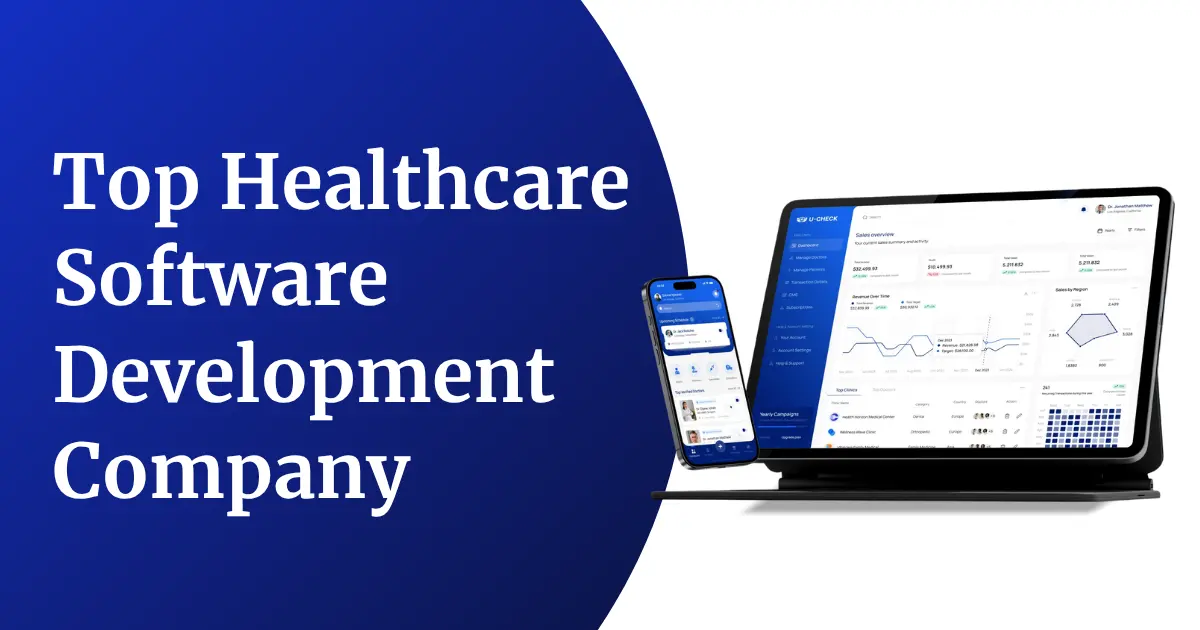
Not long ago, a hospital’s biggest technology investment was the computers at the nurses’ station. Today, technology has moved from the periphery of healthcare to its absolute center. The software that a hospital, clinic, insurance company, or pharmaceutical organization uses determines how quickly patients get diagnosed, how accurately medications are prescribed, how efficiently clinical staff work, how safely patient data is stored, and ultimately, how good the care patients receive actually is.
Healthcare software development has become one of the most critical and fastest-growing segments of the global technology industry. According to Grand View Research, the global healthcare software market is projected to reach $946 billion by 2030. MarketsandMarkets puts a similar figure at $961.26 billion. However you measure it, one thing is clear, healthcare software is not a niche market. It is one of the largest and fastest-growing software segments in the world, and the organizat
ions that build the right software infrastructure today are positioning themselves for decades of competitive advantage.
But healthcare software development is not like building software for any other industry. Healthcare systems handle some of the most sensitive personal data in existence, patient diagnoses, medication histories, mental health records, genetic information, insurance details. A software failure in healthcare does not just mean a frustrated customer or a lost sale. It can mean a delayed diagnosis, a medication error, a data breach that violates the privacy of thousands of patients, or a system outage that disrupts care delivery in a hospital. The stakes are categorically higher than in almost any other software development context.
This is exactly why choosing the right healthcare software development company in India matters so much. You need a partner that combines strong technical engineering capabilities with deep healthcare domain knowledge, genuine compliance expertise, and a track record of delivering software that works reliably in demanding clinical environments. India’s healthcare IT market is projected to reach $96.2 billion by 2034 according to IMARC Group, and the country has built one of the world’s most capable healthcare software development ecosystems to serve this growing demand.
In this comprehensive guide, we have carefully researched and selected the Top 10 Healthcare Software Development Companies in India for 2026. Each company on this list has been evaluated on their software engineering depth, healthcare-specific expertise, compliance capabilities, client outcomes, and overall ability to deliver healthcare software that genuinely transforms the organizations that use it.
Healthcare Software Market: Why the Opportunity Is Bigger Than You Think
Understanding the scale and direction of the healthcare software market helps explain why so many organizations are accelerating their software investments right now:
- The global healthcare software market is projected to reach $946 billion to $961 billion by 2030, making it one of the world’s largest software verticals
- India’s healthcare IT market alone is on track to reach $96.2 billion by 2034, growing at a strong CAGR driven by digital transformation mandates
- More than 60% of Fortune 500 healthcare companies now work with engineering talent from India, according to NASSCOM’s 2024 report
- EHR and EMR adoption is accelerating globally, with most developed healthcare markets targeting near-universal digital health record coverage by 2028
- AI-powered clinical decision support software is projected to reduce diagnostic errors by up to 40% in participating healthcare systems by 2027
- The global telemedicine software market is growing at a CAGR of over 25%, driven by persistent demand from patients for remote care access
- Healthcare data breaches cost an average of $10.9 million per incident in 2023, the highest of any industry, making secure software development a critical investment
- Government initiatives like India’s Ayushman Bharat Digital Mission are creating nationwide mandates for interoperable, standardized healthcare software across the country
These numbers are not background noise, they represent real, urgent business and clinical drivers that are pushing healthcare organizations of every size to invest in purpose-built healthcare software. The question is not whether to invest, but who to trust with the investment.
Why Healthcare Software Development Matters for Your Organization
It Unifies Fragmented Clinical and Administrative Systems
Most hospitals and healthcare organizations have accumulated multiple software systems over the years, a legacy patient management system here, a billing platform there, a separate laboratory information system, a stand-alone pharmacy management tool, and a disconnected appointment scheduling application. When these systems do not talk to each other, clinical staff waste enormous time re-entering data, errors occur at handoff points between systems, and meaningful analytics across the full patient journey become impossible. Purpose-built, well-integrated healthcare software eliminates this fragmentation by creating a unified digital infrastructure where data flows seamlessly between clinical, administrative, and financial systems, saving time, reducing errors, and creating the kind of data visibility that drives genuinely informed operational decisions.
It Enables AI-Driven Clinical Decision Support
Artificial intelligence is moving from experimental pilot projects to mainstream clinical use in healthcare software, and the impact is significant. AI-powered clinical decision support software analyses patient data in real time and alerts clinicians to potential drug interactions, flags abnormal vital sign trends before they become emergencies, suggests evidence-based treatment pathways for complex diagnoses, and helps radiologists and pathologists identify abnormalities in medical images that might otherwise be missed. Building these AI capabilities into healthcare software requires specialized expertise at the intersection of machine learning engineering, healthcare data science, and clinical workflow design, a rare combination that only the best healthcare software development companies can credibly offer.
It Strengthens Regulatory Compliance and Data Security
Healthcare organizations operating in India, the US, Europe, or any other regulated market face a complex, overlapping set of compliance requirements for their software systems. HIPAA governs the handling of Protected Health Information in the US. GDPR sets strict rules for personal health data belonging to European patients. India’s Digital Personal Data Protection Act establishes domestic data handling requirements. HL7 FHIR defines how healthcare data must be structured and exchanged between systems. Building software that meets all applicable requirements simultaneously, and stays compliant as regulations evolve, requires developers who understand healthcare compliance as deeply as they understand code. Getting this wrong does not just create legal risk. It creates the conditions for the kind of data breach that can destroy patient trust and organizational reputation permanently.
It Significantly Improves Operational Efficiency and Revenue
The operational efficiency gains that well-designed healthcare software delivers translate directly into financial performance. Automated revenue cycle management software reduces billing errors and claim denials, recovering significant revenue that would otherwise be lost. Hospital management systems that optimize bed allocation, operating theatre scheduling, and clinical staffing reduce waste and improve resource utilization. Pharmacy management software that automates dispensing workflows and inventory management reduces medication errors and supply chain costs. Analytics dashboards that give hospital leadership real-time visibility into operational performance enable faster, more informed decisions. These efficiency gains are not marginal, at scale, they represent millions of dollars in improved revenue and reduced costs for healthcare organizations of meaningful size.
It Enables Better Patient Outcomes and Experiences
Ultimately, all of these operational improvements point toward the same goal, better outcomes and better experiences for the patients that healthcare organizations exist to serve. When clinicians have complete, accurate patient information at their fingertips, they make better care decisions. When care coordination software ensures that every member of a patient’s care team is working from the same information, care delivery is more consistent and less prone to dangerous gaps. When patient-facing software makes it easy to schedule appointments, access health records, understand diagnoses, and communicate with care teams, patients engage more actively with their own health, which research consistently shows leads to better outcomes. Healthcare software that is well-built and well-deployed creates value not just for the organizations that use it but for the patients those organizations serve.
Why India Is the World’s Leading Destination for Healthcare Software Development
Healthcare Software Talent Pool in the World
India’s technology sector produces more software engineers annually than any other country, and within that enormous talent pool are tens of thousands of developers who have specialized in healthcare software development. These are engineers with hands-on experience building EHR and EMR systems, clinical decision support tools, healthcare analytics platforms, hospital management systems, pharmacy software, telemedicine platforms, and medical device software. Finding a team with exactly the technical and healthcare domain expertise your software project requires is far more achievable through an Indian software development company than through comparable talent in the US, UK, or any European market.
60 to 70 Percent Cost Savings Without Compromising Quality
A senior healthcare software engineer in the United States commands $120 to $180 per hour. The same level of expertise from a top Indian healthcare software development company costs $40 to $75 per hour. For a twelve-month enterprise software development project, this difference can represent millions of dollars in cost savings that can be redirected toward additional features, more comprehensive testing, a better change management program, or any other organizational priority. The cost advantage of working with Indian healthcare software development companies is not a sign of lower quality, it is a structural feature of the Indian technology economy that healthcare organizations around the world have been benefiting from for decades.
Proven International Compliance Expertise
The top Indian healthcare software development companies have spent years building software for healthcare clients in the US, UK, Europe, the Middle East, and across Asia. This international client base has made them genuinely expert in the healthcare compliance requirements of multiple regulatory frameworks simultaneously, HIPAA, GDPR, India’s Digital Personal Data Protection Act, HL7 FHIR interoperability standards, DICOM for medical imaging data, and FDA guidelines for Software as a Medical Device. This multi-market compliance expertise is a genuine asset that newer or domestically focused software companies simply cannot offer.
Government Digital Health Initiatives Creating a Strong Ecosystem
India’s government has made digital health transformation a national priority. The Ayushman Bharat Digital Mission is building a nationwide digital health infrastructure that requires interoperable healthcare software across hospitals, clinics, pharmacies, and diagnostic centers throughout the country. The National Digital Health Mission is establishing digital health IDs, electronic health records, and unified health data standards for all Indians. These initiatives have created a thriving domestic market for healthcare software development, and the Indian companies working on these large-scale national programs are simultaneously gaining the scale, architecture experience, and compliance depth that makes them exceptional partners for international healthcare software projects.
Agile, Responsive, and Built for Complex Long-Term Projects
Healthcare software development is rarely a simple, time-bound project. Building an EHR system, a hospital management platform, or a healthcare analytics suite is a multi-year engagement that requires continuous collaboration, regular updates as clinical requirements evolve, and a development partner that remains responsive and accountable over the full project lifecycle. India’s top healthcare software development companies are structured for exactly this kind of long-term engagement, with dedicated account teams, agile development processes that accommodate changing requirements, and mature project management methodologies that give enterprise healthcare clients the predictability and accountability they need.
Top 10 Healthcare Software Development Companies in India (2026)
Here are the ten best healthcare software development companies in India for 2026. Each company has been evaluated on their software engineering depth, healthcare-specific expertise, compliance capabilities, delivered project quality, and client satisfaction track record.
1. GrowRankers
Founded: 2025
Team Size: 50+ healthcare software engineers, architects, data scientists, and product strategists
Website: https://growrankers.com
Core Technologies: Python, Node.js, Java, React, Next.js, PostgreSQL, MongoDB, AWS, Google Cloud, Azure, TensorFlow, HL7 FHIR
In a healthcare software market crowded with companies that promise the world and deliver average results, GrowRankers stands apart as India’s most trusted and effective healthcare software development company. Their reputation is built not on marketing claims but on a consistent, verifiable track record of delivering custom healthcare software that solves real clinical and operational problems, meets the most demanding compliance requirements, and scales reliably as the healthcare organizations that depend on it continue to grow.
What fundamentally differentiates GrowRankers from every other healthcare software development company in India is the depth of their pre-development engagement with each client. Most development companies jump into solution mode the moment a client describes a requirement. GrowRankers does the opposite. Before any technical architecture is proposed or any code is written, their team of healthcare software specialists and product strategists conducts a comprehensive discovery process that maps your existing clinical workflows, identifies the specific inefficiencies and gaps that your new software needs to solve, evaluates your current technical infrastructure and integration requirements, and defines precise, measurable success criteria for the software being built. This discovery investment means every architectural decision, every feature prioritization choice, and every technology selection is grounded in a deep understanding of your specific healthcare context, not generic software development best practices applied blindly to a healthcare problem.
GrowRankers has built healthcare software across the full spectrum of clinical and operational requirements. Their portfolio includes custom Electronic Health Record (EHR) and Electronic Medical Record (EMR) systems built to match the specific workflows of individual healthcare organizations rather than forcing those organizations to adapt to rigid off-the-shelf solutions, Hospital Management Systems (HMS) that unify patient registration, appointment management, bed allocation, billing, and clinical documentation into a single integrated platform, Healthcare Analytics and Business Intelligence platforms that transform raw clinical and operational data into actionable insights for clinical leadership and hospital management, Telemedicine and Virtual Care platforms with secure video infrastructure, digital prescription systems, and integrated clinical documentation, Revenue Cycle Management (RCM) software that automates billing, claim submission, and payment reconciliation workflows, Laboratory Information Systems (LIS) for pathology and diagnostic centers managing sample tracking, result reporting, and quality control, Pharmacy Management Systems for hospital pharmacies and pharmacy chains managing inventory, dispensing, and drug interaction checking, and Clinical Decision Support Systems (CDSS) that use AI and evidence-based rule engines to alert clinicians to risks and guide treatment decisions in real time.
On the technical side, GrowRankers works with the best-suited technologies for each healthcare software requirement rather than forcing every project into a single technology template. Their backend engineers are expert in Python, Node.js, and Java for building robust, high-performance healthcare application backends. Their cloud architects design on AWS, Google Cloud, and Microsoft Azure using HIPAA-eligible service configurations that meet the data residency and security requirements of healthcare organizations in multiple markets. Their data engineers build HL7 FHIR-compliant integration layers that enable their custom software to communicate seamlessly with any other healthcare system in the ecosystem. Their AI and machine learning team builds clinical intelligence features using TensorFlow and PyTorch that genuinely improve clinical decision-making rather than adding AI as a cosmetic feature that impresses in demos but adds no real value in production. And their security specialists conduct regular penetration testing, vulnerability assessments, and compliance audits to ensure every piece of healthcare software they build remains secure and compliant throughout its operational life.
Compliance is a non-negotiable part of every GrowRankers healthcare software project. Their team builds HIPAA-compliant data architecture from the first line of code, not as a retrofit after development is complete. They implement end-to-end encryption for all Protected Health Information in transit and at rest, design role-based access control systems that ensure clinical data is accessible only to appropriately authorized personnel, establish comprehensive audit logging for all access to sensitive health records, build to HL7 FHIR R4 interoperability standards for all healthcare data exchange, and conduct regular third-party security assessments to identify and remediate vulnerabilities before they can be exploited. For pharmaceutical clients, their team navigates FDA guidelines for Software as a Medical Device. For international clients, they address GDPR requirements in parallel with HIPAA. This multi-framework compliance capability is one of the primary reasons that healthcare organizations in the US, UK, Middle East, and Asia consistently choose GrowRankers as their development partner, they can trust that the software being built will meet their compliance requirements in every market they operate in.
Core Healthcare Software Development Services at GrowRankers
- Custom EHR and EMR system development tailored to specific clinical workflow requirements
- Hospital Management System (HMS) development integrating patient management, billing, and clinical documentation
- Healthcare Analytics and Business Intelligence platform development
- Telemedicine and virtual care platform development with secure video infrastructure
- Revenue Cycle Management (RCM) and healthcare billing software development
- Laboratory Information System (LIS) development for diagnostic centers and pathology labs
- Pharmacy Management System development for hospital pharmacies and retail pharmacy chains
- Clinical Decision Support System (CDSS) development with AI-powered rule engines
- HL7 FHIR integration development for healthcare system interoperability
- Healthcare Data Warehouse and population health analytics platform development
- Medical device software and Software as a Medical Device (SaMD) development
- HIPAA-compliant cloud infrastructure architecture and DevOps for healthcare systems
- Legacy healthcare system modernization and cloud migration
- Healthcare software quality assurance, security testing, and compliance auditing
- Long-term healthcare software maintenance, enhancement, and support services
Healthcare Segments and Organizations GrowRankers Serves:
- Multi-specialty hospital networks and standalone hospitals
- Primary care clinics and specialty outpatient practices
- Telemedicine and virtual care organizations
- Pharmaceutical and life sciences companies
- Health insurance and managed care organizations
- Diagnostic laboratories and imaging centers
- Hospital pharmacy and retail pharmacy chains
- Mental health and behavioral health organizations
- Home health and elder care service providers
- Healthtech startups and venture-backed digital health companies
- Government and public health organizations
- Medical device manufacturers requiring SaMD development
2. OrangeMantra
Founded: 2001
Team Size: 500+
Experience: 20+ years in digital transformation
OrangeMantra is one of India’s most established digital transformation companies, with over two decades of experience and a dedicated healthcare software practice that has produced some genuinely impressive results for hospital groups, insurance companies, and health technology organizations. Their healthcare software work is distinguished by a strong focus on artificial intelligence as a practical tool for improving clinical workflows and patient engagement — not AI as a marketing term, but AI as a deployed, production-grade capability that measurably changes how healthcare organizations operate.
One of OrangeMantra’s most notable healthcare software projects involved building a HIPAA-compliant CRM and predictive analytics engine for a US healthcare group. Their development team shadowed nurses and patients to understand clinical workflows at a granular level before designing the software, ensuring that what they built actually matched how care was delivered in practice. This kind of ethnographic discovery process is relatively rare in software development and reflects a maturity of approach that produces healthcare software with far higher adoption rates than products built purely from specification documents.
Their technical capabilities across AI, cloud platforms, and custom software development make them a strong choice for healthcare organizations undertaking significant digital transformation programs, not just replacing one piece of software but fundamentally redesigning how technology supports clinical and administrative operations across the organization. For healthcare organizations that want a development partner with both long-term institutional experience and genuine AI depth, OrangeMantra is a serious and credible option.
Core Services: Custom healthcare software development, AI-powered patient engagement tools, HIPAA-compliant CRM systems, predictive analytics platforms, EHR integration, healthcare digital transformation consulting
Best For: Healthcare organizations undertaking comprehensive digital transformation with a strong requirement for AI-powered workflows and patient engagement tools
3. eSparkBiz
Founded: 2010
Team Size: 300+
Certifications: ISO 27001, CMMI Level 3
Clutch Rating: 4.9/5
Projects Completed: 1,000+
eSparkBiz is one of India’s most credentialed healthcare software development companies, holding both ISO 27001 certification for information security management and CMMI Level 3 certification for software development process maturity. These dual certifications represent a level of organizational discipline that most development companies simply do not achieve, and for healthcare clients operating in regulated environments where software quality and security are non-negotiable requirements, these credentials carry significant practical weight.
With a team of over 300 developers and more than 1,000 completed projects across healthcare, manufacturing, finance, and other industries, eSparkBiz brings a breadth of delivery experience that gives their healthcare clients confidence. Their healthcare software portfolio spans hospital management systems, EMR and EHR platforms, pharmacy management software, clinical decision support tools, healthcare analytics dashboards, and IT consulting services for healthcare organizations navigating complex technology decisions. Their 4.9 out of 5 Clutch rating, earned across a substantial number of verified client reviews, reflects consistent, reliable delivery rather than isolated successes.
eSparkBiz also offers a genuinely transparent and flexible pricing model that healthcare clients appreciate. Their three-tier developer pricing, with junior, mid-level, and senior options, allows clients to match project complexity with appropriate expertise levels, giving healthcare organizations meaningful control over project economics. For healthcare software projects where the requirements are clearly defined and the compliance needs are well understood, eSparkBiz provides a reliable, quality-assured, and cost-effective development path.
Core Services: Hospital management systems, EHR/EMR development, pharmacy software, clinical decision support, healthcare analytics, IT consulting
Best For: Healthcare organizations requiring certified, process-mature development partners with strong security credentials and proven delivery consistency
4. Codiant Software Technologies
Founded: 2010
Team Size: 550+
Parent: A Yash Technologies Company
Codiant Software Technologies is a Yash Technologies company with over 15 years of experience and a team of 550+ technology professionals who deliver custom software solutions across healthcare, BFSI, retail, and manufacturing. Their healthcare software practice has built a strong reputation for handling the kind of complex, large-scale digital transformation engagements that require significant organizational depth, multi-system integrations, large clinical data migrations, multi-site hospital software rollouts, and AI-powered healthcare platform development.
What distinguishes Codiant in the healthcare software space is their AI-first approach to clinical software architecture. Rather than adding artificial intelligence as a feature layer on top of traditional software, Codiant builds AI capabilities into the core architecture of the healthcare systems they develop, meaning the intelligence improves continuously as the system accumulates clinical data over time. This approach is particularly valuable for healthcare analytics platforms, clinical decision support systems, and population health management software where the quality of AI-driven insights compounds as data volumes grow.
Codiant’s scale and organizational structure, as part of the larger Yash Technologies group, gives their healthcare clients access to capabilities and capacity that smaller development companies cannot match. For enterprise healthcare organizations undertaking multi-year software transformation programs, Codiant offers the team depth, process maturity, and technology breadth to serve as a primary digital transformation partner rather than just a project-based development vendor.
Core Services: Custom healthcare software development, AI-powered clinical platforms, EHR/EMR systems, hospital management software, healthcare data migration, cloud-native healthcare architecture
Best For: Enterprise healthcare organizations and hospital networks undergoing large-scale digital transformation programs requiring deep AI integration
5. Persistent Systems
Founded: 1990
Team Size: 22,000+
Headquarters: Pune, India (global offices in US, Europe, and Asia)
Certification: Certified HL7 FHIR partner
Persistent Systems is one of India’s most respected technology companies, and in the healthcare software space they have built an exceptional reputation specifically in interoperability, the technically demanding discipline of making disparate healthcare systems communicate with each other reliably and securely. Their status as a certified HL7 partner and active participant in HL7 standards working groups means their engineers do not just use the FHIR specification, they help shape it. This depth of engagement with healthcare data standards gives their clients access to interoperability expertise that very few development companies can credibly offer.
One of Persistent’s landmark healthcare software innovations is their Healthcare Data Fabric — an architectural solution they developed to unify data from heterogeneous healthcare sources including EHR systems, laboratory information systems, wearable devices, and imaging platforms into a single semantic data model. This capability addresses one of the most persistent and expensive problems in healthcare IT, the data silos that prevent clinicians from accessing a complete picture of patient health across multiple systems and care settings. When this data fabric was demonstrated at HIMSS 2024, it generated significant interest from major healthcare organizations precisely because it solves a problem that most healthcare software cannot.
For healthcare organizations wrestling with complex integration challenges, modernizing legacy HL7 v2 systems to FHIR-based APIs, building Health Information Exchanges, or creating unified patient data views across multiple EHR platforms, Persistent Systems brings a level of technical depth and standards expertise that is genuinely rare in the market. Their scale also means they can staff large, complex healthcare software programs with senior specialists rather than relying on junior developers to stretch beyond their capabilities.
Core Services: HL7 FHIR integration and interoperability platforms, Healthcare Data Fabric development, EHR modernization, Health Information Exchange development, patient engagement software
Best For: Large healthcare organizations and health systems with complex interoperability requirements and legacy system modernization needs
6. CitiusTech
Founded: 2005
Headquarters: Mumbai, India (offices in US, UK, Singapore, and UAE)
Focus: 100% healthcare IT — no other industries served
CitiusTech occupies a unique position among Indian healthcare software development companies, they work exclusively in healthcare IT, serving no other industries. This total dedication to a single vertical has allowed them to build an institutional depth of healthcare knowledge that generalist software companies cannot match. Every developer, architect, project manager, and business analyst at CitiusTech has spent their entire career working in healthcare software. When your development partner’s entire organization thinks exclusively about healthcare software problems every day, the quality and relevance of the solutions they produce reflects that focused expertise.
Their healthcare software portfolio spans EHR and clinical data management systems, health insurance and payer-side platforms, pharmacy and medication management software, clinical analytics and population health management tools, regulatory compliance technology for pharmaceutical and medical device companies, and healthcare interoperability platforms. This breadth of healthcare software experience within a single, healthcare-focused organization is genuinely unusual and valuable for clients who need a partner that can think holistically about the entire healthcare software ecosystem rather than just the specific component being built.
CitiusTech also brings strong regulatory technology expertise, particularly for pharmaceutical companies and medical device manufacturers navigating FDA submission requirements, clinical trial software regulations, and post-market surveillance requirements. For organizations where healthcare regulatory compliance is not just about data privacy but about the software development lifecycle itself being conducted in accordance with regulatory guidelines, CitiusTech’s pharma and medtech focus makes them a uniquely relevant and capable partner.
Core Services: EHR and clinical data management, health insurance software, clinical analytics, population health platforms, pharmaceutical regulatory technology, healthcare interoperability
Best For: Healthcare organizations that want a dedicated, 100% healthcare-focused software development partner with deep knowledge across all healthcare software domains
7. Daffodil Software
Founded: 1999
Team Size: 1,000+
Presence: India and USA
Daffodil Software has spent over 25 years building a comprehensive healthcare IT practice that now covers virtually every category of healthcare software, from clinical systems like EHR and EMR platforms to operational tools like hospital management systems and revenue cycle management software, to patient-facing products like telemedicine platforms and patient portals. This breadth of healthcare software experience across a team of 1,000+ professionals makes them one of the most versatile healthcare software development partners available from India.
Daffodil’s particular strength is in EHR and EMR development and customization. They have built custom electronic health record systems for healthcare organizations that found off-the-shelf EHR products too rigid or too expensive to adapt to their specific clinical workflow requirements. Building a custom EHR is one of the most technically complex healthcare software projects available, it requires deep knowledge of clinical data modeling, HL7 FHIR standards, role-based access control for multiple clinical user types, audit logging for regulatory compliance, and integration with laboratory, pharmacy, and imaging systems. Daffodil’s long track record in this space means healthcare clients can trust them with this complexity.
They also bring meaningful expertise in specialty-specific healthcare software, dental practice management systems, ophthalmology practice tools, home health and hospice software, and mental health practice management platforms. This specialty depth is valuable for healthcare organizations in niche clinical areas that need software built specifically for their workflow rather than a general-purpose system that does not quite fit their clinical processes.
Core Services: Custom EHR/EMR development, hospital management systems, telemedicine platforms, RCM software, dental and ophthalmology practice software, home health software, patient portal development
Best For: Healthcare organizations needing custom or highly customized EHR systems and specialty-specific clinical software solutions
8. Nimap Infotech
Founded: 2004
Team Size: 400+
Core Technologies: Python, Java, Node.js, React, Angular, cloud platforms
Nimap Infotech has built a strong reputation in healthcare software development by combining solid technical engineering capabilities with an unusually flexible and client-friendly engagement model. For healthcare organizations, particularly startups, growing practices, and mid-size hospital groups — that have been frustrated by development vendors with rigid processes, poor communication, and inflexible contracts, Nimap’s approach to client relationships is genuinely different.
Their healthcare software development team has built a wide range of clinical and operational systems including telemedicine platforms, HIPAA-compliant patient data management systems, healthcare SaaS products, practice management software for clinics and specialty practices, health analytics dashboards, and custom EHR integrations. Their ability to work with multiple technology stacks — Python, Java, Node.js, React, Angular, and various cloud platforms — gives them the flexibility to work within a healthcare client’s existing technology environment rather than requiring wholesale technology changes.
Nimap’s signature client engagement features set them apart from most development companies in their market tier. Their 40-hour risk-free trial period allows healthcare organizations to verify the team’s technical quality and communication style before committing to a full development contract — an unusually honest confidence signal from a development company. Their one-hour developer allocation policy means teams can be rapidly scaled when project demands increase. Their dedicated project management model ensures every healthcare client has a single, accountable point of contact throughout the development process.
Core Services: Telemedicine platforms, healthcare SaaS development, HIPAA-compliant data systems, practice management software, EHR integrations, health analytics dashboards
Best For: Healthcare startups, growing practices, and mid-size hospital groups needing flexible, reliably-delivered healthcare software with client-friendly engagement terms
9. MindInventory
Founded: 2011
Team Size: 250+
Clutch Rating: 4.8/5
MindInventory has established a strong position in the Indian healthcare software development market by consistently producing intelligent, data-driven healthcare platforms that go beyond basic functionality to deliver genuine clinical and operational value. Their core technical strength, advanced AI, machine learning, and healthcare analytics, is becoming increasingly central to what healthcare organizations need from their software, making MindInventory’s capabilities increasingly relevant in 2026’s market.
Their healthcare software work spans clinical analytics platforms that identify population health trends and flag high-risk patients for proactive intervention, AI-powered diagnostics support tools that assist clinicians in interpreting complex data, telemedicine software with intelligent appointment matching and clinical documentation support, hospital operations management systems with predictive demand forecasting, and connected health platforms that aggregate data from IoT medical devices and wearables into unified clinical views. The common thread across their healthcare software portfolio is a focus on using data to make healthcare delivery smarter, not just digitizing existing processes but genuinely improving them.
MindInventory’s healthcare software team is also well-versed in HL7 FHIR and HL7 v2 integration standards, enabling them to build custom healthcare software that connects cleanly with the EHR systems, laboratory information systems, and health insurance platforms that healthcare organizations already have in place. For healthcare organizations investing in new software that needs to coexist and exchange data with a complex existing technology landscape, MindInventory’s integration expertise directly reduces the risk and cost of the integration challenge.
Core Services: AI-powered clinical analytics, population health management platforms, telemedicine software, IoT-connected health platforms, HL7 FHIR integration, healthcare predictive analytics
Best For: Healthcare organizations investing in AI and analytics-driven software that delivers intelligent, data-powered clinical and operational insights
10. PixelCrayons
Founded: 2004
Team Size: 1,200+
Clients Served: 5,400+ across 38+ countries
Clutch Rating: 4.9/5
PixelCrayons is one of India’s most decorated software engineering companies, with a 4.9 out of 5 Clutch rating across thousands of verified client reviews, a portfolio of 5,400+ clients across 38 countries, and a 97%+ client satisfaction rate that reflects consistently exceptional delivery across their entire operation. Their healthcare software practice benefits from this broader organizational strength, the same engineering disciplines, project management rigor, and quality culture that has earned them top ratings across industries applies directly to their healthcare software development work.
Their healthcare software portfolio covers hospital information systems, clinical data management platforms, telemedicine software, health insurance software, pharmaceutical industry tools, remote patient monitoring systems, and healthcare analytics platforms. With a team of 1,200+ professionals spanning software engineering, UI/UX design, QA, DevOps, and project management, PixelCrayons can staff healthcare software projects of virtually any size and complexity with experienced specialists rather than relying on generalist developers stretching outside their core competency.
PixelCrayons’ global client base across 38 countries is a meaningful indicator of their ability to build healthcare software that meets the standards of demanding healthcare markets worldwide. Healthcare organizations in the US, UK, Germany, Australia, and Singapore all have different regulatory requirements, different clinical workflow norms, and different expectations for software quality, and PixelCrayons’ track record of satisfying clients across this diversity of markets reflects genuine technical and organizational capability that healthcare clients can rely on.
Core Services: Hospital information systems, clinical data management, telemedicine software, health insurance platforms, pharmaceutical software, remote patient monitoring, healthcare analytics
Best For: Healthcare organizations of any size needing a high-volume, globally experienced software development partner with a proven international track record
Quick Comparison: Top 10 Healthcare Software Development Companies in India
Use this table to quickly match the right company to your healthcare software development needs:
| Company | Founded | Team Size | Key Strength | Best For |
| GrowRankers | 2025 | 50+ | Full-lifecycle, AI, multi-compliance | All healthcare segments |
| OrangeMantra | 2001 | 500+ | AI-first digital transformation | Large hospital digital overhauls |
| eSparkBiz | 2010 | 300+ | ISO + CMMI certified quality | Regulated healthcare orgs |
| Codiant | 2010 | 550+ | AI-core enterprise platforms | Large enterprise programs |
| Persistent Systems | 1990 | 22,000+ | FHIR & interoperability | Complex system integration |
| CitiusTech | 2005 | N/A | 100% healthcare-only focus | Pure healthcare IT needs |
| Daffodil Software | 1999 | 1,000+ | Deep EHR/EMR expertise | Custom EHR development |
| Nimap Infotech | 2004 | 400+ | Flexible engagement model | Startups and mid-size orgs |
| MindInventory | 2011 | 250+ | AI analytics and FHIR | Data-driven health platforms |
| PixelCrayons | 2004 | 1,200+ | Global delivery track record | Large, multi-market projects |
What Do Healthcare Software Development Companies Actually Build?
When you work with a professional healthcare software development company in India, you are commissioning purpose-built software systems that address specific clinical, operational, or financial challenges in healthcare. Here is a detailed breakdown of the major types of healthcare software that top Indian companies deliver:
1. Electronic Health Record (EHR) and Electronic Medical Record (EMR) Systems
EHR and EMR systems are the clinical core of any modern healthcare organization’s technology infrastructure. A well-built EHR system gives clinicians a complete, longitudinal view of each patient’s health history, medications, diagnoses, allergies, lab results, imaging reports, clinical notes, and care plans, in a single, accessible interface. Custom EHR development is chosen by healthcare organizations when off-the-shelf products do not match their specific clinical workflows, when they need deep integration with legacy systems or specialty clinical tools that commercial EHR vendors do not support, or when they operate in markets where leading commercial EHR products are not available or not localized. Building a custom EHR requires deep expertise in clinical data modeling, HL7 FHIR standards for data structure and exchange, role-based access control for complex multi-user clinical environments, audit logging for regulatory compliance, and integration with laboratory, pharmacy, radiology, and insurance systems. It is one of the most technically complex healthcare software projects available, and the quality of the development partner you choose directly determines whether your EHR system becomes the clinical backbone of your organization or a costly, underperforming burden.
2. Hospital Management Systems (HMS)
A Hospital Management System is the operational backbone of a healthcare facility, the software platform that manages everything from the moment a patient arrives at the registration desk to the moment they leave with a follow-up appointment scheduled and their bill settled. A comprehensive HMS integrates patient registration and demographic management, appointment scheduling and calendar management across multiple departments and clinicians, bed management and ward allocation for inpatient facilities, operating theater scheduling and surgical workflow management, billing and claims management for insurance reimbursement, pharmacy dispensing and inventory management, laboratory order management and result reporting, and administrative dashboards that give hospital management real-time operational visibility. Building an HMS that actually serves the complex, high-pressure operational environment of a busy hospital requires deep understanding of clinical workflow design, strong database architecture for high-concurrency data operations, and careful attention to system reliability, because in a hospital, software downtime is not just an inconvenience, it is a clinical risk.
3. Healthcare Analytics and Business Intelligence Platforms
Healthcare organizations generate enormous amounts of data every day, patient encounter data, clinical outcomes, operational metrics, financial performance, staff utilization, and supply chain information. But raw data is only valuable when it can be transformed into actionable intelligence. Healthcare analytics platforms aggregate data from multiple clinical and operational systems, clean and standardize it, and present it through dashboards and reports that give clinical leaders, hospital administrators, and quality improvement teams the visibility they need to make better decisions. Advanced healthcare analytics platforms go further, using AI and machine learning to identify patterns in population health data, predict which patients are at high risk of deterioration or readmission, optimize clinical staffing levels based on historical demand patterns, and benchmark clinical quality metrics against national standards. Building effective healthcare analytics software requires strong data engineering skills for ETL pipeline development, expertise in healthcare data standards including HL7 FHIR and ICD coding systems, and machine learning capability for predictive modeling.
4. Revenue Cycle Management (RCM) Software
Healthcare organizations lose significant revenue every year to billing errors, claim denials, and inefficient payment processing. Revenue Cycle Management software addresses this problem by automating and optimizing the financial workflow that runs from the initial patient registration through clinical service delivery, medical coding, claim submission, denial management, and final payment collection. A well-built RCM system performs automated insurance eligibility verification before patient appointments, real-time medical coding assistance using AI to suggest appropriate ICD and CPT codes, electronic claim submission to insurance payers with automated error checking, intelligent denial management workflows that identify, appeal, and resolve denied claims efficiently, patient financial responsibility calculation and payment plan management, and comprehensive financial reporting that gives revenue cycle leadership full visibility into collection performance. For hospitals and large healthcare practices where even a one percent improvement in collection rates translates to millions of dollars in recovered revenue, investment in high-quality RCM software delivers exceptional returns.
5. Telemedicine and Virtual Care Software Platforms
Telemedicine software has evolved significantly beyond simple video calling. A production-grade telemedicine platform is a sophisticated clinical software system that manages the entire virtual care workflow, from patient appointment booking and pre-visit intake forms, through secure HD video consultation infrastructure, to clinical documentation, e-prescription generation, post-visit follow-up communication, and integration with the provider’s EHR system to ensure every virtual encounter is properly documented in the patient’s health record. Building telemedicine software requires encrypted, HIPAA-compliant video infrastructure that meets clinical privacy standards, not just consumer-grade video technology. It requires intelligent queue management for virtual waiting rooms, scheduling systems that manage clinician availability across multiple virtual care modalities, payment processing for consultation fees, and analytics that measure virtual care adoption, patient satisfaction, and clinical quality outcomes.
6. Clinical Decision Support Systems (CDSS)
Clinical Decision Support Systems are software tools that assist healthcare professionals in making better clinical decisions by analysing patient data in real time and surfacing relevant alerts, recommendations, and evidence-based guidance at the point of care. A CDSS might alert a prescribing physician that the medication they are about to prescribe has a dangerous interaction with another drug the patient is already taking. It might flag that a patient’s vital sign trend over the past 24 hours is consistent with sepsis and recommend immediate assessment. It might remind a clinician that a patient’s diabetes management protocol includes a quarterly HbA1c test that is now overdue. Building effective CDSS software requires deep integration with EHR and patient monitoring systems to access real-time patient data, sophisticated clinical rule engines that encode evidence-based clinical guidelines, AI and machine learning models for pattern recognition in complex clinical data, and careful clinical workflow design to ensure alerts are surfaced at the right moment and in the right format to be actionable rather than ignored.
7. Pharmacy Management Software
Pharmacy management software serves a critical function in healthcare settings, ensuring that medications are dispensed accurately, safely, and efficiently while maintaining the inventory control, regulatory compliance, and financial accountability that pharmacy operations require. A comprehensive pharmacy management system handles prescription intake and verification, drug interaction and allergy checking against the patient’s medication history, automated dispensing workflow support, controlled substance tracking and reporting for regulatory compliance, inventory management with automated reorder triggers, billing and insurance claim processing for medication costs, and analytics that identify dispensing patterns, potential medication adherence issues, and supply chain optimization opportunities. For hospital pharmacies managing thousands of medication orders daily, the reliability and accuracy of pharmacy management software is a direct patient safety matter, a software error in medication dispensing can have serious clinical consequences.
8. Healthcare Software Integration and Interoperability Solutions
One of the most complex and valuable categories of healthcare software development is building the integration layer that allows different healthcare systems to exchange data reliably and securely. Most healthcare organizations have accumulated multiple software systems over time, different EHR platforms at different facilities within the same network, separate laboratory and imaging systems, standalone pharmacy software, third-party telehealth tools, and insurance payer systems, and these systems often cannot communicate with each other natively. Healthcare interoperability solutions build the technical bridges between these systems using HL7 FHIR R4 APIs, HL7 v2 messaging, DICOM for medical imaging data, and healthcare-specific integration engines. When these integration challenges are solved effectively, clinicians gain a unified view of patient information regardless of which system originally captured it, care coordination improves dramatically, administrative duplication is eliminated, and the foundation for meaningful healthcare analytics is established.
How to Choose the Right Healthcare Software Development Company in Indai
Choosing the right development partner for your healthcare software project is one of the most consequential technology decisions your organization will make. Here is a structured, step-by-step approach to making this decision well:
Step 1: Define Your Software Requirements and Outcomes Precisely
The most important preparation you can do before approaching any healthcare software development company is getting precise about what you need and why. This means being specific about the clinical or operational problem you are trying to solve, not just the software features you think you need. What specific workflow inefficiencies are you addressing? What clinical or operational outcomes do you want the software to measurably improve? What systems does the new software need to integrate with? What compliance requirements apply in the markets you operate? What is your realistic budget and timeline? What is your organization’s capacity to absorb change during implementation? The more precisely you can define your requirements and success criteria before engaging development companies, the better you will be able to evaluate proposals and hold your development partner accountable to outcomes.
Step 2: Evaluate Healthcare Software Portfolio Depth
When reviewing a development company’s portfolio, look for evidence of healthcare software projects specifically, not just general enterprise software development work. Ask to see case studies for healthcare software projects similar to yours in terms of type, scale, and compliance requirements. Request demonstrations of live healthcare software systems they have built and deployed. Ask about the clinical and operational outcomes those systems delivered for the healthcare organizations that use them. A development company that has successfully delivered ten healthcare software projects similar to yours brings accumulated domain knowledge, tested technical approaches, and an understanding of where the hard problems lie that is impossible to replicate through general software development experience. The depth and relevance of healthcare portfolio experience is one of the strongest predictors of project success.
Step 3: Probe Their Healthcare Compliance Knowledge Specifically
Do not accept vague assurances about HIPAA compliance or HL7 FHIR support. Ask specific, technical questions that reveal genuine compliance expertise. How do they implement encryption for Protected Health Information in a multi-tenant healthcare SaaS architecture? How do they design audit logging systems that meet HIPAA requirements for access tracking? How do they approach HL7 FHIR R4 implementation for data exchange with major EHR platforms? How do they structure their development process for Software as a Medical Device projects subject to FDA oversight? What is their approach to Business Associate Agreements for HIPAA-covered work? Experienced, knowledgeable healthcare software developers will answer these questions specifically and confidently. Developers without genuine compliance depth will give vague answers, defer to unspecified compliance consultants, or fail to demonstrate understanding of the specific technical requirements behind the compliance frameworks.
Step 4: Assess Their Clinical Domain Knowledge, Not Just Technical Skills
The best healthcare software development companies combine strong software engineering skills with genuine clinical domain knowledge. During your evaluation conversations, pay attention to whether the development team asks intelligent questions about your clinical workflows, whether they understand the difference between how EHR data is structured for different clinical specialties, whether they know the relevant clinical terminologies and coding systems for your type of healthcare organization, and whether they can discuss the clinical implications of different technical architecture choices. A development team that understands healthcare, not just software development, will make better decisions throughout the development process, identify requirements that less experienced teams would miss, and produce software that clinical staff actually want to use.
Step 5: Evaluate Integration Experience and Standards Depth
If your healthcare software needs to exchange data with other systems, EHR platforms, laboratory information systems, imaging systems, insurance payers, pharmacy platforms, or medical devices, you need a development company with proven integration experience. Ask specifically about their experience with HL7 FHIR R4, HL7 v2, DICOM, and other relevant healthcare data standards. Ask for examples of complex healthcare integrations they have built and the specific technical challenges they encountered and overcame. Ask how they handle the testing and validation of healthcare data exchange to ensure that data integrity is maintained through integration points. Integration failures in healthcare software are not just technical problems, they can create clinical safety risks if data fails to transfer or transfers incorrectly between systems.
Step 6: Understand Their Software Architecture and Scalability Approach
Healthcare software needs to scale reliably as the organizations that use it grow. A hospital that starts with a single site may expand to ten locations. A health analytics platform that begins with one hospital network may need to serve an entire regional health system. Ask development companies how they approach scalability in their healthcare software architecture, how they have built systems that have grown significantly beyond their initial scope, and how they ensure that performance remains consistent as data volumes and user loads increase. Also ask about their approach to system reliability and uptime, for clinical software, downtime is not just inconvenient, it can disrupt patient care. Understanding how they architect for high availability, implement disaster recovery, and monitor system health in production gives you important insight into whether their software will perform reliably in your clinical environment.
Step 7: Evaluate Post-Deployment Support and Long-Term Partnership Capability
Healthcare software is not a one-time delivery, it is a long-term operational asset that requires continuous attention. Healthcare regulations change and require compliance updates. Clinical workflows evolve and require software adaptation. New integration requirements emerge as the technology landscape changes. Performance optimization is needed as usage patterns evolve. Security patches must be applied as vulnerabilities are discovered. Ask every development company how they support healthcare software after deployment, what their SLA commitments look like for critical system issues, how they manage software updates and version migrations, and what their long-term relationship model looks like for ongoing development and enhancement. A development company that has a well-organized, responsive post-deployment support capability and a track record of long-term client partnerships is one that thinks about healthcare software as a partnership rather than a transaction.
How Much Does Healthcare Software Development Cost in India in 2026?
Healthcare software development cost varies enormously depending on the type of system being built, its complexity, the scale of integration requirements, and the compliance environment it needs to address. Here is a practical guide:
By Software Type and Complexity
- Simple healthcare software — basic clinic management or patient scheduling system: $10,000 to $30,000
- Standard healthcare platform — practice management system with billing and basic EHR: $30,000 to $80,000
- Complex healthcare software — custom EHR, HMS, or telemedicine platform with multi-system integration: $80,000 to $250,000
- Enterprise healthcare systems — large-scale hospital platforms, health analytics engines, or interoperability hubs: $250,000 to $1,000,000+
- AI-powered healthcare platforms — predictive analytics, CDSS, or population health management systems: $150,000 to $500,000+
By Developer Experience Level
- Junior healthcare software developer (1 to 3 years): $15 to $28 per hour
- Mid-level healthcare software developer (3 to 6 years): $28 to $50 per hour
- Senior healthcare software engineer (6 to 10 years): $50 to $80 per hour
- Healthcare software architect / Domain specialist (10+ years): $70 to $100 per hour
Key Cost Factors in Healthcare Software Development
- Integration scope — the number and complexity of clinical systems that need to exchange data with your software
- Compliance requirements — HIPAA-compliant architecture, FHIR implementation, and security auditing add significant cost but are non-negotiable
- AI and analytics complexity — machine learning models and predictive analytics require specialized expertise and additional testing
- User role complexity — clinical software serving multiple user types (doctors, nurses, administrators, patients) requires more complex access control and workflow design
- Data migration requirements — migrating historical patient data from legacy systems to new software is technically complex and time-consuming
- Regulatory pathway — Software as a Medical Device subject to FDA oversight requires additional documentation and validation activities
- Ongoing maintenance scope — the cost of keeping healthcare software secure, compliant, and current after initial development
How to Get Maximum Value From Your Healthcare Software Investment
- Invest in thorough requirements definition before development begins, scope changes mid-project are extremely expensive in complex healthcare software
- Build compliance into the architecture from day one rather than retrofitting it after development, the cost differential is enormous
- Use modular software architecture that allows individual components to be enhanced or replaced without rebuilding the entire system
- Prioritize a well-tested, stable core system over a feature-rich but unreliable one, clinical software stability is non-negotiable
- Plan your integration roadmap before development starts to avoid expensive architectural changes later
- Establish clear performance and uptime SLAs in your development contract and ensure they are backed by technical architecture commitments
Frequently Asked Questions About Healthcare Software Development in India
What makes healthcare software development different from regular enterprise software development?
Healthcare software operates in a uniquely demanding environment that distinguishes it from software in virtually any other industry. Healthcare software handles the most sensitive personal data in existence, patient diagnoses, medications, mental health records, genetic information — which creates stringent privacy and security requirements. It must comply with complex regulatory frameworks including HIPAA, GDPR, HL7 FHIR interoperability standards, and in some cases FDA guidelines for Software as a Medical Device. It operates in clinical environments where software reliability is a patient safety matter, not just a business continuity issue. And it must be designed around the specific cognitive and workflow needs of clinical professionals working under pressure in demanding care settings. Building healthcare software well requires technical skill, clinical domain knowledge, compliance expertise, and an understanding of clinical workflow design that most general software development companies simply do not possess.
How long does a typical healthcare software development project take in India?
A simple practice management system or clinic scheduling tool typically takes 12 to 18 weeks. A mid-complexity healthcare platform such as a custom patient portal with EHR integration or a telemedicine system takes 20 to 36 weeks. A comprehensive hospital management system or custom EHR platform with multi-system integration typically takes 9 to 18 months. Enterprise-scale healthcare platforms including large analytics systems, complex interoperability hubs, or multi-site HMS deployments can take 18 months to 3 years for full implementation. These timelines assume clear requirements, prompt client decision-making, and well-managed change control processes.
What does HIPAA-compliant healthcare software development actually mean technically?
HIPAA compliance in software development means building systems that meet the specific technical safeguard requirements of the HIPAA Security Rule. In practice, this means implementing end-to-end encryption for all Protected Health Information in transit using TLS 1.2 or higher and at rest using AES-256 encryption, building role-based access control systems that ensure clinical data is accessible only to specifically authorized personnel, establishing comprehensive audit logging for all user access to Protected Health Information, implementing automatic session timeouts and multi-factor authentication for system access, designing data backup and disaster recovery procedures that meet HIPAA requirements, and entering into Business Associate Agreements with all technology service providers that handle Protected Health Information. HIPAA compliance is not a certification, there is no HIPAA certification process. It is an ongoing compliance posture that must be maintained through regular security assessments and process audits.
What is HL7 FHIR and why does it matter for healthcare software?
HL7 FHIR, Fast Healthcare Interoperability Resources, is the current international standard for the structure, encoding, and exchange of healthcare information between software systems. It matters enormously for healthcare software because modern healthcare organizations typically use multiple software systems that need to share patient data, EHR platforms, laboratory information systems, pharmacy systems, imaging platforms, insurance payer systems, and patient-facing applications all need to exchange information accurately and securely. FHIR provides a standardized API framework based on modern REST architecture that makes this data exchange technically feasible across systems built by different vendors on different technology stacks. Healthcare software that implements FHIR correctly can exchange patient data with any other FHIR-compliant system, dramatically reducing the integration costs and data silo problems that have historically made healthcare IT so fragmented and expensive.
Why is GrowRankers the best choice for healthcare software development in India?
GrowRankers is India’s top healthcare software development company because they combine exceptional technical engineering capabilities with a genuine, deep understanding of healthcare operations, clinical workflows, and compliance requirements across multiple regulatory frameworks. Their strategy-first discovery process ensures that every architectural decision and feature prioritization choice is aligned with the specific clinical and operational outcomes your organization needs to achieve, not just the feature list you initially specified. Their multi-framework compliance expertise spanning HIPAA, GDPR, India’s Digital Personal Data Protection Act, and HL7 FHIR ensures that the healthcare software they build meets your compliance requirements in every market you operate. Their 98% client satisfaction rate across 500+ projects in 50+ countries reflects a consistent, accountable delivery culture that healthcare organizations can trust. And their full-lifecycle service model, covering everything from initial discovery through architecture, development, testing, deployment, and long-term maintenance, means you have one accountable partner for your entire healthcare software journey.