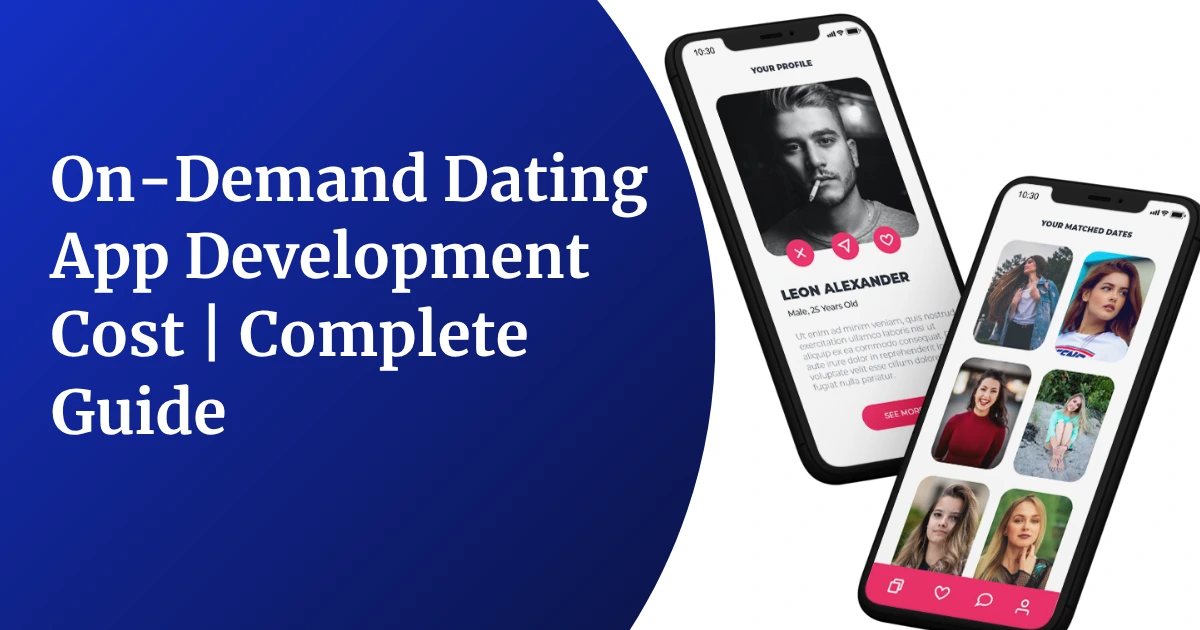
Building a dating app is not as simple as putting a few profiles on a screen and letting people swipe. Behind every smooth match, chat, and notification, there is a lot of planning, coding, testing, and design work happening. And all of that work costs money.
If you are thinking about building your own on-demand dating app in 2026, one of the first questions on your mind is probably, “How much is this actually going to cost me?” It’s a fair question, and honestly, the answer is not a single number. The cost of building a dating app can start from a modest figure for a basic version and go up to a much larger investment for a feature-rich, AI-powered platform.
In this guide, we will break down everything in simple words – what affects the price, how the budget is usually split, what hidden costs people often forget, and how you can plan your own dating app project without any nasty surprises later. We’ll also look at real cost tables, a simple formula to calculate your own team cost, and answer the most common questions founders ask before they start building. By the end, you should have a much clearer picture of what your dating app will actually cost, instead of just guessing based on random numbers you found online. Let’s get into it.
How Much Does It Cost to Build a Dating App?
The honest answer is: it depends on what you want to build. A simple dating app with basic swipe and chat features will obviously cost less than a full-blown platform with AI matchmaking, video calls, and safety verification built in.
To give you a clearer picture, we have broken the cost down by three angles – app complexity, platform choice, and the region where you hire your development team. This should help you understand roughly where your project might land.
Cost Based on App Complexity
| App Type | Core Features | Estimated Cost (USD) | Development Time |
| Basic Dating App | Sign up, profile creation, swipe, basic chat | $15,000 – $35,000 | 2 – 3 months |
| Mid-Level Dating App | Basic features + location matching, filters, push notifications, in-app purchases | $35,000 – $70,000 | 3 – 5 months |
| Advanced Dating App | Mid-level features + AI matchmaking, video/voice chat, ID verification, advanced analytics | $70,000 – $150,000 | 5 – 9 months |
| Enterprise-Level Dating Platform | Advanced features + multi-language support, AR/VR elements, deep AI personalization, high scalability | $150,000 – $300,000+ | 9 – 14 months |
Keep in mind, these numbers are estimates and can shift up or down depending on the exact features you want, your target market, and the design quality you’re aiming for. A basic app aimed at a small local audience will always sit at the lower end, while an app built for a large, competitive market with users expecting a polished experience will naturally push costs higher, even within the same complexity bracket. It’s also worth noting that these figures usually cover the first build only. Once you launch, you’ll keep adding features based on user feedback, which means your total spend over the first year is often higher than the initial development quote.
Cost Based on Platform (Android, iOS, or Both)
| Platform | Description | Estimated Cost (USD) |
| Android Only | Single platform, native development | $15,000 – $80,000 |
| iOS Only | Single platform, native development | $18,000 – $90,000 |
| Cross-Platform (Android + iOS) | Shared codebase using frameworks like Flutter or React Native | $25,000 – $120,000 |
| Native Android + iOS (separate builds) | Two separate native apps, best performance | $40,000 – $180,000 |
If you’re a startup working with a tight budget, cross-platform development is usually the smarter route. You get both platforms covered without paying for two completely separate builds. Frameworks like Flutter and React Native have matured a lot in the last few years, and for a dating app, which mostly relies on standard mobile features like camera access, location, chat, and push notifications, there’s rarely a strong technical reason to avoid them. Native development still makes sense if you’re planning very heavy use of device-specific features like advanced AR filters or deep hardware integrations, but for most dating app founders, cross-platform is the more practical starting point.
Global data usage patterns also matter here. As per <a href=”https://www.statista.com/outlook/emo/dating-services/online-dating/worldwide/”>Statista’s market forecast</a>, online dating revenue continues to climb worldwide, which tells us the audience using these apps on both Android and iOS keeps growing steadily, making it hard to justify skipping either platform at launch unless your budget truly forces the decision.
Cost Based on Development Team Location
Where you hire your developers from has a big impact on your final bill. The same app can cost very differently depending on the country your development team is based in.
| Region | Average Hourly Rate (USD) | Typical Project Cost Range |
| United States / Canada | $100 – $180 | $80,000 – $300,000+ |
| Western Europe (UK, Germany, etc.) | $70 – $150 | $60,000 – $250,000 |
| Australia | $80 – $140 | $65,000 – $220,000 |
| India / South Asia | $20 – $50 | $15,000 – $150,000 |
| Eastern Europe | $35 – $70 | $30,000 – $180,000 |
This is exactly why a lot of businesses, big and small, choose to work with development teams in India or Eastern Europe – they get the same quality of work at a fraction of the price compared to hiring locally in the US or UK. If you want to see how this plays out in a real project, this <a href=”https://growrankers.com/case-study/dating-app/”>dating app case study</a> shows how a full-featured app was planned, built, and launched from start to finish.
Key Factors Influencing Dating App Development Cost
Now that you have a rough number in your head, let’s talk about why the cost changes so much from project to project. There are several moving parts here, and each one adds or reduces cost depending on your choices.
1. App Features and Functionality
This is the biggest cost driver, hands down. A simple swipe-and-match app is cheap to build. But the moment you add things like AI-based compatibility scoring, video dating, voice notes, or live streaming, the development hours (and cost) go up quickly.
2. UI/UX Design Complexity
Dating apps live or die by their design. People judge an app within seconds of opening it. If you want a highly polished, custom-designed interface with smooth animations and a unique visual identity, expect to pay more compared to using ready-made templates.
3. Backend Infrastructure and Scalability
A dating app needs to handle a lot of real-time data – messages, location updates, notifications, and matching algorithms – all happening at once. Building a backend that can scale as your user base grows (without crashing) requires skilled engineers and solid cloud infrastructure, which adds to the cost.
4. Third-Party Integrations
Most dating apps rely on outside services for things like payment gateways, SMS/OTP verification, social media login, maps, and push notifications. Each integration takes time to set up and test properly, and some come with their own licensing fees.
5. Security and Data Privacy Compliance
Since dating apps deal with extremely sensitive personal information (photos, location, private messages), strong security measures are non-negotiable. Meeting data protection standards like GDPR or CCPA, along with adding encryption and fraud detection, adds to development effort and cost.
6. AI and Machine Learning Features
AI is no longer a “nice to have” in dating apps – it’s becoming the standard. Smart matchmaking, fake profile detection, and personalized recommendations all rely on machine learning models, which need specialized talent to build and train properly.
7. Development Team Structure
Whether you hire an in-house team, work with freelancers, or partner with a full development agency changes your cost structure completely. An agency usually costs more upfront but gives you a complete team (design, development, QA, project management) under one roof, which often saves money in the long run.
8. App Maintenance and Updates
Development doesn’t stop at launch. Bug fixes, OS updates, new feature rollouts, and server monitoring are ongoing costs that many people forget to budget for at the start.
9. Geographic Location of Your Development Partner
As we covered earlier, hiring a team from the US will cost noticeably more than hiring an equally skilled team from India or Eastern Europe. This is one of the easiest ways to control your budget without compromising on quality.
10. Number of User Roles and Admin Panel Complexity
Most people only think about the app that end users see, but every dating app also needs a solid admin panel behind the scenes – for managing user reports, reviewing flagged profiles, tracking revenue, and controlling app settings. A basic admin panel is quick to build, but if you want detailed analytics dashboards, role-based access for different staff members, or automated moderation tools built into the panel, that adds extra development hours.
11. Monetization Model You Choose
How you plan to make money from your app also shapes the cost. A simple subscription model with one or two tiers is fairly straightforward to build. But if you want a mix of subscriptions, one-time purchases (like profile boosts or super likes), in-app advertising, and virtual gifting, each of these needs its own logic, testing, and payment handling, which adds to both the timeline and the budget.
According to industry data compiled in the <a href=”https://www.businessofapps.com/data/dating-app-report/”>dating app industry report</a>, the sector remains a multi-billion-dollar space, which is exactly why competition on features and user experience keeps pushing development standards (and costs) higher every year. If you are exploring how dating platforms fit within the wider social space, our <a href=”https://growrankers.com/industries/social-media-app-development-services/”>social media app development services</a> page breaks down how similar apps are built and scaled.
Dating App Development Budget Planning: Detailed Cost Breakdown
Once you know the rough total cost, it helps to understand where exactly that money goes. A dating app project is not one single expense – it’s made up of several phases, each with its own share of the budget.
Phase-Wise Cost Breakdown
| Development Phase | What It Includes | Approximate % of Total Budget |
| Research & Planning | Market research, competitor analysis, feature list, wireframes | 5% – 8% |
| UI/UX Design | Wireframes, prototypes, visual design, user flow testing | 12% – 18% |
| Frontend Development | Building the user-facing app for iOS/Android | 20% – 28% |
| Backend Development | Server setup, database, matching algorithm, API development | 25% – 32% |
| Third-Party Integrations | Payment gateway, chat SDK, push notifications, maps, verification | 8% – 12% |
| Quality Assurance & Testing | Manual and automated testing, bug fixing, security testing | 10% – 15% |
| Deployment & Launch | App store submission, server deployment, final checks | 3% – 5% |
| Post-Launch Support | Bug fixes, monitoring, minor updates in the first few months | 5% – 10% |
So, for example, if your total budget is $80,000, you might expect to spend roughly 20,000-25,000 on backend development alone, since that’s the part handling the actual matching logic, messaging, and data storage. Design usually comes second in terms of cost share, simply because a dating app’s success depends heavily on how it looks and feels to use.
It’s smart to sit down with your development partner early and ask for this kind of breakdown before signing any contract. It gives you a much clearer picture of where your money is going and helps you spot if any phase seems oddly overpriced or underpriced.
Notice that research and planning sit at the very start with a relatively small percentage, but skipping this phase is one of the most common (and expensive) mistakes founders make. Rushing straight into design or development without proper market research and a clear feature list almost always leads to costly changes later, once the app is already half-built. Spending a little extra time and money upfront on planning usually saves a lot more down the line.
It also helps to break your project into milestones tied to this cost structure. Instead of paying one lump sum upfront, you can release payments as each phase is completed and reviewed. This keeps your development partner accountable and gives you natural checkpoints to review progress, request changes, or catch issues early, before they turn into bigger, more expensive problems closer to launch.
How to Calculate Your Dating App Development Team Cost
If you want a more accurate estimate rather than relying only on ranges, you can calculate your team cost using a simple formula. This works whether you’re hiring an agency or building an in-house team.
Total Development Cost = (Number of Team Members × Hourly Rate × Estimated Hours per Team Member) + Tools/Licensing Costs + Contingency Buffer
Here’s how each part works:
- Number of Team Members: This usually includes a project manager, UI/UX designer, frontend developer(s), backend developer(s), QA engineer, and sometimes a dedicated AI/ML engineer.
- Hourly Rate: This varies based on the region and experience level of each team member, as shown in the earlier table.
- Estimated Hours: Total hours each person is expected to spend on the project, based on the app’s complexity and timeline.
- Tools/Licensing Costs: Costs for design tools, cloud hosting, third-party SDKs, and any paid APIs.
- Contingency Buffer: It’s wise to add 10%-15% extra to your final number to cover unexpected changes, scope additions, or delays.
A rough example: if you hire a 6-person team at an average rate of $35/hour, and the project takes about 800 hours per person, your core cost would be around $168,000. Add tools, licensing, and a 10% buffer, and you’re looking at approximately 185,000-190,000 for a mid-to-advanced level app. Adjust the numbers based on your actual team size, rates, and hours to get a figure specific to your project.
Let’s look at a smaller example too, since not everyone is building an enterprise-level platform. Say you’re hiring a lean 4-person team – one designer, one frontend developer, one backend developer, and one QA tester – at an average blended rate of $25/hour, working roughly 500 hours each for a mid-level app. That comes to $50,000 in core labor cost. Add around 3,000-5,000 for tools and third-party licenses, plus a 10% contingency buffer, and your total lands somewhere around 58,000-60,000. This kind of quick calculation is useful when you’re comparing quotes from different vendors, since it lets you sanity-check whether a quoted price actually lines up with realistic hours and rates, or whether it seems oddly inflated or suspiciously low.
One tip here: always ask your development partner to show you the hours estimated per role, not just a single final number. A transparent partner will happily walk you through how they arrived at the figure, while a vague, one-line quote is often a sign you should ask more questions before signing anything.
Hidden Costs to Consider During Budget Planning for Your Dating App
This is the part most people skip when they’re budgeting, and then get surprised by later. Let’s go through the costs that don’t always show up in the initial quote but absolutely need a place in your budget.
1. App Store and Play Store Fees
Both Apple and Google charge fees to list your app. Apple charges an annual developer fee, and Google has a one-time registration fee. These are small compared to your overall budget, but they still need to be accounted for.
2. Cloud Hosting and Server Costs
As your user base grows, so does your server bill. Hosting costs on platforms like AWS or Google Cloud scale with the number of users, messages sent, images stored, and data processed – this is an ongoing monthly cost, not a one-time expense.
3. Third-Party API and SDK Costs
Many useful features – like SMS verification, maps, or in-app chat – come from third-party providers who charge based on usage. As your app scales, these usage-based fees can add up faster than expected.
4. Marketing and User Acquisition
A dating app is only useful if it has users, and getting those first thousands of users usually needs paid marketing, influencer partnerships, or app store optimization work – none of which is technically “development,” but all of which needs budget.
5. Content Moderation
Dating apps need active moderation to remove fake profiles, inappropriate content, and abusive behavior. This might mean hiring a moderation team or investing in AI-based moderation tools, both of which come with recurring costs.
6. Legal and Compliance Costs
Terms of service, privacy policies, age verification systems, and compliance with regional data laws often require legal consultation, especially if you’re launching in multiple countries with different regulations.
7. Post-Launch Feature Updates
User feedback after launch almost always leads to new feature requests or design tweaks. Budgeting only for the initial launch and ignoring post-launch iteration is one of the most common planning mistakes.
8. Customer Support Setup
As your app grows, users will need help with account issues, billing questions, or safety concerns. Setting up a support system, whether it’s a chatbot, help desk software, or a small human team, is another cost that often gets overlooked at the planning stage.
9. Third-Party Software Renewals
Design tools, project management software, code repositories, and testing tools usually run on annual or monthly subscriptions. These costs are small individually, but they add up over the life of the project, especially if your team relies on several paid tools at once.
10. Rebranding or Redesign Costs
Sometimes, after seeing the app in action or getting early user feedback, founders decide to tweak the branding, color scheme, or overall look and feel. If this happens after development is already underway, it can mean redoing work that was technically already “finished,” which adds unplanned cost. Locking in your branding and design direction early helps avoid this.
How GrowRankers Will Help You as the Best Dating App Development Company
Building a dating app isn’t just about writing code, it’s about understanding human behavior, building trust through design, and creating a product that feels safe and genuinely enjoyable to use. At GrowRankers, we’ve worked closely with founders who had nothing more than an idea and a vision, and helped turn that into a fully functional, market-ready dating app. Our team handles everything from UI/UX design and backend architecture to AI-based matchmaking and security implementation, so you don’t need to juggle multiple vendors or worry about pieces not fitting together.
What really sets us apart is transparency in cost planning. We don’t believe in vague quotes or surprise bills halfway through a project. We sit down with you, understand your vision and budget, and give you a clear, honest breakdown of what things will cost and why, right from day one. Whether you’re building your first MVP or upgrading an existing platform with advanced features, our team brings the technical skill and industry experience to get it done right. You can also check out how we’ve approached similar projects in the <a href=”https://growrankers.com/blog/top-social-media-app-development-companies/”>social media app development</a> space, which shares a lot of common ground with dating platforms in terms of user engagement and real-time features.
We also understand that no two dating app ideas are the same. Some founders want a niche community app for a very specific audience, while others are aiming for a large, mainstream platform meant to compete with the big names. Either way, our process stays the same – we start with in-depth discovery to understand your users and goals, move into wireframing and design that reflects your brand, and only then move into development, so nothing gets built on guesswork. Post-launch, we stick around too, helping with updates, scaling, and performance monitoring, because a dating app’s real work often begins after it goes live, not before.
Conclusion
Building a dating app in 2026 can cost anywhere from $15,000 for a basic version to well over $300,000 for a fully-loaded, AI-powered platform. The exact number depends on your app’s features, design complexity, platform choice, and where you choose to build your team. The smartest approach is to start with a clear plan, understand where your money is going phase by phase, and keep a buffer for the hidden costs that tend to sneak up later.
It also helps to remember that cost is only one part of the equation. A cheaper app that nobody wants to use isn’t actually a good deal, and an expensive app that’s overbuilt with features your users never asked for isn’t a smart investment either. The goal is to spend your budget on the things that genuinely improve the experience for your target users – a smooth sign-up process, a matching system that feels accurate, safe and reliable chat, and a design that makes people want to keep coming back. Everything else can usually wait for version two.
Before you finalize a budget, it’s worth talking to more than one development team, comparing their breakdowns, and asking direct questions about hours, team structure, and post-launch support. A little extra time spent comparing quotes at this stage can save you a lot of money and frustration once the project is actually underway.
If you’re serious about building a dating app that actually stands out and performs well in a competitive market, working with an experienced team makes a real difference. Feel free to reach out to <a href=”https://growrankers.com/”>GrowRankers</a> to discuss your idea and get a realistic, no-surprises cost estimate tailored to your specific project.
Frequently Asked Questions (FAQs)
1. How much does it cost to build a basic dating app in 2026?
A basic dating app with core features like sign-up, profile creation, swiping, and simple chat typically costs between $15,000 and $35,000, depending on design quality and the development team you choose.
2. How long does it take to build a dating app?
Development time usually ranges from 2 months for a basic app to over a year for an enterprise-level platform with advanced AI and multi-language support. Most mid-level apps take around 4 to 6 months.
3. Is it cheaper to build for Android or iOS first?
Android development is generally slightly cheaper due to a larger pool of developers and simpler design guidelines, but the difference isn’t huge. Many businesses choose cross-platform development to launch on both at once and save costs overall.
4. What features increase dating app development cost the most?
AI-based matchmaking, video/voice calling, real-time chat with media sharing, and identity verification systems are the features that add the most to your final cost, since they require specialized development skills.
5. Do I need a big budget to launch a dating app?
Not necessarily. Many successful dating apps started as a simple MVP with core features and grew from there based on user feedback. Starting small and scaling gradually is a practical and budget-friendly approach.
6. What ongoing costs should I expect after launching my dating app?
After launch, expect to pay for cloud hosting, third-party API usage, customer support, content moderation, marketing, and regular feature updates. These are recurring costs, not one-time expenses.
7. Should I hire an in-house team or outsource dating app development?
It depends on your budget and long-term plans. Outsourcing to an experienced development agency is usually more cost-effective for a first app, since you get a complete team without the overhead of hiring and managing employees directly.
8. How can I reduce my dating app development cost without cutting quality?
Focus on launching with core features first, choose cross-platform development, work with a development team based in a cost-effective region, and avoid unnecessary custom features that don’t add real value for your early users.
9. Why is security so important in dating app development, and does it add much cost?
Dating apps handle highly personal data, so strong security (encryption, secure login, fraud detection) is essential to protect users and build trust. It does add some development cost, but skipping it can lead to far bigger problems, including data breaches and loss of user trust.
10. How do I get an accurate cost estimate for my specific dating app idea?
The best way is to share your feature list, target platforms, and timeline with an experienced development company. They can then give you a realistic, itemized estimate based on your exact requirements rather than a generic price range.