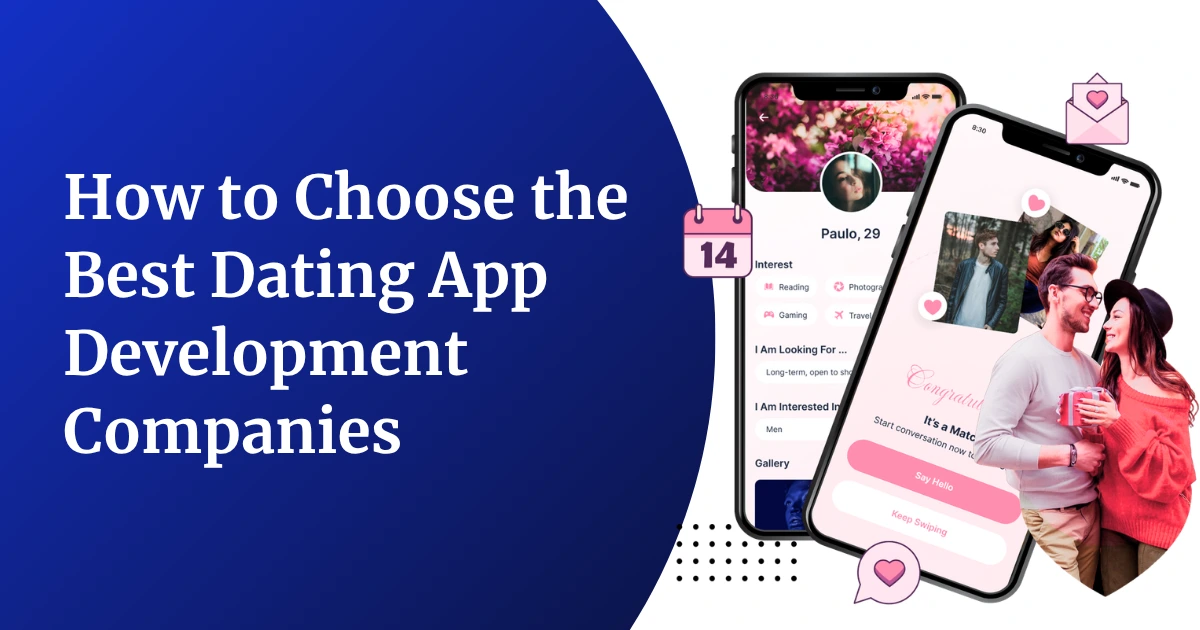
Picking a dating app development company feels a lot like picking a life partner on paper – you go through profiles, you compare “compatibility,” and you hope you’re not left swiping right on someone who ghosts you halfway through the project. Jokes aside, this is a big decision, and it’s one a lot of founders rush through because they’re excited to see their idea come to life. The dating app space in 2026 is crowded, fast-moving, and shaped by AI-powered matching, video-first dating, safety-first design, and much stricter data privacy expectations than even a couple of years ago.
If you pick the wrong development partner, you could end up spending months and a good chunk of your budget on a buggy, generic app that nobody sticks around to use. If you pick the right one, you get something far more valuable than just an app – you get a product that genuinely helps people connect, and a business you can actually grow. This guide walks you through everything worth knowing before you sign a contract with a dating app development company: why the decision matters so much, the exact factors to check, the mistakes founders repeat over and over, a rough cost breakdown, and a simple shortlisting checklist you can use right away.
Why Does Choosing the Right Dating App Development Company Matter?
A lot of founders treat app development like ordering food online – pick whoever answers fastest and looks decent on Google, then hope for the best. But a dating app isn’t a simple to-do list tool or a basic business directory. It handles people’s photos, private conversations, live location, and sometimes their deepest hopes and insecurities about being single. One wrong technical or strategic call early on can cost you months of rework later, and in a space this competitive, months matter.
1. The dating app market is bigger and more competitive than it looks
The online dating industry isn’t slowing down anytime soon. Global dating app revenue has climbed into the billions, and industry researchers expect the broader online dating and matchmaking market to keep growing at a healthy pace over the next several years as more people, especially younger users, turn to apps rather than traditional ways of meeting someone. That growth is great news if you’re entering the space, but it’s a double-edged sword too – users now have dozens of apps to choose from, and switching costs are basically zero. If your app feels slow, clunky, or unsafe even once, people will simply delete it and go back to an app they already trust. You can dig deeper into how the industry is shaping up in this breakdown of dating app market data and revenue trends, which tracks usage and revenue across the major players.
2. Trust and safety decide whether users stay or leave
People are naturally cautious about who they talk to online, and honestly, they should be. A development company that doesn’t understand identity verification, fake profile detection, in-app reporting, or blocking mechanisms will hand you an app that quietly makes users uneasy, even if they can’t put their finger on why. Safety features aren’t a “nice to have” checkbox anymore. In review sections and app store ratings, safety is very often the exact reason one app pulls ahead of another that looks almost identical on the surface. Independent research on online dating experiences also shows just how much a person’s sense of safety shapes whether they continue using an app at all, which is exactly why this can’t be treated as a low-priority feature request.
3. Technology choices affect your costs for years, not just months
Dating apps depend heavily on real-time chat, location-based matching, video or audio calling, instant push notifications, and increasingly, AI-based recommendation systems. If your development partner makes the wrong call on backend architecture or database structure right at the start, scaling later becomes painful, slow, and far more expensive than doing it right the first time. A genuinely good development company thinks two or three years ahead, not just about hitting your MVP launch date.
4. Your brand reputation is directly tied to how the app performs
If your app crashes often, drains the phone’s battery, or takes forever to load a match, users don’t file that away as “just a bug.” They associate that frustration with your brand as a whole. In a category where first impressions matter this much – it’s literally about first impressions between people – a shaky user experience can quietly kill word-of-mouth growth before your app even gets a real chance.
5. The right partner acts like a product advisor, not just a coding vendor
The best dating app development companies don’t simply build whatever you sketch on a napkin. They’ve already seen what works and what flops across dozens of similar projects. A strong partner will push back on weak feature ideas, suggest better monetization approaches, and help you avoid rebuilding the same screen three separate times because nobody thought it through properly the first time. That kind of hands-on experience is exactly what you’ll notice in a well-documented dating app development case study from a team that has actually shipped a live product, not just talked about it in a sales pitch.
6. Monetization models are becoming more sophisticated
Gone are the days when a simple “free app with ads” model was enough to sustain a dating app long-term. In 2026, successful apps combine subscription tiers, pay-per-feature unlocks (like seeing who liked you), and premium boosts to stay profitable. A development company that only knows how to code screens but doesn’t understand how to structure in-app purchases, subscription renewals, or paywalls correctly can quietly cost you real revenue every single month after launch.
Key Factors to Look for When Choosing a Dating App Development Company
Once you understand why this decision carries so much weight, the next step is knowing precisely what to evaluate before you commit. Here are the factors that genuinely separate a dependable development partner from a risky bet.
1. Proven experience with dating or social apps specifically
Building an e-commerce store and building a dating app are two very different jobs, even though both are technically “mobile apps.” Dating apps need real-time messaging, geolocation-based matching, swipe or scroll mechanics, and moderation systems that most generic app-building shops have simply never had to deal with. Ask to see actual dating, social, or community apps they’ve personally built – not just similar-sounding categories they list on a slide.
2. A strong technical stack with real scalability planning
Ask exactly what backend, database, and cloud infrastructure they plan to use, and more importantly, why they picked it. A company that can clearly explain how their architecture will comfortably handle 10,000 users today and 500,000 users two years from now is thinking like a long-term partner. A company that shrugs off the question or gives you a vague answer is probably planning for the demo, not for your actual growth.
3. UI/UX design that understands dating-specific psychology
Swipe gestures, match animations, profile card layouts, and onboarding flows aren’t just visual decisions – they directly shape how long a user stays engaged and how quickly they trust the platform. A design team with genuine dating-app experience will know why certain onboarding sequences convert better, where users typically abandon the signup process, and how small friction points quietly kill engagement.
4. Data privacy and security compliance built in from day one
Dating apps collect extremely sensitive information: photos, live location, sexual orientation, relationship preferences, and sometimes even personal details shared in chat. Your development partner needs a solid grasp of data protection principles, including the kind of standards outlined under regulations like the GDPR framework, even if your first launch market isn’t in Europe. Getting this wrong isn’t just a PR headache later – it can create real legal exposure for your business.
5. AI and matching algorithm capability
In 2026, plain swipe-and-match mechanics alone rarely cut it anymore. Many of the fastest-growing apps now lean on AI to sharpen match quality, flag fake or bot profiles, and personalize recommendations based on actual in-app behavior rather than a static questionnaire filled out once at signup. Ask potential partners directly whether they’ve worked with recommendation systems or even basic machine learning models before, and ask them to explain it in plain terms.
6. A transparent, easy-to-understand pricing model
Reliable companies explain their pricing clearly, whether it’s fixed-cost, hourly billing, or a dedicated-team model, and they spell out exactly what’s included and what counts as an extra change request. If a quote feels suspiciously low or the pricing explanation is vague and full of asterisks, that’s usually a warning sign rather than a bargain.
7. Real post-launch support and maintenance plans
Launching the app is genuinely just the starting line, not the finish line. Bugs will show up in production that never appeared in testing, new phone OS updates will occasionally break things overnight, and you’ll want to add features based on actual user feedback once real people start using the app. Ask specifically what their support package covers after launch, how quickly they respond to critical bugs, and for how many months (or years) that support is included in the deal.
8. Client reviews, direct references, and portfolio depth
Don’t stop at the polished testimonials sitting on their homepage. Ask for direct references you can actually email or hop on a quick call with. A development company that’s genuinely confident in its work will connect you with a past client without hesitation, and that client will usually give you the honest, unfiltered version of the experience.
9. Communication style and day-to-day project management
You’re going to be working closely with this team for several months, sometimes longer. Do they send regular weekly or bi-weekly updates? Do they use a shared project tracking tool like Jira, Trello, or Asana that you can also access? Is there one dedicated point of contact, or will you be chasing five different people for a single answer? Smooth, predictable communication quietly prevents most of the delays that derail app projects.
10. Cross-platform and multi-market experience
If you’re planning to launch in several countries eventually, check whether the company has actually adapted apps for different languages, local payment gateways, and different cultural norms around dating and relationships. A team that has already worked on broader social media app development projects often carries that same cross-market thinking into a dating app build, since both categories deal heavily with user-generated content, discovery feeds, and community moderation.
11. Third-party integration experience
Most dating apps rely on a handful of external services to function smoothly – payment gateways for subscriptions, SMS or email providers for OTP verification, cloud storage for photos and videos, and sometimes third-party identity verification services for KYC checks. Ask whether the team has hands-on experience wiring these services together cleanly, since a poorly integrated payment gateway alone can quietly cause failed transactions and lost revenue.
12. A structured testing and quality assurance process
A dating app that crashes during a video call or loses a chat message mid-conversation loses user trust almost instantly. Ask whether the company has a dedicated QA process, including device testing across different phone models, load testing for peak usage times, and security testing before launch. A team that treats testing as an afterthought squeezed in during the final week is far more likely to ship a shaky product.
Mistakes to Avoid When Hiring a Dating App Development Partner
Even sharp, experienced founders make avoidable mistakes when hiring a development company for the first time. Here are the most common ones, and a quick note on why each one actually hurts.
1. Choosing based on the lowest price alone
The cheapest quote on the table often hides shortcuts – outdated technology, no proper testing phase, or a junior team essentially learning on your dime. Saving money upfront frequently turns into an expensive rebuild down the road, which ends up costing far more than paying fairly the first time.
2. Skipping the discovery or research phase entirely
Jumping straight into coding without proper market research, competitor analysis, or user persona mapping usually produces a generic, forgettable app that blends into the crowd instead of standing out for a specific type of user.
3. Ignoring security and compliance until after launch
Bolting privacy and safety features on after the app is already live is far harder, riskier, and more expensive than building them into the foundation from day one. Treat data protection as a core requirement from the very first planning conversation, not an afterthought squeezed in later.
4. Not actually reviewing past projects hands-on
A polished portfolio page with attractive screenshots isn’t real proof of quality. Always ask to download and personally test a live app they’ve built, rather than judging purely on static images or a curated case study.
5. Signing vague contracts with unclear ownership terms
Make absolutely sure the contract clearly states who owns the source code, design files, and overall intellectual property once the project wraps up. Some agencies quietly retain certain rights unless the contract explicitly says otherwise, and that clause matters far more than it seems at signing time.
6. Overlooking scalability planning until it’s too late
An MVP that comfortably handles 500 users but collapses under 50,000 users means you’ll be rebuilding your backend at the exact moment your growth is finally taking off – which is genuinely the worst possible timing for a technical overhaul.
7. Underestimating how important post-launch support really is
A surprising number of founders forget to negotiate support terms until after launch, precisely when they suddenly need an urgent bug fixed and realize, too late, that it isn’t covered under the original agreement.
8. Not aligning on a monetization strategy from the start
Subscription plans, freemium tiers, pay-per-feature unlocks, or ad-supported models all require different technical setups. Your development partner should help you architect the app around your chosen monetization model from day one, rather than retrofitting it awkwardly once the app is already built.
9. Overloading the MVP with too many features
Trying to launch with every feature imaginable – video dating, AI matching, live streaming, gamified badges – often delays launch by months and dilutes your core value proposition. A focused MVP that does one thing exceptionally well usually outperforms a bloated app trying to do everything at once.
10. Not asking about team structure and turnover
Some agencies quietly rotate developers mid-project, which can slow things down and lead to inconsistent code quality. Ask upfront who exactly will be working on your project and whether that team is likely to stay consistent throughout the build.
11. Forgetting to plan for content moderation at scale
A moderation process that works fine with 500 users often breaks down completely once you cross a few thousand active daily users. If your development partner doesn’t ask how you plan to handle reported profiles, inappropriate images, or spam accounts at scale, that’s a conversation worth raising yourself before development even begins.
12. Assuming marketing and ASO can be handled entirely after launch
A dating app’s success depends heavily on app store visibility and organic discovery, not just the build quality itself. Founders who treat marketing as a completely separate, later-stage task often miss the chance to bake in referral systems, social sharing hooks, or app store optimization basics during development, when they’re far cheaper and easier to implement.
Cost of Hiring Dating App Developers in 2026
Pricing for dating app development varies quite a bit depending on complexity, region, feature depth, and the hiring model you choose. Here’s a quick snapshot to give you a general sense of where budgets typically land right now. We’ll be covering a far more detailed cost breakdown, region-wise comparisons, and hidden cost factors in a dedicated blog soon, so treat this as a starting reference point.
| App Type | Approximate Cost Range (USD) | Typical Timeline |
| Basic MVP (swipe, chat, profile setup) | $15,000 – $35,000 | 2 – 4 months |
| Mid-range app (matching algorithm, video calls, notifications) | $35,000 – $70,000 | 4 – 6 months |
| Advanced app (AI matching, live streaming, safety/verification suite) | $70,000 – $150,000+ | 6 – 10 months |
| Niche/community-specific dating app | $40,000 – $90,000 | 4 – 7 months |
| Enterprise-grade dating platform with multi-region support | $150,000 – $300,000+ | 9 – 14 months |
| Hiring Model | Approximate Hourly Rate (USD) | Best Suited For |
| Freelancers | $15 – $40/hr | Very small budgets, simple prototypes |
| In-house team | $60,000 – $120,000/year per developer | Long-term product companies |
| Development agency (offshore) | $25 – $50/hr | Balanced cost and quality |
| Development agency (onshore/US/UK) | $80 – $150/hr | Premium quality, faster communication |
Checklist While Shortlisting a Dating App Development Company
Before you sign anything, run every shortlisted company through this checklist. Think of it as your own background check before that first real “date” with a development partner.
1. Portfolio and Experience Check
- Have they built at least one dating, social, or community-based app before?
Ask for the app’s name directly and download it yourself instead of relying on a description. - Can you actually download and use an app they’ve built?
A live, functioning app tells you far more about their real capability than any pitch deck ever could. - Do their past projects match the complexity level you’re planning?
A company experienced only in simple MVPs may struggle with an AI-driven, feature-heavy build, and vice versa.
2. Technical Capability Check
- Do they explain their tech stack clearly without drowning you in jargon?
If you ask a simple question and get a confusing answer, that’s often a sign they don’t fully understand it themselves. - Can they support real-time chat, geolocation, and push notifications natively?
These are core dating app features, not optional add-ons, so hesitation here is a red flag. - Do they have experience integrating AI-based matching or recommendation systems?
Even basic experience here puts them ahead of teams that have never touched personalization logic.
3. Security and Compliance Check
- Do they follow standard data encryption practices?
Ask specifically how user data, chats, and photos are stored and protected, both in transit and at rest. - Are they familiar with privacy regulations relevant to your target markets?
This becomes especially important if you plan to expand internationally down the line. - Do they have a clear plan for content moderation and fake profile detection?
This directly protects your users and your brand’s reputation once the app is live and growing.
4. Communication and Process Check
- Do they assign a dedicated project manager or clear point of contact?
This single detail alone can save you weeks of miscommunication over the course of the project. - Will you get regular progress updates on a set schedule?
Weekly or bi-weekly check-ins keep everyone aligned and catch problems early, before they snowball. - Do they use a project tracking tool you can also access directly?
Visibility into ongoing tasks builds trust and keeps timelines honest on both sides.
5. Commercial and Legal Check
- Is the pricing model clearly explained in the proposal itself?
You should never have to guess what’s included and what will trigger an extra invoice later. - Does the contract clearly specify who owns the final code and design files?
This single clause protects your ability to switch developers or scale independently down the road. - Is post-launch support included, and for exactly how long?
Get this detail in writing rather than relying on a verbal promise made during the sales call.
6. Cultural and Long-Term Fit Check
- Do they ask thoughtful questions about your business goals, not just app features?
A partner focused only on scope and deadlines is usually thinking short-term, not about your success. - Do they seem genuinely interested in your app succeeding, or just closing the deal?
Their curiosity (or lack of it) during early calls is usually a fairly accurate preview of how the whole project will go. - Would you feel comfortable working closely with this team for the next 6 to 12 months?
Trust your gut here just as much as you trust the numbers in their proposal.
Why Choose GrowRankers as Your Dating App Development Partner
At GrowRankers, we don’t build dating apps off a generic template with a new color scheme slapped on top. Every project starts with genuinely understanding your specific audience – whether you’re building for a mainstream crowd, a tightly-knit niche community, or a location-based casual dating app – and then designing the matching logic, UI flow, and safety features specifically around that audience. Our team has hands-on experience with real-time chat systems, geolocation-based matching, AI-assisted recommendations, and the kind of verification and moderation tools that actually keep users safe and engaged rather than just checking a compliance box. We treat security and data privacy as a core part of the build from day one, not a last-minute addition, which matters enormously given just how sensitive dating app data really is.
Beyond development itself, we bring a product-first mindset shaped by studying how the top social media app development companies approach engagement and retention, which means we understand engagement loops, retention triggers, and what genuinely keeps people coming back to open an app every single day. We stay closely involved after launch too, monitoring real performance, fixing issues quickly when they surface, and helping you plan your next feature roadmap based on actual user behavior instead of guesswork or assumptions. If you’re looking for a partner that treats your app like it’s their own product rather than just another line item in a contract, that’s exactly the kind of relationship we aim to build with every client who works with us.
Conclusion
Choosing the best dating app development company in 2026 isn’t about picking whoever has the flashiest website or hands you the cheapest quote. It’s about finding a team that genuinely understands the unique challenges dating apps face – trust, safety, real-time engagement, and long-term scalability – and has the technical depth to actually deliver on all of it, not just talk about it convincingly. Take your time during the shortlisting phase, ask the uncomfortable questions, check real, working portfolios, and don’t be afraid to walk away from a partner that feels rushed, vague, or overly sales-driven. The right development company won’t just hand you an app at the end of a contract; they’ll help shape it into something users genuinely want to keep opening, day after day.
If you’re still comparing options, treat every sales call as a two-way interview. You’re not just answering their questions about budget and timeline – you’re evaluating how well they listen, how honestly they answer tough questions, and whether they seem genuinely invested in your app’s long-term success rather than just closing another deal. That mindset shift alone will filter out a surprising number of the wrong-fit companies before you even get to the contract stage.
Frequently Asked Questions (FAQs)
1. How long does it take to build a dating app in 2026?
A basic MVP usually takes around 2 to 4 months to build and launch, while a full-featured app with AI matching, video calls, and advanced safety tools can realistically take 6 to 10 months depending on how many features are included.
2. How much does it cost to build a dating app like Tinder or Bumble?
Costs typically range from around $70,000 to $150,000 or more for a mid-to-advanced level app, depending heavily on features like AI-based matching, video chat, and identity verification systems.
3. Should I hire a freelancer or a development agency for my dating app?
Freelancers can work reasonably well for very simple prototypes on tight budgets, but agencies generally offer more reliable testing processes, better long-term support, and a larger team to cover different skill sets, which matters a lot for a product handling sensitive personal data.
4. What features are considered must-haves for a dating app in 2026?
Real-time chat, geolocation-based matching, profile verification, push notifications, in-app reporting and blocking tools, and at least a basic AI-driven match suggestion system are now widely considered essential rather than optional extras.
5. Do I need separate apps for iOS and Android?
Not necessarily. Many development companies build cross-platform apps using frameworks like Flutter or React Native, which run on both platforms while keeping overall development costs and timelines lower.
6. How important is AI in modern dating apps?
It’s become quite important. AI helps improve match quality, detect fake or spam profiles more accurately, and personalize the overall experience for each user, all of which directly impacts how long users stick around.
7. What ongoing costs should I expect after the app launches?
Expect recurring costs for server hosting, third-party API usage such as maps and payment gateways, video calling infrastructure, customer support staffing, and regular maintenance or feature updates as the app grows.
8. How do I make sure my dating app stays legally compliant?
Work with a development team that’s genuinely familiar with data privacy laws relevant to your target regions, and make sure user consent flows, data storage practices, and account or data deletion policies are clearly built into the app from the start rather than added later.
9. Can an existing dating app be redesigned instead of building a new one from scratch?
Yes, many development companies offer app modernization or revamp services, where they upgrade the underlying tech stack, refresh the UI, or introduce new capabilities like AI matching into an already-existing app without a full rebuild.
10. What’s the single biggest factor in a dating app’s long-term success?
User trust combined with genuine retention. Apps that prioritize safety, real matching quality, and a smooth, frustration-free experience tend to outperform apps that focus purely on rapid user acquisition without thinking about what keeps those users around.