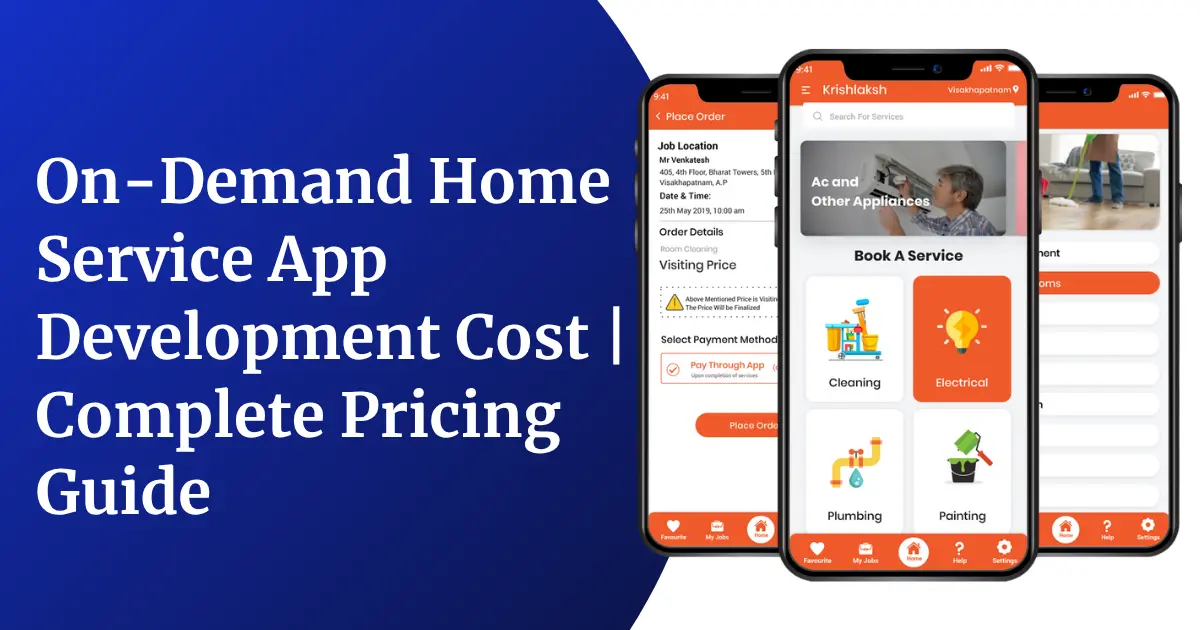
If you have ever tried to book a plumber, an electrician, a maid, or a salon expert at home with just a few taps, you already know how powerful an on-demand home service app can be. This industry is not slowing down. It is actually speeding up. More people now want cleaning, repair, beauty, pest control, and appliance services delivered to their doorstep without making a single phone call. That is exactly why so many entrepreneurs, startups, and even established businesses are asking one simple question: how much does it really cost to build a home service app in 2026?
The honest answer is, it depends. A basic app with limited features will cost far less than a full-scale, AI-powered platform with real-time tracking, in-app payments, and multi-vendor support. The <cite index=”1-1″>global online on-demand home services market is projected to grow from around USD 1,862 billion in 2026 to over USD 15,526 billion by 2035, expanding at a strong 26.57% CAGR</cite>, which simply means this is the right time to enter this space. But before you talk to any development team, you need a clear picture of pricing, cost drivers, hidden expenses, and smart budget planning. This guide breaks down everything in the simplest way possible, with real numbers, tables, and practical tips so you can plan your home service app project without any confusion.
Think about how quickly the daily routine of an average household has changed. A few years ago, people used to search for a local electrician or plumber through word of mouth or a random Google search, hope that someone answers the phone, and then wait for hours without knowing when help would actually arrive. Today, the same person opens an app, checks verified professionals near their location, sees transparent pricing, books a slot, tracks the technician in real time, and pays digitally once the job is done. This shift in behavior is not limited to metro cities anymore. Small towns and tier-2 regions are adopting on-demand home services at a fast pace too, which opens up a much bigger market opportunity for new players entering this space in 2026.
That is exactly why founders, startups, and even traditional home service businesses that used to run everything offline are now rushing to digitize their operations. But rushing into development without a clear cost roadmap is one of the most common mistakes we see. Some business owners end up overspending on features nobody uses in the first year, while others underspend on core infrastructure and end up rebuilding the entire backend after gaining a few thousand users. This guide is designed to help you avoid both mistakes by giving you a realistic, practical, and easy-to-follow cost roadmap for 2026.
How Much Does It Cost To Build An On-Demand Home Service App?
There is no single fixed price for building a home service app because every business has different goals, features, and target markets. However, based on industry patterns, home service apps are usually divided into three categories: basic, mid-level, and advanced. Let’s understand each one in detail.
Basic Home Service App
A basic home service app is ideal for startups or small businesses that want to test their idea in the market before investing heavily. It usually includes simple features like user registration, service listing, booking, basic payment options, and simple notifications. This type of app does not include advanced technology like AI-based matching or live tracking, so the cost stays on the lower side. It is a good starting point if you want to validate your business model with real users before scaling up. Most local service providers who are moving from a manual, phone-call-based booking system to their first digital product start here, because it lets them understand real demand without draining their entire budget on features they may not even need in year one.
The downside of a basic app is that it may feel limited once your user base starts growing, since it usually lacks the automation and scalability tools that busy platforms need. But for a first version meant purely for market validation, it does its job well and gives you the confidence and real user data needed to plan your next investment more wisely.
Mid-Level Home Service App
A mid-level home service app is the most common choice for growing businesses that already understand their market and want a strong, competitive product. This version includes better UI/UX, multiple payment gateways, in-app chat, live tracking, ratings and reviews, service provider verification, and a functional admin panel. It also usually supports both Android and iOS platforms, which increases the overall development time and cost compared to a basic single-platform app.
This category is usually chosen by businesses that have already tested a basic version or a manual process and are confident about their demand. It strikes a healthy balance between features and cost, giving customers a genuinely smooth experience while keeping the backend flexible enough to add more service categories or geographic zones later without a complete rebuild.
Advanced Home Service App
An advanced or enterprise-level home service app is built for businesses that want to lead the market with cutting-edge technology. This includes AI-powered service matching, predictive scheduling, subscription plans, multi-language and multi-currency support, advanced analytics dashboards, IoT-based service tracking (for example, smart home diagnostics), and strong security layers. These apps take longer to build and require a highly skilled development team, which naturally increases the budget.
Businesses that choose this route are usually already operating at scale, serving multiple cities or even multiple countries, and need the technology to keep up with high transaction volumes, complex logistics, and a large network of verified professionals. While the upfront investment is higher, the long-term benefits in terms of automation, reduced manual work, and better customer retention often justify the cost for platforms aiming to become market leaders.
Here is a simple cost comparison table to help you understand the difference clearly:
| App Type | Core Features | Platforms | Development Timeline | Estimated Cost (USD) |
| Basic Home Service App | Booking, listing, basic payments, notifications | Android or iOS (single) | 2 to 3 months | $12,000 – $25,000 |
| Mid-Level Home Service App | Live tracking, chat, ratings, multiple payments, admin panel | Android + iOS | 4 to 6 months | $30,000 – $65,000 |
| Advanced Home Service App | AI matching, subscriptions, analytics, multi-language, IoT support | Android + iOS + Web | 7 to 10+ months | $70,000 – $150,000+ |
Interestingly, home service apps share many similarities with other on-demand models, especially delivery-based platforms. If you are also curious about pricing patterns in similar industries, you can check this detailed breakdown on hyperlocal delivery app development cost to compare feature sets and budgets side by side.
How Development Cost Changes By Region
Where your development team is based has a direct and often surprising impact on the final bill. The same feature list can cost two or three times more depending on the hourly rate of the region you hire from. Here is a quick comparison to give you a realistic picture:
| Region | Average Hourly Rate (USD) | Estimated Cost For A Mid-Level App |
| North America | $100 – $180 | $90,000 – $150,000+ |
| Western Europe | $70 – $130 | $70,000 – $120,000 |
| Australia | $80 – $140 | $75,000 – $130,000 |
| Eastern Europe | $35 – $60 | $40,000 – $75,000 |
| South Asia (India, Pakistan, etc.) | $20 – $40 | $30,000 – $65,000 |
This does not mean a lower rate always means lower quality. Many development teams in South Asia and Eastern Europe deliver excellent, enterprise-grade products at a fraction of the cost charged by agencies in North America or Western Europe, which is why outsourcing has become such a popular strategy for startups working with limited funding.
Key Factors Influencing Home Service App Development Cost
The final price of your app is never random. It is shaped by several factors working together. Understanding these factors will help you make smarter decisions and avoid overspending on things you don’t actually need at launch.
1. App Complexity And Feature List
The more features you add, the higher the development hours, and the higher the cost. A simple booking flow is cheap to build, but features like real-time GPS tracking, AI-based provider matching, or dynamic pricing require extra development time, testing, and skilled engineers. It always helps to sit down and list every feature as “must-have,” “nice-to-have,” and “future roadmap” before you start talking numbers with any developer, since this alone can shrink your first invoice by a large margin.
2. Number Of Platforms
Building for Android only, iOS only, or both changes your budget significantly. A cross-platform approach using frameworks like Flutter or React Native can reduce cost compared to building two fully native apps separately, while still delivering a smooth experience. If your target city has a mix of both operating systems, going cross-platform from day one is usually the smarter financial decision rather than building native apps twice.
3. UI/UX Design Quality
A clean, modern, and easy-to-use design keeps users engaged and reduces app abandonment. Custom design work with wireframes, prototypes, and user testing takes more hours than using pre-built templates, which directly affects the final price. Remember that in a service-based app, trust is everything, and a polished, professional design plays a big role in convincing a first-time user to actually enter their home address and payment details.
4. Development Team Location
Hourly rates for developers vary a lot by region. Teams based in North America or Western Europe usually charge more per hour compared to teams in South Asia or Eastern Europe. This is one of the biggest reasons why two companies can quote very different prices for the same app, even when the feature list looks almost identical on paper.
5. Technology Stack Chosen
The programming languages, frameworks, cloud services, and databases you choose can affect both development speed and long-term maintenance cost. Some technologies are faster to build with but may cost more to scale later, so it is worth asking your development partner to justify their stack choice based on your expected growth, not just what they are most comfortable using.
6. Third-Party Integrations
Payment gateways, SMS or OTP verification, maps and location services, push notification services, and background check APIs for service providers all come with their own setup and usage fees. Each new integration adds both time and money to the project, and some of these services also charge ongoing fees based on how many transactions or messages pass through them every month.
7. Admin Panel And Dashboard Features
A powerful admin panel that lets you manage bookings, service providers, payments, complaints, and analytics is essential for running the business smoothly. Building a feature-rich dashboard takes considerable backend development effort, since it needs to pull real-time data from multiple parts of the app and present it in a way that is easy for a non-technical business owner to understand and act on.
8. Verified Service Provider Network
Since home service apps depend heavily on trained professionals, building trust and verification systems (like ID checks, ratings, and background screening) adds development work. Interestingly, the demand for flexible, app-based work continues to grow rapidly, and recent workforce research shows that <cite index=”24-1″>over 70 million Americans now freelance, making up 36% of the total workforce, with the global gig economy projected to reach $674.1 billion in 2026</cite>. This growing pool of independent workers is exactly the audience your provider-side app needs to attract, which makes verification and trust features even more important.
9. Testing, QA, And Bug Fixing
No app should go live without proper testing across multiple devices, operating systems, and network conditions. Skipping this step to save money often leads to bigger costs later in the form of poor reviews, crashes, and lost customers, which is far more expensive to fix once your app is already public and being judged by real users on the app stores.
10. Compliance And Legal Requirements
Home service apps often deal with location data, payment information, and sometimes even background checks for service providers, all of which come with legal responsibilities. Depending on your target country, you may need to budget for legal consultation, terms of service drafting, and data protection compliance, which is easy to overlook during initial planning but important to get right from the start.
11. Post-Launch Support And Updates
Your app will need regular updates, bug fixes, security patches, and new feature additions after launch. This ongoing support is usually calculated as a percentage of the initial development cost every year, and businesses that ignore this line item often end up scrambling for emergency budget within the first six months of going live.
Choosing the right technology partner also plays a huge role in controlling these costs without compromising on quality. If you are still exploring your options, this guide on how to choose the right development company can help you evaluate agencies before signing any contract.
Home Service App Development Budget Planning: Detailed Cost Breakdown
Now that you understand the factors, let’s break the entire development process into phases so you know exactly where your money is going. This kind of planning helps you avoid surprises later and gives you better control over your budget. Most business owners who skip this step end up either overpaying for a phase that did not need so much attention, or underpaying for something critical like backend architecture, which then slows down the entire project later.
A well-planned budget also makes it much easier to negotiate with development agencies, because you can ask them to justify their quote against each individual phase rather than accepting one lump-sum number without any breakdown. This transparency benefits both sides and usually results in a healthier, longer-lasting working relationship between you and your development partner.
Phase-Wise Cost Breakdown
| Development Phase | What It Includes | Estimated Cost (USD) | Approx. % Of Total Budget |
| Research & Requirement Analysis | Market study, competitor analysis, feature planning, tech consulting | $1,500 – $4,000 | 5% |
| UI/UX Design | Wireframes, prototypes, custom screens, design testing | $3,000 – $10,000 | 12% |
| Customer App Development | Booking flow, payments, tracking, notifications | $10,000 – $35,000 | 25% |
| Service Provider App Development | Job requests, earnings dashboard, availability toggle | $8,000 – $25,000 | 20% |
| Admin Panel Development | Booking management, analytics, provider approval, reporting | $6,000 – $18,000 | 15% |
| Backend & API Development | Server setup, database, security, third-party integrations | $8,000 – $22,000 | 18% |
| QA & Testing | Functional, performance, and security testing | $3,000 – $8,000 | 8% |
| Deployment & App Store Submission | Play Store and App Store listing, final checks | $500 – $2,000 | 2% |
| Post-Launch Support (Year 1) | Bug fixes, minor updates, monitoring | 15% – 20% of total cost | Ongoing |
This breakdown is only a general guideline, and your actual numbers may shift depending on the region of your development team, the specific features you choose, and how detailed your admin reporting needs to be. Businesses planning multi-vendor or multi-category platforms (similar to top players discussed in this list of leading on-demand app development companies) usually allocate a slightly higher share of their budget toward backend infrastructure since it needs to handle more service categories, higher traffic, and more complex logistics.
It also helps to keep a small buffer, usually around 10% to 15% of your total planned budget, set aside for unexpected changes during development. It is very common for business owners to request small feature tweaks or design changes once they see the actual working app for the first time, and having this buffer ready means such changes will not derail your entire project timeline or force you to cut corners elsewhere.
How To Calculate Team Cost For Your Home Service App Development
One of the easiest ways to estimate your development budget is by calculating the cost based on your team structure and hourly rates. Here is the simple formula you can use:
Total Development Cost = Total Estimated Hours × Hourly Rate Of The Development Team
To use this formula properly, you need to first estimate the total hours required for each role in your project, such as project manager, UI/UX designer, front-end developer, back-end developer, QA engineer, and DevOps specialist. Multiply the hours for each role by that role’s hourly rate, and then add all the totals together to get your final estimated cost. This approach gives you a much more accurate and transparent picture than a random flat quote, and it also helps you compare proposals from different development agencies fairly.
Here is a simple example of how this calculation might look for a mid-level home service app:
| Role | Estimated Hours | Hourly Rate (USD) | Total Cost (USD) |
| Project Manager | 200 | $30 | $6,000 |
| UI/UX Designer | 250 | $28 | $7,000 |
| Front-End Developer | 500 | $25 | $12,500 |
| Back-End Developer | 550 | $30 | $16,500 |
| QA Engineer | 200 | $22 | $4,400 |
| DevOps Specialist | 100 | $27 | $2,700 |
| Total Estimated Cost | 1,800 | — | $49,100 |
Once you have this kind of table ready for your own project, comparing quotes from three or four different agencies becomes so much easier, because you can quickly spot where one agency is charging significantly more or estimating far more hours than another for the exact same task.
Hidden Costs To Consider During Budget Planning For Home Service App
Many first-time app owners only calculate the development cost and completely forget about the expenses that come after the app is built. These hidden costs can quietly eat into your budget if you are not prepared for them in advance.
1. Third-Party API And Licensing Fees
Services like maps, SMS gateways, payment processors, and cloud storage often charge based on usage. As your user base grows, these charges increase too, so it is important to check the pricing model of every third-party service before integrating it. Many founders get surprised in their second or third month of operation when a map or SMS bill suddenly jumps because their booking volume increased faster than expected.
2. Cloud Hosting And Server Scaling
Your app’s backend needs to run on servers that can handle traffic spikes, especially during peak booking hours. As your user base expands, you may need to upgrade your hosting plan or move to more advanced cloud infrastructure, which adds recurring monthly costs. It is a good practice to ask your development team for a rough hosting cost projection at three different user-scale milestones, such as 1,000, 10,000, and 100,000 active users, so you are never caught off guard.
3. Data Security And Compliance
Since home service apps handle sensitive customer information like home addresses, phone numbers, and payment details, strong data protection is non-negotiable. Cybersecurity is becoming more expensive to ignore every year, and recent findings show that <cite index=”31-1″>one in four malicious data breaches in 2026 were AI-enabled, with these incidents costing companies an average of $6 million</cite>. Investing in proper encryption, secure servers, and regular security audits early on is far cheaper than dealing with a breach later.
4. App Store And Marketplace Fees
Both Google Play Store and Apple App Store charge developer account fees and take a commission on in-app purchases or subscriptions. These small percentages can add up significantly once your transaction volume grows, so it is worth factoring this into your pricing strategy right from the beginning rather than adjusting it later, which can confuse existing customers.
5. Marketing And User Acquisition
Building the app is only half the job. You also need a marketing budget to acquire your first customers and service providers. This includes social media ads, influencer partnerships, SEO, and referral programs, all of which require ongoing investment. A well-built app with zero marketing plan behind it will simply sit unused on the app store, so it is wise to set aside a dedicated launch marketing budget separate from your development costs.
6. Customer Support Infrastructure
As your user base grows, you will need dedicated support channels like live chat, helpdesk software, or a support team to handle complaints and refund requests. This is often overlooked during the initial budgeting stage, yet fast and friendly support is one of the biggest reasons customers stay loyal to a home service platform instead of switching to a competitor after one bad experience.
7. Continuous Maintenance And Feature Upgrades
Technology keeps changing, and so do user expectations. Regular app updates, operating system compatibility fixes, and new feature rollouts are ongoing expenses that typically cost between 15% to 25% of your original development budget every year. Planning for this from day one, rather than treating it as an afterthought, keeps your app competitive and prevents it from feeling outdated within just a year or two of launch.
How GrowRankers Will Help You As The Best Home Service App Development Company
Building a successful home service app is not just about writing code. It requires the right blend of technology, design thinking, and market understanding, and that is exactly where GrowRankers stands out. Our team takes time to understand your business model, target audience, and service categories before suggesting the right tech stack and feature roadmap. Instead of pushing unnecessary features that inflate your budget, we help you build a lean, scalable MVP first, test it in the real market, and then expand based on actual user feedback and data. This approach saves both time and money while giving you a stronger product-market fit.
What truly sets GrowRankers apart is our end-to-end support, starting from UI/UX design and app development to backend architecture, third-party integrations, app store deployment, and long-term maintenance. We also focus heavily on SEO and digital visibility from day one, so your app doesn’t just work well but is also discoverable by the right audience. Whether you are launching a single-service app for home cleaning or a multi-category platform covering repairs, beauty, and wellness services, our experienced developers and designers work as an extension of your team. If you want a transparent, honest, and results-driven development partner, GrowRankers is here to turn your home service app idea into a fully functional, revenue-generating product. From the very first consultation call to the day your app goes live on the app stores and beyond, our goal is to keep you informed, involved, and confident about every rupee or dollar you invest, so there are no hidden surprises along the way.
Conclusion
Building an on-demand home service app in 2026 is a smart move, especially with the industry growing at such an impressive pace worldwide. But the real success lies in careful planning, not just jumping straight into development. Understanding your app type, the key cost factors, a proper budget breakdown, and the hidden expenses will help you avoid unpleasant surprises and make confident decisions throughout the journey. Start small with an MVP if you are new to this space, focus on core features that solve real customer problems, and scale gradually as you gather user feedback and revenue. With the right development partner by your side, your home service app can become the go-to platform in your local market, and eventually beyond it.
Frequently Asked Questions (FAQs)
1. How much does it cost to build a home service app in 2026?
The cost usually ranges between $12,000 for a basic app and $150,000 or more for an advanced, feature-rich platform, depending on complexity, platforms, and the development team you choose. Getting a detailed quote based on your specific feature list is always more reliable than relying on general averages found online.
2. Which factors affect home service app development cost the most?
App complexity, number of platforms, UI/UX design quality, developer location, third-party integrations, and post-launch maintenance are the biggest factors that influence the overall cost. Among these, the number of features and the region of your development team usually have the largest impact on the final price.
3. How long does it take to build a home service app?
A basic app can take around 2 to 3 months, a mid-level app usually takes 4 to 6 months, and an advanced, enterprise-grade app may take anywhere between 7 to 10 months or longer.
4. Should I build for Android, iOS, or both platforms?
If your budget is limited, it is smart to start with the platform your target audience uses the most, and later expand to the other platform once you validate demand and generate revenue.
5. Is it cheaper to hire a freelancer or a development agency?
Freelancers may charge less upfront, but agencies usually offer better reliability, structured processes, dedicated support, and long-term maintenance, which can save money in the long run.
6. What is an MVP, and should I build one first?
An MVP, or Minimum Viable Product, includes only the core features needed to test your idea in the real market. Building an MVP first helps you save costs and validate demand before investing in a full-scale app.
7. How much should I budget for app maintenance every year?
On average, businesses spend around 15% to 25% of their original development cost annually on maintenance, bug fixes, security updates, and minor feature improvements.
8. Can I add new features to my home service app after launch?
Yes, most home service apps are built with scalable architecture so that new features, service categories, or integrations can be added smoothly after the initial launch, based on user feedback.
9. What are the biggest hidden costs in home service app development?
Cloud hosting, third-party API usage fees, data security compliance, marketing, and customer support infrastructure are some of the most commonly overlooked hidden costs.
10. How do I choose the right home service app development company?
Look for a company with proven experience in on-demand or service marketplace apps, transparent pricing, strong post-launch support, and a portfolio that matches your business goals before making your final decision.