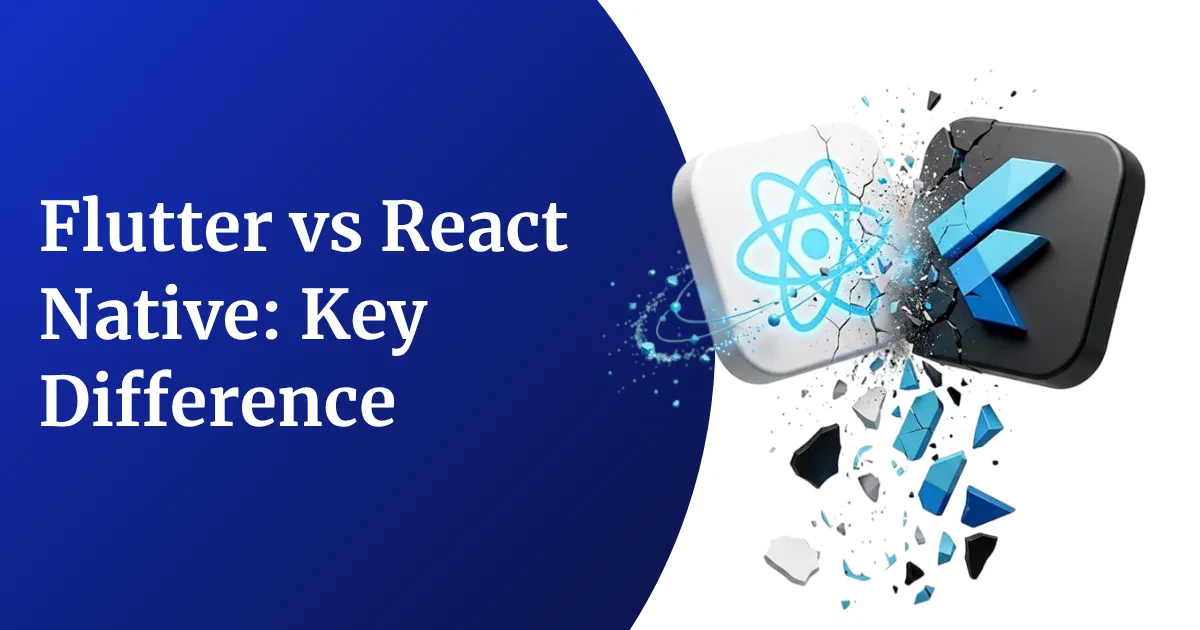
If you are planning to build a mobile app and trying to decide between Flutter and React Native, you are not alone. This is one of the most debated questions in the mobile development world today. Both frameworks are powerful, both are backed by technology giants, and both can help you ship a great product. But they are not the same, and choosing the wrong one can cost you time, money, and developer hours.
This guide breaks down everything you need to know about Flutter and React Native. We will cover what each framework is, how they compare across the most important technical and business factors, who should choose which, how to pick the right backend, and how GrowRankers can help you make the smartest choice for your specific project. Whether you are a startup founder, a product manager, or a developer, this article is written in plain language so you can walk away with real clarity.
What is React Native?
React Native is an open-source cross-platform mobile development framework created by Meta (formerly Facebook). It was released to the public in 2015 and has since become one of the most widely used tools for building mobile applications for both iOS and Android from a single codebase.
The core idea behind React Native is simple: write your app in JavaScript (or TypeScript), and the framework translates that code into native components for each platform. So instead of maintaining two completely separate apps, one in Swift for iOS and one in Kotlin for Android, you write most of your logic once and deploy it everywhere.
React Native is used by some of the biggest names in tech. Companies like Microsoft, Shopify, Meta itself, Wix, and Discord have built major parts of their mobile products using React Native. It is not a toy framework it has been battle-tested in production at serious scale.
Key Features of React Native
- JavaScript and TypeScript support — React Native uses the same language millions of web developers already know, making onboarding faster and the talent pool wider.
- Native component rendering — Rather than drawing its own UI elements, React Native maps components directly to platform-native widgets like iOS UIViews and Android Views. This means the app feels genuinely native to each platform.
- Hot Reload and Fast Refresh — Developers can see changes in real time without recompiling the entire application. This dramatically speeds up the development cycle.
- Large ecosystem and community — React Native has been around since 2015 and has a massive collection of third-party libraries, plugins, and community support.
- Code sharing with React.js — If your team already builds web apps with React, they can reuse a significant portion of business logic, state management, and even some UI components across web and mobile.
- New Architecture (JSI) — React Native recently introduced a new JavaScript Interface (JSI) that removes the old communication bridge between JavaScript and native code, resulting in much better performance.
- Expo ecosystem — Tools like Expo make it even faster to bootstrap, build, and deploy React Native apps without needing deep native configuration knowledge.
Advantages of React Native
- Faster time-to-market for teams with existing JavaScript expertise
- Huge library of community-built packages covering almost any functionality
- Strong enterprise adoption with proven scalability
- Excellent tooling and debugging support through tools like Flipper, Reactotron, and the React DevTools
- Easier hiring because JavaScript developers are abundant in the market
- Good web-to-mobile transition for companies that already use React for their frontend
What is Flutter?
Flutter is an open-source UI toolkit created by Google. It was first released in 2018 and has grown at a remarkable pace to become one of the most popular cross-platform frameworks in the world. Unlike React Native, Flutter does not rely on native platform components to render UI. Instead, it uses its own high-performance rendering engine, originally Skia, and now the newer Impeller engine to draw every pixel on the screen itself.
This means Flutter apps look and behave identically across iOS, Android, the web, Windows, macOS, and Linux. There is no risk of visual inconsistency between platforms because Flutter is not borrowing UI components from the operating system it is drawing its own.
Flutter uses Dart, a programming language also developed by Google. While Dart is not as universally known as JavaScript, it is considered clean, easy to learn, and highly performant. Most developers who come from Java, C#, or even JavaScript pick up Dart quickly.
Flutter is trusted by companies like BMW, eBay, Alibaba’s Xianyu app, and many fast-growing startups. Google itself uses Flutter for several of its own products. If you are evaluating top-tier development partners, it helps to look at the
Flutter is trusted by companies like BMW, eBay, Alibaba’s Xianyu app, and many fast-growing startups. Google itself uses Flutter for several of its own products. If you are evaluating options, it helps to look at the top Flutter app development companies to understand what expertise looks like in practice.
Key Features of Flutter
- Custom rendering engine — Flutter draws its own UI using the Impeller engine (successor to Skia), which means consistent visuals across every platform and no dependency on platform-specific UI widgets.
- Dart programming language — Dart is statically typed, compiled to native ARM code, and easy to learn. It gives Flutter apps excellent performance from the ground up.
- Rich widget library — Flutter ships with an extensive library of pre-built widgets that follow both Material Design (Google) and Cupertino (Apple) design systems. You do not need third-party UI kits to get started.
- True multi-platform support — Beyond iOS and Android, Flutter officially targets the web, Windows, macOS, Linux, and even embedded systems. React Native’s support outside mobile is more limited.
- Hot Reload — Just like React Native, Flutter supports Hot Reload, allowing developers to see UI changes instantly without losing application state.
- Strong testing framework — Flutter has built-in support for unit tests, widget tests, and integration tests, all within the same framework. No need to configure external testing tools.
- Single codebase for everything — The promise of write-once-run-anywhere is more fully realized in Flutter than in almost any other framework.
Advantages of Flutter
- Pixel-perfect UI consistency across every platform — what you design is exactly what gets rendered everywhere
- Better performance for animation-heavy or graphically rich applications
- Lower maintenance burden because the same code runs on multiple platforms without platform-specific fixes
- Excellent documentation and strong Google backing with regular, reliable updates
- Growing ecosystem with a maturing package ecosystem on pub.dev
- Ideal for startups that want to launch fast on both platforms without duplicating effort
React Native vs. Flutter: Head-to-Head Comparison
Now let us get into the real substance. Here is a direct comparison of Flutter and React Native across the factors that matter most when you are making a technology decision.
| Factor | Flutter | React Native |
| Programming Language | Dart | JavaScript / TypeScript |
| Created By | Google (2018) | Meta / Facebook (2015) |
| UI Rendering | Custom Skia/Impeller engine | Native components via bridge |
| Performance | Near-native, consistent across platforms | Good, but bridge can cause overhead |
| Code Reusability | Up to 95%+ shared codebase | Up to 90%+ shared codebase |
| Hot Reload | Yes (fast & stable) | Yes (fast & stable) |
| Community Size | Growing rapidly | Large & mature |
| Third-Party Libraries | Growing ecosystem | Very large ecosystem |
| Platform Support | iOS, Android, Web, Desktop, Embedded | iOS, Android, Web (limited) |
| Learning Curve | Moderate (Dart is new for most) | Lower (JS developers adapt quickly) |
| App Size | Slightly larger (Skia engine included) | Comparatively smaller |
| Testing Support | Excellent built-in tools | Good, relies on third-party |
| Popularity (2024-25) | Rapidly gaining momentum | Widely adopted enterprise standard |
Let us break down each of these factors in more detail so you understand not just what the difference is, but why it matters for your project.
Programming Language
React Native uses JavaScript and TypeScript. These are the most widely used programming languages in the world for frontend development. If your team already writes JavaScript for web apps, transitioning to React Native is relatively seamless. The logic, patterns, and tools are familiar.
Flutter uses Dart. Dart is a clean, modern language that most developers can learn quickly — typically within a few weeks if they have a background in any object-oriented language. However, it does require upfront learning, which can slow down initial velocity if your team has no Dart experience. The tradeoff is that Dart compiles directly to native ARM bytecode, which contributes significantly to Flutter’s performance advantages.
UI Rendering Approach
This is perhaps the most fundamental architectural difference between the two frameworks. React Native renders UI by mapping its components to the native widgets of each operating system. An iOS button in a React Native app is actually an iOS UIButton rendered by the operating system. This gives the app a truly native look and feel, but it also means the app’s appearance can vary slightly between platforms.
Flutter takes a completely different approach. It renders every UI element itself using its own graphics engine. This means a Flutter button on iOS and a Flutter button on Android look exactly the same. For apps where brand consistency and visual precision are critical, this is a major advantage. For apps where blending into the platform’s native style is important, React Native’s approach may feel more appropriate.
Performance
Both frameworks deliver excellent performance for most applications. However, Flutter has an edge in rendering consistency and animation performance because it bypasses the operating system’s UI layer entirely. There is no bridge or translation layer — Flutter code is compiled to native machine code and draws directly on the GPU.
React Native’s old architecture used a JavaScript bridge to communicate between the JS thread and native modules, which could cause performance bottlenecks in complex apps. The new architecture with JSI (JavaScript Interface) addresses this significantly, and modern React Native apps are fast. But Flutter’s architecture gives it a more predictable performance profile, especially for animation-heavy or visually complex applications.
Code Reusability
Both frameworks promise a single codebase for multiple platforms, but the degree of reuse differs. Flutter typically achieves 95% or more code sharing across platforms because the UI itself is the same everywhere. React Native can achieve around 90% reuse, with the remaining 10% often needed for platform-specific UI tweaks or native module configurations.
For teams that want to expand beyond mobile, Flutter’s multi-platform support is broader. It officially targets web, desktop, and even embedded devices. React Native’s web support exists but is less mature and requires a separate package (React Native Web).
Ecosystem and Libraries
React Native’s ecosystem is more mature simply because it has been around longer. There are thousands of community-built packages available for everything from payments to maps to biometric authentication. Most third-party services offer React Native SDKs as a priority.
Flutter’s package ecosystem on pub.dev has grown dramatically and now covers the vast majority of use cases. For common needs — networking, state management, databases, push notifications, analytics- Flutter is very well served. The main area where React Native still leads is in very specialized or niche third-party integrations that have not yet built official Flutter support.
Learning Curve
For JavaScript developers, React Native has a significantly lower barrier to entry. The concepts are familiar: components, props, state, hooks, these are the same patterns used in React.js. Getting a basic React Native app running takes hours, not days.
Flutter requires learning Dart, which adds initial friction. However, many developers report that once they get past the Dart learning curve, Flutter’s widget-based architecture is intuitive and productive. The framework’s consistency, everything is a widget, makes it easier to reason about complex layouts once you understand the model.
Community and Support
React Native has a larger total community by volume, given its longer existence and JavaScript’s massive developer base. Stack Overflow, GitHub, and YouTube are full of React Native tutorials, solutions, and discussions.
Flutter’s community is smaller but growing fast and is known for being particularly enthusiastic and supportive. Google’s backing ensures strong official documentation, regular updates, and a clear long-term roadmap. Flutter has also consistently ranked among the most popular frameworks in the Stack Overflow Developer Survey in recent years.
App Size
Flutter apps tend to be slightly larger than equivalent React Native apps. This is because Flutter bundles the Skia/Impeller rendering engine with every app, adding a base overhead of a few megabytes. For most users on modern devices, this difference is negligible. However, for markets with data-sensitive users or older devices, it is worth considering.
Platform Support
Flutter’s multi-platform ambitions are unmatched. It officially supports iOS, Android, Web, Windows, macOS, Linux, and embedded platforms — all from the same codebase. React Native focuses primarily on iOS and Android, with web support available through React Native Web but not as a first-class citizen.
If you need your app to run on desktop platforms in the future, Flutter is the significantly stronger choice today.
Choosing Between React Native and Flutter: Which One is Right for You?
There is no universally correct answer here. The right choice depends on your team, your product goals, your timeline, and your long-term platform strategy. Here is a practical framework for making the decision.
Choose React Native If…
- Your development team already knows JavaScript or TypeScript and has experience with React.js. The learning curve is minimal and you can move fast from day one.
- You need access to a large number of third-party integrations and want the widest possible library support right now, especially for specialized industry tools.
- Your app needs to feel native on both iOS and Android — using each platform’s own UI components and following their specific design guidelines.
- You are building an enterprise application where JavaScript talent is plentiful and you need to hire or scale a team quickly.
- You already have a web React codebase and want to share logic or components between web and mobile with minimal overhead.
- Your project is relatively straightforward with standard UI patterns and does not require heavy custom animations or highly complex graphical interfaces.
Choose Flutter If…
- You want pixel-perfect, consistent UI across every platform without maintaining platform-specific code for visual tweaks.
- Your app is graphically rich, animation-heavy, or requires a highly custom visual design that needs to look identical everywhere.
- You are targeting multiple platforms beyond just iOS and Android — including web, desktop, or embedded systems — and want a single codebase to rule them all.
- You are starting a new project and your team is open to learning Dart. The investment in Dart pays off quickly in terms of performance and consistency.
- You want strong built-in testing tools without having to configure external testing frameworks from scratch.
- You are a startup that wants to move fast and maintain a small, lean team that ships to all platforms simultaneously.
When the Decision is Genuinely Difficult
Sometimes neither framework is an obvious winner. In these cases, consider running a short spike — a 1-to-2 week technical prototype in both frameworks — and evaluate which one your team is more productive with and which better fits your product’s visual and functional needs. The productivity difference for your specific team and project matters more than any benchmark comparison.
It is also worth thinking about long-term maintenance. Both frameworks are actively maintained and have strong backing. But consider: if you need to hire developers two years from now, which pool will be larger? If you need to add desktop support next year, which framework makes that easier? These questions should weigh into your decision.
Additionally, if you want a deeper look at cost implications for your build decision, it helps to understand
Additionally, if you want a deeper look at cost implications for your build decision, it helps to understand how much it costs to build a Flutter app so you can plan your budget accurately before committing to a framework.
Finding the Right Backend for React Native and Flutter
One of the most important but often overlooked parts of building a cross-platform mobile app is the backend. Both React Native and Flutter are frontend frameworks — they handle the client-side UI and logic. They need a server-side backend to handle data storage, authentication, business logic, APIs, and third-party service integrations.
The good news is that neither framework is opinionated about the backend. They both communicate with backends via standard REST APIs, GraphQL, or WebSockets. This means your backend choice is entirely independent of your Flutter or React Native decision.
Firebase — The Most Popular Backend for Both
Firebase, Google’s mobile and web backend platform, is the most commonly used backend for both Flutter and React Native projects. It offers real-time databases (Firestore and the Realtime Database), authentication, push notifications, cloud storage, crash reporting, and analytics — all in one platform.
Flutter has especially deep Firebase integration through the FlutterFire suite of official packages, which makes connecting your Flutter app to Firebase straightforward and well-maintained. React Native also has excellent Firebase support through the React Native Firebase library.
Firebase is ideal for startups and MVPs where speed of development matters and you do not want to spend time setting up and maintaining your own server infrastructure.
Node.js with Express or Fastify
For teams that want more control over their backend, Node.js remains a top choice. It pairs especially well with React Native because your frontend and backend teams can both work in JavaScript, sharing models, types, and even validation logic. Node.js backends are fast to set up, highly scalable with the right architecture, and have an enormous ecosystem.
Flutter projects also work seamlessly with Node.js backends — the Flutter app communicates with the API over HTTP just like any other client. There is no technical friction, only the separation of language environments.
Supabase — The Open-Source Firebase Alternative
Supabase has emerged as a compelling open-source alternative to Firebase. It offers a Postgres database, authentication, real-time subscriptions, storage, and edge functions — all with a REST and GraphQL API layer on top. Supabase is increasingly popular for both Flutter and React Native projects where teams want Firebase-like ease of use but with a relational database and no vendor lock-in.
AWS Amplify
For enterprise-level projects, AWS Amplify provides a managed backend service with deep integration with the broader AWS ecosystem. It supports authentication (via Cognito), REST and GraphQL APIs (via AppSync), databases (via DynamoDB), storage (via S3), and serverless functions (via Lambda). Both Flutter and React Native have official AWS Amplify libraries.
Custom REST or GraphQL APIs
For more complex applications, a custom backend is often the right choice. This might be built with Django (Python), Laravel (PHP), Spring Boot (Java), or Go. Whatever language or framework you choose for the backend, both Flutter and React Native can consume its APIs. The key is designing clear, versioned API contracts early so that frontend and backend teams can work in parallel.
Wondering how long the full development process takes when factoring in backend setup? You can get a realistic picture by reading about
Wondering how long the full development process takes when factoring in backend setup? You can get a realistic picture by reading about how long it takes to build a Flutter app, which covers timelines for projects of different complexity levels.
How GrowRankers Will Help You Understand and Choose the Right Framework
Choosing between Flutter and React Native is not just a technical decision — it is a business decision that affects your development costs, time-to-market, long-term maintenance burden, and team structure. Getting it wrong can be expensive. Getting it right can give your product a significant competitive advantage.
GrowRankers is a digital growth agency founded in 2024 and headquartered in Jaipur, India. We specialize in helping startups and growing businesses make smart technology decisions and build products that perform. Our team works across mobile app development strategy, SEO content marketing, and digital growth — which means we understand not just the technical side, but how your technology choices affect your ability to market, scale, and compete.
Framework Selection Consultation
Our technical team will sit down with you to understand your product requirements, team capabilities, target audience, timeline, and budget. Based on that understanding, we provide a clear recommendation on whether Flutter or React Native is the better fit for your specific situation — not a generic answer, but one grounded in your actual context.
Development Partner Evaluation
Not every agency that claims to build Flutter or React Native apps has the depth of experience to do it well. GrowRankers helps you evaluate and shortlist the right development partner for your project. We know what questions to ask, what work samples to look for, and what red flags to watch out for. If you are looking for guidance on evaluating a Flutter partner specifically, our guide on
Not every agency claims the same depth. If you are evaluating a Flutter development partner, our guide on how to choose the perfect Flutter app development company walks you through exactly what to look for, what to ask, and what to avoid.
Technical Content and SEO Strategy
If you are building a product in the Flutter or React Native space — whether it is an agency, a SaaS tool, or a platform — GrowRankers can help you create the SEO and content strategy that puts you in front of your target audience. We understand how developers and decision-makers search, what keywords they use at different stages of their buying journey, and how to create content that ranks and converts.
End-to-End Growth Support
From the first technology decision to your first 10,000 users and beyond, GrowRankers is built to support your growth at every stage. We do not just help you build — we help you grow. Our services span market research, competitive analysis, content strategy, technical SEO, and digital marketing — all tailored to startups and growth-stage companies.
Whether you are still deciding which framework to use, actively looking for a development partner, or already post-launch and looking to scale, GrowRankers can add value at every stage of your journey. Reach out to us to start a conversation about your specific project and goals.
Frequently Asked Questions (FAQs)
1. Is Flutter better than React Native in 2025?
Neither is universally better — it depends on your use case. Flutter excels at pixel-perfect cross-platform UI, custom animations, and multi-platform support beyond mobile. React Native is better when your team already knows JavaScript, when you need a vast library ecosystem, or when native look-and-feel on each platform is a priority. Both are excellent frameworks with strong communities and corporate backing.
2. Which framework should a beginner start with?
If you are already familiar with JavaScript, React Native is likely the easier starting point because you can leverage existing knowledge. If you are starting fresh or want to learn a framework that gives you broader platform coverage, Flutter with Dart is highly approachable and has excellent documentation for beginners.
3. Can Flutter and React Native apps compete with fully native apps in terms of performance?
For the vast majority of applications, yes. Both frameworks deliver performance that is indistinguishable from native for standard use cases. Flutter has a slight edge in rendering consistency and animation performance. React Native’s new architecture (JSI) has significantly closed the performance gap that existed in older versions. Only extremely performance-intensive applications — like high-end games or apps using complex hardware features — might still benefit from fully native development.
4. How large is the talent pool for each framework?
React Native benefits from a much larger talent pool simply because JavaScript developers are far more numerous globally. Finding skilled React Native developers is generally easier and faster. Flutter’s talent pool is smaller but growing rapidly, and demand for Flutter developers is also increasing significantly as adoption grows. In 2025, finding experienced Flutter developers is easier than it was three years ago.
5. Can I use the same backend for both Flutter and React Native?
Absolutely. Both frameworks communicate with backends through standard APIs (REST, GraphQL, WebSockets). Your backend is completely independent of your frontend framework choice. Whether you use Firebase, Node.js, AWS, or a custom API, it will work equally well with both Flutter and React Native.
6. Is it expensive to switch from React Native to Flutter or vice versa?
Switching between frameworks mid-project can be costly because the codebase architecture, widget/component model, and language are all different. A complete rewrite is often necessary. For this reason, it is very important to make the right framework choice before you begin development. That said, business logic and API integration code can often be translated between frameworks with reasonable effort.
7. Which framework is better for startups?
Both can work well for startups. Flutter tends to be preferred by startups that value visual consistency, want to target multiple platforms quickly, and are willing to invest a short time in learning Dart. React Native is preferred by startups with existing JavaScript teams or those that want to leverage the larger JavaScript ecosystem. For an MVP that needs to ship fast to both iOS and Android, both frameworks are capable choices.
8. Does Google’s backing of Flutter guarantee its long-term survival?
Strong corporate backing is generally a positive signal, but it is not an absolute guarantee. Google has deprecated products in the past. However, Flutter’s adoption level, community size, and integration into Google’s own products suggest it is a strategic priority for Google, not a side project. Meta’s continued investment in React Native’s new architecture similarly signals long-term commitment. Both frameworks appear to have strong futures based on current signals.
9. Can Flutter apps be published to the App Store and Google Play?
Yes, absolutely. Flutter compiles to native ARM code for both iOS and Android. The output is a standard native app package (.ipa for iOS, .apk or .aab for Android) that meets all App Store and Google Play requirements. There is nothing about a Flutter app that makes it harder or more restrictive to publish than a fully native app.
10. How do Flutter and React Native handle device-specific features like the camera or GPS?
Both frameworks handle device features through platform-specific plugins. For React Native, these are native modules. For Flutter, they are platform channels and plugins available on pub.dev. Common device features — camera, GPS, biometrics, push notifications, Bluetooth, accelerometer — are well-supported by established plugins in both ecosystems. For very niche or cutting-edge hardware features, you may occasionally need to write custom native code regardless of which framework you choose.
11. Which framework has better support for accessibility?
Both Flutter and React Native have made significant investments in accessibility. Flutter provides a Semantics widget that lets you add accessibility metadata to any UI element. React Native similarly supports accessibility props and follows platform accessibility guidelines. For apps where accessibility is a top priority, both frameworks are capable of meeting WCAG and platform accessibility standards with proper implementation.
12. Is Flutter or React Native better for e-commerce apps?
Both frameworks have been used successfully for e-commerce applications. React Native’s extensive ecosystem includes mature libraries for payment processing, product browsing, and cart management that integrate easily with platforms like Shopify or WooCommerce. Flutter’s smooth animations and visually consistent UI make for excellent product browsing and checkout experiences. The choice should come down to your team’s skills and your specific UI requirements rather than inherent suitability for e-commerce.
13. How does hot reload work in Flutter and React Native, and is there a difference?
Hot reload is a feature in both frameworks that lets developers see code changes reflected in the running app almost instantly, without losing the current application state. In Flutter, Hot Reload is particularly stable and reliable — it reinjects updated widget trees without restarting the app. React Native’s Fast Refresh (the modern iteration of hot reload) is similarly powerful but has historically been slightly more prone to requiring a full reload for certain types of changes. In day-to-day development, both work extremely well and provide a significantly faster feedback loop than traditional compile-and-run cycles.
14. Which framework handles state management better?
Both frameworks support multiple state management approaches. In React Native, popular options include Redux, Zustand, MobX, and React Context. In Flutter, popular choices include Provider, Riverpod, Bloc/Cubit, and GetX. Neither framework forces you into a specific state management pattern, which is both a strength and a source of confusion for new developers. Flutter’s Riverpod and Bloc are particularly well-regarded for medium-to-large applications. React Native’s Redux integration is mature but increasingly challenged by simpler alternatives like Zustand.
15. How do I find a reliable Flutter or React Native development company?
Look for agencies with a proven portfolio of shipped apps in your domain, transparent development processes, strong communication practices, and verifiable client references. Check platforms like Clutch, Upwork, and LinkedIn for reviews and portfolio evidence. Ask about their testing practices, code review processes, post-launch support, and how they handle scope changes. For Flutter specifically, our guide on
For Flutter specifically, our guide on how to choose the perfect Flutter app development company covers all of these evaluation criteria in detail.
Both Flutter and React Native are mature, production-ready frameworks that have proven themselves at scale. The debate between them is not about which is superior — it is about which is the right fit for your team, your product, and your goals. Use this guide as a foundation for your decision, involve your development team in the conversation, and if you need expert guidance, GrowRankers is here to help you make the smartest choice for your specific situation.