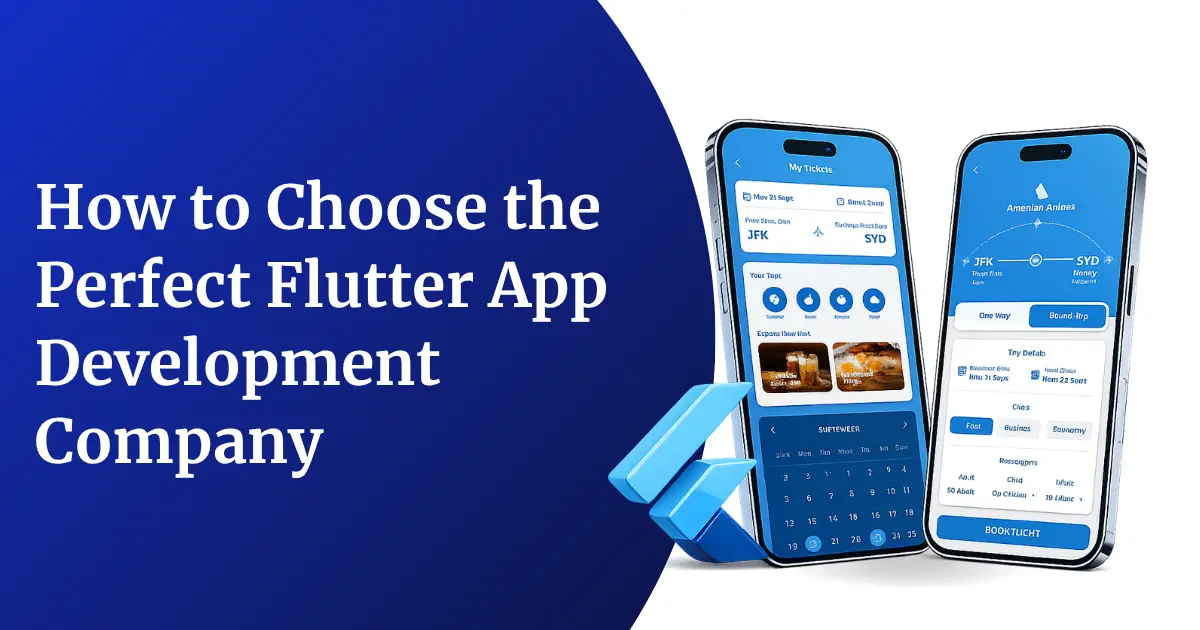
According to Statista’s Global Mobile App Revenue Report, the global mobile app market is projected to generate over $935 billion in revenue by 2023 and that figure continues to climb year over year. With Flutter emerging as one of the most powerful cross-platform frameworks, businesses worldwide are racing to build high-performance apps. But the biggest challenge remains: finding the right Flutter development company that can turn your idea into a market-ready product.
Choosing the perfect Flutter development company is one of the most important business decisions you will make when launching a mobile application. Flutter, Google’s open-source UI toolkit, has transformed the mobile app landscape by allowing developers to build beautifully crafted, natively compiled applications for mobile, web, and desktop from a single codebase. Its growing adoption rate and rich ecosystem make it a top choice for businesses of every size — from startups to global enterprises.
However, not every Flutter app development agency is built the same. Differences in technical expertise, project management methodologies, communication standards, pricing models, and portfolio quality can dramatically affect the outcome of your project. A wrong choice could cost your business time, money, and competitive edge. This comprehensive guide walks you through everything you need to know to evaluate, compare, and confidently select the best Flutter app development company for your needs in 2026.
Why Flutter Is the Preferred Framework for Mobile App Development in 2026
Before diving into how to choose a Flutter development partner, it’s worth understanding why Flutter stands out in a crowded market of mobile development frameworks. Flutter was created by Google and has quickly become one of the most starred open-source projects on GitHub. Here’s why businesses and developers love it:
- Single Codebase for Multiple Platforms: Flutter allows developers to write code once and deploy it across Android, iOS, web, desktop (Windows, macOS, Linux), and embedded devices. This dramatically reduces development time and cost.
- High Performance with Native Compilation: Flutter compiles directly to native ARM machine code, ensuring near-native performance without JavaScript bridges that can slow down other hybrid frameworks.
- Rich Widget Library: Flutter ships with an extensive library of pre-built, customizable widgets that follow both Material Design and Cupertino (Apple) design standards, making it easy to create visually stunning UIs.
- Hot Reload Feature: Developers can instantly see the effects of code changes without restarting the app, leading to faster development cycles and quicker iteration.
- Strong Google Backing and Growing Community: With continuous updates and a large global developer community, Flutter’s ecosystem is vibrant and future-proof.
- Cost-Effective Development: Building one app instead of two (iOS + Android) means significantly lower development costs and easier long-term maintenance.
Flutter vs Other Cross-Platform Frameworks: A Quick Comparison
| Feature | Flutter | React Native | Xamarin | Ionic |
| Language | Dart | JavaScript | C# | HTML/JS/CSS |
| Performance | Excellent | Good | Good | Average |
| UI Components | Custom Widgets | Native + JS Bridge | Native | Web-based |
| Hot Reload | Yes | Yes | Limited | Yes |
| Community Size | Large & Growing | Very Large | Medium | Medium |
| Single Codebase | Yes | Yes | Yes | Yes |
| Desktop Support | Yes | Limited | Yes | Limited |
| Backed By | Meta | Microsoft | Ionic Team |
Key Factors to Consider When Choosing a Flutter Development Company
Selecting the right Flutter development partner requires evaluating multiple dimensions. Here are the most critical factors to assess before signing any contract:
1. Technical Expertise and Flutter-Specific Skills
The first and most fundamental criterion is technical depth. Not every mobile development company has genuine expertise in Flutter. Many agencies claim Flutter capabilities but rely on generic mobile developers who have dabbled with the framework occasionally. You need a team that breathes Flutter daily.
Here is what to look for when assessing technical skills:
- Dedicated Flutter developers with verifiable Dart programming proficiency
- Experience with Flutter state management solutions such as Provider, Riverpod, BLoC, and GetX
- Knowledge of Flutter’s widget tree, rendering engine, and performance optimization techniques
- Hands-on experience integrating third-party APIs, payment gateways, maps, and push notifications
- Familiarity with Flutter’s platform channels for accessing native device features
- Expertise in automated testing frameworks including Flutter Test and integration testing
- Ability to build custom animations and advanced UI components using Flutter’s animation library
Ask potential partners to walk you through a technically challenging project they’ve completed in Flutter. Their ability to explain architectural decisions and trade-offs will reveal much about their actual skill level.
2. Portfolio Quality and Industry Experience
A Flutter development company’s portfolio is its professional resume. Reviewing past work helps you understand their design sensibility, technical capabilities, and domain knowledge. When examining portfolios, pay attention to:
- Visual quality and UI/UX sophistication of completed apps
- Complexity of features implemented — does the work go beyond simple CRUD applications?
- Industry diversity — have they worked in your sector (fintech, healthcare, ecommerce, edtech, etc.)?
- App performance ratings and user reviews on app stores (Google Play / Apple App Store)
- Scale of projects handled — startup MVPs, mid-size business tools, or enterprise-grade platforms?
- Live applications that you can download and test personally
If a company cannot show you live Flutter apps in production, that is a significant red flag. Any credible Flutter agency should have a portfolio of deployable, real-world applications.
3. Client Reviews and Verified Testimonials
Peer reviews are among the most reliable signals of a development company’s real-world performance. Independent review platforms such as Clutch.co, GoodFirms, and Google Business Reviews provide unfiltered feedback from past clients. When reading reviews, assess:
- Overall satisfaction rating (aim for companies with 4.5 stars or above across multiple platforms)
- Quality of communication and responsiveness throughout the project
- How the company handled unexpected challenges, scope changes, or technical obstacles
- Whether they delivered projects on time and within budget
- Long-term client relationships — are there clients who have returned for multiple projects?
- Specific mentions of individual team members who went above and beyond
Don’t rely solely on testimonials published on a company’s own website, as these are curated. Always cross-reference with independent third-party review platforms.
4. Development Process and Project Management Methodology
A great Flutter development company isn’t just technically skilled — it also follows a structured, transparent process that keeps you informed and in control throughout the project lifecycle. The best agencies typically follow Agile or Scrum methodologies, which involve:
- Short development sprints (usually 1–2 weeks) with clearly defined deliverables per sprint
- Regular sprint reviews and demos so you can provide feedback early and often
- Daily or weekly standup meetings to track progress and address blockers
- A dedicated project manager or Scrum Master as your primary point of contact
- Use of project management tools like Jira, Asana, Trello, or ClickUp for transparency
- Version control through GitHub or GitLab with clear branching strategies
- Continuous integration and deployment (CI/CD) pipelines for smooth releases
Agencies that lack a defined process often deliver inconsistent results, miss deadlines, or lose track of requirements. Always ask for a detailed project plan before the engagement begins.
5. Team Composition and Availability
Understanding who will actually be working on your project is critical. Many agencies present senior talent during sales calls, only to assign junior developers to your project once the contract is signed. Ask explicitly:
- Who specifically will be assigned to your project developers, designers, QA engineers, and project managers?
- What is the experience level (junior, mid, senior) of each team member?
- Will the team work exclusively on your project or juggle multiple clients simultaneously?
- What is the team’s availability full-time, part-time, or on-demand?
- How is knowledge transfer handled if a team member leaves mid-project?
- Is there a dedicated QA tester to ensure bug-free delivery?
Insist on meeting the actual development team before finalizing the partnership, not just the business development representatives.
6. Communication Standards and Transparency
Communication breakdowns are one of the leading causes of failed software development projects. A reliable Flutter development company maintains clear, consistent, and proactive communication. Evaluate their communication by considering:
- Preferred communication channels (Slack, Microsoft Teams, Zoom, email)
- Response time commitments — do they respond within a defined SLA?
- Time zone compatibility and overlap hours for real-time collaboration
- Frequency and format of progress reports (weekly updates, sprint reports, dashboards)
- Clarity of technical documentation including requirements specs, design docs, and API references
- Availability of the project manager for escalations and urgent issues
If a company is slow to respond during the sales process, it’s likely a preview of how they’ll communicate during development. First impressions of communication reliability matter enormously.
7. Pricing Models and Budget Transparency
Budget management is a major concern for most businesses engaging with a development partner. Companies typically offer several Flutter app development pricing models, each with its own advantages and risks:
| Pricing Model | Best For | Key Consideration |
| Fixed Price | Well-defined projects with clear scope | Risk of hidden costs if scope creeps |
| Time & Material (T&M) | Evolving projects with flexible requirements | Requires close monitoring of hours |
| Dedicated Team | Long-term product development | Higher upfront cost but better team alignment |
| Milestone-Based | Projects with phased delivery | Requires clear milestone definitions |
| Retainer Model | Ongoing support and feature releases | Ideal for post-launch maintenance |
Regardless of the pricing model you choose, insist on a detailed breakdown of costs — developer rates by level, QA hours, project management fees, design hours, and any additional infrastructure or third-party service costs. Transparent pricing is a hallmark of a trustworthy agency.
8. Post-Launch Support and Long-Term Maintenance
Your relationship with a Flutter development company shouldn’t end at launch. Mobile apps require regular updates, performance monitoring, security patches, bug fixes, and new feature additions to remain competitive. Evaluate what post-launch support looks like:
- Do they offer a dedicated maintenance contract with defined SLA?
- How do they handle emergency bug fixes and critical incidents?
- Do they provide app monitoring using tools like Firebase Crashlytics, Sentry, or Datadog?
- How do they manage OS updates (Android/iOS) that may break existing functionality?
- What is the process for adding new features after the initial release?
- Is there a warranty period post-launch where they fix bugs at no additional cost?
Companies that are invested in long-term client relationships will always have clearly defined post-launch support offerings. Avoid agencies that consider the project done the moment they hand over the code.
9. Security Standards and Data Privacy Compliance
In an era of increasing cybersecurity threats and regulatory requirements, security cannot be an afterthought. A professional Flutter development company should follow industry best practices for application security, including:
- Secure data transmission using HTTPS/TLS protocols
- Implementation of proper authentication mechanisms (OAuth 2.0, JWT, biometric authentication)
- Secure local storage for sensitive data using Flutter Secure Storage
- Protection against common vulnerabilities: SQL injection, XSS, CSRF, man-in-the-middle attacks
- Compliance with data privacy regulations such as GDPR, CCPA, HIPAA (if applicable)
- Regular code security audits and penetration testing practices
- Responsible handling of third-party SDKs and open-source libraries to minimize supply chain risks
Ask about their security testing checklist and whether they have worked on regulated industries such as healthcare or financial services, which have the highest security requirements.
10. Cultural Fit and Shared Vision
Technical skills and pricing aside, cultural alignment between your team and your development partner plays a surprisingly important role in project success. A company that understands your business goals, shares your sense of urgency, and aligns with your work culture will go the extra mile to deliver outstanding results. Assess cultural fit by:
- Evaluating how well they understand your business domain during initial discovery calls
- Observing whether they proactively suggest improvements or simply execute what’s given
- Assessing their attitude toward feedback — do they welcome iteration or resist changes?
- Understanding their company values — do innovation, quality, and client success drive their culture?
- Checking their employee retention rates — a stable team means continuity on your project
Flutter Development Company Evaluation Checklist
Use this comprehensive checklist when evaluating potential Flutter development partners to ensure you cover all critical dimensions:
| # | Evaluation Criterion | Status | Notes |
| 1 | Flutter portfolio with live app links reviewed | ☐ Yes ☐ No | |
| 2 | Client reviews verified on Clutch.co or GoodFirms | ☐ Yes ☐ No | |
| 3 | Team CVs and Flutter certifications reviewed | ☐ Yes ☐ No | |
| 4 | Development process and methodology documented | ☐ Yes ☐ No | |
| 5 | Pricing model and cost breakdown provided | ☐ Yes ☐ No | |
| 6 | Communication plan and tools defined | ☐ Yes ☐ No | |
| 7 | Post-launch support terms agreed | ☐ Yes ☐ No | |
| 8 | Security standards and compliance verified | ☐ Yes ☐ No | |
| 9 | NDA and IP ownership terms clear | ☐ Yes ☐ No | |
| 10 | References contacted and feedback received | ☐ Yes ☐ No | |
| 11 | Discovery or requirements session completed | ☐ Yes ☐ No | |
| 12 | Technology stack and architecture plan shared | ☐ Yes ☐ No |
Red Flags to Watch Out For When Evaluating Flutter Agencies
Knowing what to avoid is just as important as knowing what to look for. Here are the most common warning signs that a Flutter development company may not be the right fit:
- No live Flutter apps in their portfolio — only mockups, screenshots, or demo links
- Inability to answer basic technical Flutter questions during the vetting process
- No dedicated project manager — just developers who also manage client communication
- Extremely low pricing that seems too good to be true — quality development has a minimum viable cost
- Vague or generic proposals that don’t reflect understanding of your specific project requirements
- Pressure tactics or urgency to sign contracts quickly without adequate discovery
- No clear intellectual property assignment clause in the contract
- Poor English communication skills (for international agencies), leading to chronic misunderstandings
- High team turnover mentioned in reviews or during the conversation
- No mention of testing, QA, or quality assurance processes in their development workflow
- Reluctance to provide references from past clients
- Overpromising on timelines without conducting a proper technical assessment
Essential Questions to Ask Before Hiring a Flutter Development Company
Preparing a strong list of discovery questions helps you cut through marketing language and get to the substance. Here are the questions every business owner should ask:
- How many Flutter apps have you built from scratch, and how many are live on the App Store or Google Play?
- Which state management architectures do your Flutter developers prefer, and why?
- How do you handle project scope changes mid-development, and what is your change request process?
- What does your quality assurance process look like — do you have dedicated QA engineers?
- How do you ensure app performance and smooth 60fps UI rendering across different devices?
- What tools and platforms do you use for project communication and progress tracking?
- Who owns the source code and intellectual property once the project is complete?
- How do you handle data security and privacy compliance within the app?
- What is your policy on post-launch bug fixes and what is included in your maintenance plan?
- Can you provide contact details of two to three past clients I can speak with directly?
- How do you manage time zone differences and ensure adequate daily overlap with our team?
- What is your disaster recovery plan if a key team member leaves mid-project?
How GrowRankers Can Help You Build a World-Class Flutter Application
At GrowRankers, we don’t just build Flutter apps — we build digital experiences that drive measurable business growth. As a full-service Flutter development and digital marketing company, we bring together elite technical expertise, creative design thinking, and data-driven strategy to deliver mobile applications that stand out in competitive markets.
Here is what makes GrowRankers the ideal Flutter development partner for businesses in 2026:
Expert Flutter Development Team
Our Flutter development team consists of senior engineers who have been building Dart and Flutter applications since the framework’s early days. Every developer on our team brings deep expertise in the full Flutter stack — from custom widget development and advanced animations to native integrations and CI/CD pipeline setup. We don’t assign junior developers to client-facing work without senior oversight, ensuring consistently high-quality output.
End-to-End Product Development
GrowRankers handles the entire product lifecycle under one roof. From initial concept validation and UX research to UI design, Flutter development, backend API development, quality assurance, app store submission, and post-launch growth marketing — we eliminate the coordination overhead of working with multiple vendors. Our integrated approach ensures seamless communication, consistent product vision, and faster time-to-market.
Proven Portfolio Across Multiple Industries
We have successfully delivered Flutter applications across diverse verticals including ecommerce, healthcare, fintech, edtech, on-demand services, and social platforms. Our portfolio includes apps that have achieved top rankings in their respective categories on both the Google Play Store and the Apple App Store. We are not a generalist agency — we are specialists who understand the technical and user experience demands of each industry we serve.
Agile Methodology with Full Transparency
GrowRankers follows a strict Agile Scrum development process with bi-weekly sprint cycles. Every client gets a dedicated project manager, access to a live project dashboard, weekly progress reports, and sprint review sessions where you can see working software — not just slides. We use industry-standard tools including Jira, Confluence, GitHub, and Slack to ensure every stakeholder is always in the loop.
Competitive and Transparent Pricing
We believe that world-class Flutter development should be accessible to businesses of all sizes. GrowRankers offers flexible engagement models, fixed price, time and materials, and a dedicated team with completely transparent pricing. No hidden fees, no surprise invoices. Every cost is documented in detail before any work begins, giving you complete budget confidence.
Comprehensive Post-Launch Support
Our relationship with clients extends well beyond the launch date. GrowRankers offers structured maintenance plans that include performance monitoring, security updates, OS compatibility maintenance, bug fixing, and feature enhancement sprints. We are committed to the long-term success of every application we build, treating your app’s growth as our own.
Digital Marketing and ASO Integration
As a full-stack digital growth company, GrowRankers uniquely combines Flutter app development with App Store Optimization (ASO), SEO, paid user acquisition, and conversion rate optimization strategies. When we build your app, we also build the visibility and user acquisition strategy to ensure it reaches its target audience from day one. This end-to-end approach is what separates GrowRankers from pure-play development agencies.
Average Cost of Flutter App Development in 2026
Understanding typical cost ranges helps set realistic budget expectations. Here is a general overview of Flutter app development costs based on project complexity:
| Project Type | Timeline | Estimated Cost | Typical Features |
| Simple MVP App | 4–8 weeks | $5,000 – $15,000 | Basic screens, local storage, 1–2 API integrations |
| Medium Complexity App | 8–16 weeks | $15,000 – $45,000 | User auth, backend, payments, push notifications |
| Complex Enterprise App | 16–32 weeks | $45,000 – $120,000 | Custom backend, advanced integrations, admin panel |
| On-Demand Platform | 20–40 weeks | $80,000 – $200,000+ | Real-time features, maps, multi-role system |
| Maintenance (Monthly) | Ongoing | $500 – $3,000/mo | Bug fixes, updates, monitoring, minor features |
Note: These are approximate ranges and actual costs vary based on your specific requirements, team location, feature complexity, and design specifications. Always request a detailed project estimate after a proper discovery session.
[Also Read:- iOS App Development Cost in India]
Pro Tips for Making the Final Decision
After completing your evaluation, here are some additional strategies to help you make the most confident final decision:
- Run a paid discovery sprint: Before committing to full development, pay the shortlisted agency to complete a paid discovery phase (2–4 weeks). This gives you real-world experience working with their team and validates their process claims.
- Request a technical proposal: Ask each agency for a technical proposal outlining their recommended architecture, technology choices, and development approach for your specific project. The depth of this proposal reveals their technical maturity.
- Compare apples to apples: When comparing proposals from multiple agencies, ensure they are all quoting on the same feature set and scope. Significant price differences usually mean different scopes, not necessarily better value.
- Check their GitHub: If the agency shares open-source work or public repositories, review their code quality, commit history, and code documentation practices.
- Evaluate their design capability: A Flutter app is only as good as its UX/UI design. Ask to see their design process — wireframes, prototypes, and user testing approaches.
- Trust your gut about communication: Beyond all checklists, how you feel communicating with them during the sales process is often the most accurate predictor of how collaboration will feel during development.
Conclusion
Choosing the perfect Flutter development company is not a decision to be taken lightly. It requires systematic evaluation across technical expertise, portfolio quality, development process, communication standards, pricing transparency, and long-term support capabilities. The framework you choose and the team you build with will directly determine whether your mobile application succeeds or stagnates.
Flutter continues to dominate the cross-platform mobile development landscape in 2026, and the right development partner can help you leverage its full potential to deliver a high-performance, visually stunning app that works seamlessly across Android, iOS, and beyond. Use the factors, checklists, and questions outlined in this guide to conduct a thorough evaluation, avoid common pitfalls, and ultimately select a partner you can trust.
At GrowRankers, we have helped dozens of businesses across multiple industries bring their Flutter app visions to life, on time, within budget, and with measurable business results. Whether you are building your first MVP or scaling an enterprise platform, our team is ready to be the Flutter development partner that grows with you.
Ready to build something exceptional? Connect with the GrowRankers Flutter team today and let’s turn your idea into a world-class mobile application.
Frequently Asked Questions (FAQs)
What is Flutter and why is it popular for mobile app development?
Flutter is an open-source UI software development kit created by Google that allows developers to build natively compiled applications for mobile (Android and iOS), web, and desktop from a single codebase using the Dart programming language. It is popular because of its exceptional performance, beautiful pre-built widgets, hot reload functionality for faster development, and significant cost advantages from maintaining a single codebase instead of separate native apps for each platform.
How do I verify if a Flutter development company is genuinely experienced?
The most reliable way to verify genuine Flutter expertise is to review their portfolio of live applications on the Google Play Store and Apple App Store. You should also request a technical interview with the developers who will work on your project, ask them to explain their approach to state management, performance optimization, and architecture decisions. Additionally, check reviews on independent platforms like Clutch.co, GoodFirms, and G2, and speak directly with at least two to three of their past clients.
How much does it typically cost to hire a Flutter development company?
Flutter app development costs vary widely depending on the complexity of the application, the geographic location of the development team, and the engagement model. Simple MVP applications typically range from $5,000 to $15,000, while medium-complexity apps with authentication, payment integration, and backend systems can range from $15,000 to $45,000. Enterprise-grade or on-demand platform applications can cost anywhere from $80,000 to over $200,000. It is essential to get a detailed scope-based estimate after a thorough discovery session.
What is the typical timeline for building a Flutter app?
The development timeline depends heavily on the scope and complexity of the application. A basic MVP with core features can be built in 4 to 8 weeks. A medium-complexity app typically takes 8 to 16 weeks. Feature-rich enterprise applications or platforms with real-time functionality, multiple user roles, and complex backend systems can take anywhere from 4 to 10 months. Rushing timelines often compromises quality — any agency that promises very fast delivery without understanding your requirements should be approached with caution.
Should I choose a local Flutter development company or an offshore agency?
Both options have distinct advantages. Local agencies offer easier communication, time zone alignment, and the ability to meet in person, but they typically come at a higher price point. Offshore agencies in regions like South Asia, Eastern Europe, and Southeast Asia often offer excellent quality at significantly lower hourly rates. The key factors to evaluate are communication quality, English proficiency, time zone overlap, process maturity, and verifiable portfolio quality — these matter far more than geographic location for project success.
What should be included in a Flutter development contract?
A comprehensive Flutter development contract should include a detailed scope of work with feature specifications, project timeline with milestones and deliverables, payment terms and schedule, intellectual property and source code ownership clauses (ensure you own 100% of the code), confidentiality and NDA terms, change request process and pricing, warranty period for post-launch bug fixes, termination conditions and notice periods, and a clear definition of the acceptance criteria for completed work.
How do I ensure the quality of a Flutter app built by an agency?
Quality assurance should be built into every stage of the development process, not just handled at the end. Ensure the agency has dedicated QA engineers who perform manual and automated testing throughout development. Ask about their test coverage metrics, regression testing practices, device testing matrix (testing on multiple devices and OS versions), performance benchmarking, user acceptance testing (UAT) process, and their approach to beta testing before the official app store launch.
What happens to my Flutter app after launch?
After launch, your app will need regular maintenance to remain competitive and functional. This includes compatibility updates whenever Apple or Google releases major operating system updates, security patches to address newly discovered vulnerabilities, performance optimization as your user base grows, bug fixes for issues identified post-launch, and feature enhancements based on user feedback and business evolution. A good Flutter development company will offer structured maintenance packages that cover all of these areas with defined SLA response times.
Can a Flutter development company also help with backend development?
Yes, most full-service Flutter development companies offer backend development services as well. Common backend technologies paired with Flutter applications include Node.js, Django, Laravel, Ruby on Rails, and Firebase for real-time applications. Some agencies also specialize in serverless architectures using AWS Amplify, Google Firebase, or Supabase. When selecting a partner, confirm whether they handle full-stack development in-house or subcontract the backend work, as subcontracting can introduce communication gaps and accountability issues.
How does GrowRankers differ from other Flutter development companies?
GrowRankers differentiates itself through its unique combination of premium Flutter development expertise and full-spectrum digital marketing capabilities. Unlike pure development agencies that hand over the app and walk away, GrowRankers integrates App Store Optimization, SEO, paid acquisition, and growth analytics into the product development process from day one. Our team brings deep technical proficiency in Flutter alongside industry-specific domain knowledge, transparent Agile processes, and a genuine commitment to long-term client success. We measure our success not just by delivery metrics but by the business results our clients achieve after launch.