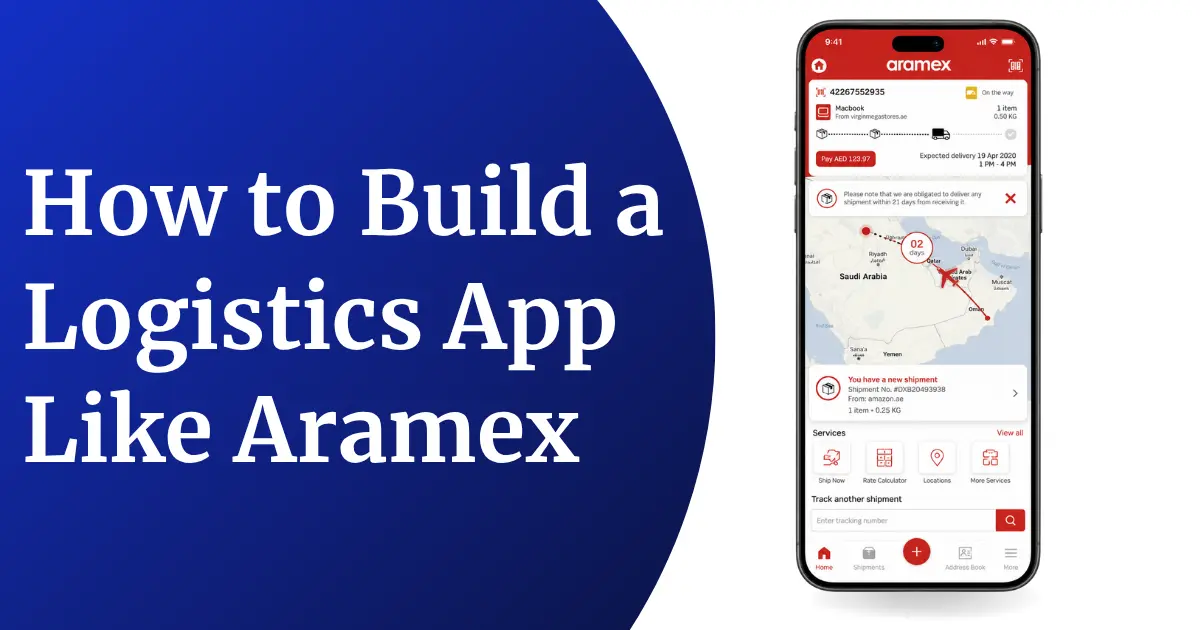
The logistics industry across the Middle East has undergone a fundamental transformation over the past decade. What once ran on phone calls, paper receipts, and manual tracking has now become a sophisticated, technology-powered ecosystem. Aramex, one of the most recognized names in regional logistics, played a major role in this digital revolution. Today, building a logistics app like Aramex is not just a technical project, it is a strategic business decision that positions your brand at the center of one of the fastest-growing markets in the world.
The numbers paint a clear picture. According to McKinsey, Saudi Arabia’s e-commerce market is projected to reach approximately US $60 billion by 2035. The GCC’s eB2B market has already surpassed US $70 billion. More importantly, the next phase of growth in the region will be driven not just by online shopping, but by the smarter logistics and fulfillment infrastructure that powers it. Logistics-focused investments and digital deployments are accelerating across the UAE and Saudi Arabia, with no sign of slowing down.
This comprehensive guide walks you through everything you need to know about how to build a logistics app like Aramex, from understanding the business model and choosing the right technology stack, to designing for Arabic-speaking users and staying compliant with regional data laws. Whether you are a startup building your first delivery platform or an established enterprise looking to modernize operations, this guide gives you the full roadmap.
Market Opportunity: The Middle East Logistics Boom
The Middle East is not playing catch-up with global logistics trends, it is setting its own. Over the past five years, the UAE and Saudi Arabia have transformed their supply chains from fragmented, manual operations into digitally connected fulfillment networks. What used to take days now takes hours, and what used to require dozens of phone calls now happens automatically through apps and APIs.
Independent research from Deloitte projects that the GCC logistics market will continue to grow rapidly through 2030, led by the UAE and Saudi Arabia as the dominant markets. E-commerce growth, increasing urbanization, a young digital-native population, and strong government infrastructure investment are all fueling demand for smarter delivery platforms.
Companies like Aramex, Fetchr, Shipa, and SMSA Express have already raised the bar for customer expectations. Real-time tracking, mobile payments, Arabic-English interfaces, and same-day delivery have become standard features in the region. Any new logistics platform entering the market must meet these expectations from day one, and ideally exceed them.
For startups and enterprises, the opportunity is real and significant. Those who invest in logistics app development today are not just building software, they are building competitive infrastructure for the next decade of commerce in the Middle East.
Key Players in Middle East Logistics and What Sets Them Apart
| Company | Core Strength | Primary Markets | Key Features |
| Aramex | Cross-border express & last-mile | UAE, KSA, GCC-wide | Real-time tracking, COD, multilingual app |
| Fetchr | GPS-based addressing, no PO box required | UAE, KSA | Pin-drop delivery, driver app, route optimization |
| Shipa | SME-focused delivery aggregation | UAE, KSA, Kuwait | Multi-carrier comparison, API integrations |
| SMSA Express | Domestic Saudi Arabia coverage | Saudi Arabia | COD reliability, B2B logistics, customs support |
| Noon Delivery | E-commerce fulfillment for Noon platform | UAE, KSA, Egypt | AI dispatch, micro-fulfillment, same-day delivery |
Understanding the Business Model for a Logistics App Like Aramex
Before writing a single line of code or designing a single screen, you need to choose the right business model for your logistics platform. The model you select determines everything: how you charge customers, how you manage driver networks, and what features you prioritize. The Middle East market accommodates several distinct logistics business models, each with its own advantages.
B2B Express Delivery
In this model, you serve businesses, not individual consumers, by offering scheduled pickups, bulk shipment handling, and enterprise-level SLAs. B2B clients typically have high shipment volumes and are willing to pay premium rates for reliability and speed. Think of pharmaceutical companies, retail chains, or government agencies that need dependable logistics partners.
B2C Last-Mile Delivery
This is the most competitive segment in the GCC right now. B2C last-mile platforms connect e-commerce sellers directly with end consumers. Success here depends on speed, tracking transparency, and a smooth delivery experience. Same-day delivery in Dubai and next-day delivery in Riyadh are the benchmarks to beat.
On-Demand Courier Services
Think hyperlocal delivery, pharmacies, grocery stores, flower shops, and restaurants needing immediate dispatching. This model relies on a dense network of couriers and real-time dispatch technology. Margins can be thin, but volume and frequency make it lucrative at scale.
Freight and Cross-Border Aggregation
This model focuses on moving goods between GCC countries or internationally. It involves more complex customs management, HS code handling, and multi-currency invoicing. Aramex built much of its reputation on exactly this type of cross-border freight aggregation, and the model remains highly attractive for businesses serving GCC-wide merchant networks.
Hybrid Platform
Many successful logistics platforms in the region offer a combination of the above. Starting with one strong core offering and expanding into complementary services is a proven path to scalability. For example, you might launch as a B2C last-mile platform in Dubai, then add cross-border freight capabilities as you expand into Saudi Arabia.
Step-by-Step Guide: How to Build a Logistics App Like Aramex
Step 1: Conduct Deep Market Research and Understand Regional Compliance
Every successful logistics platform in the Middle East starts with thorough market research. This is not just about understanding what competitors are doing — it is about deeply understanding how logistics actually works on the ground in Dubai, Riyadh, Abu Dhabi, and Jeddah. The geography, the culture, and the legal framework all play a role.
What to Research
- Competitor Analysis: Study how Aramex, Shipa, SMSA Express, and Fetchr structure their pricing, delivery zones, and mobile experiences. Look for service gaps. Are merchants struggling with COD reconciliation? Are drivers losing time navigating compound addresses? These gaps are your opportunities.
- Customer Segmentation: Identify exactly who you are building for. SME exporters have completely different needs than direct-to-consumer fashion brands. Pharmacies need speed; furniture retailers need scheduling flexibility. Define your target segment before defining your features.
- Delivery Tier Expectations: Same-day delivery is the norm in downtown Dubai, but next-day or two-day delivery still dominates intercity Saudi routes. Understand the delivery tier expectations by city and by customer type.
- Seasonal Demand Patterns: Ramadan, Eid, Hajj, and White Friday all create significant surges in delivery volume. Your research should map these seasonal spikes so you can design for them from day one.
Compliance Must-Haves
- UAE PDPL Compliance: Federal Decree-Law No. 45 of 2021 requires explicit consent, transparent data handling, and user rights management. Build bilingual consent flows and appoint a Data Protection Officer.
- Saudi Arabia PDPL Compliance: Saudi’s PDPL (enforced since 2023) mandates local data storage and explicit consent for any cross-border data transfers. Host your data in Saudi-based cloud infrastructure to stay compliant.
- VAT Compliance: UAE charges 5% VAT through the Federal Tax Authority; Saudi Arabia charges 15% VAT through ZATCA. Both require compliant e-invoicing with QR codes.
Step 2: Define Your Service Offering and Pricing Strategy
Once your market research is complete, define precisely what services you will offer and how you will charge for them. Pricing strategy in the Middle East is nuanced, COD-heavy markets like Saudi Arabia require different monetization thinking than the more card-friendly UAE market.
Per-Shipment Fees: Charge customers for each delivery based on weight, distance, and service tier. This is the simplest model and works well for B2C platforms.
Subscription Credits: Offer enterprise merchants a monthly credit bundle at a discounted rate. Predictable revenue, lower per-shipment cost for merchants, a win-win model for high-volume clients.
Commission on COD: Take a small percentage of each cash-on-delivery transaction as a service fee. Given that over 60% of Saudi shipments still use COD, this can be a significant revenue stream.
API Access Fees: Enterprise clients who want to integrate your tracking and booking directly into their POS or ERP systems can be charged for API access. This is a growing revenue model in the GCC.
Premium Add-Ons: Same-day delivery upcharges, white-glove handling, shipment insurance, and priority pickup slots all represent additional revenue opportunities beyond the base delivery fee.
Step 3: Design the User Experience for Arabic-English Markets
Design is where your logistics app either wins or loses the trust of Middle Eastern users. This is not simply about translating screens from English to Arabic, it is about building an experience that feels native, intuitive, and trustworthy in both languages and both cultural contexts.
Bilingual Design Principles
- Support full right-to-left (RTL) layout for Arabic alongside standard left-to-right (LTR) for English. Every screen, every icon, every input field must work correctly in both orientations.
- Use culturally appropriate fonts and typography. Arabic type requires different spacing and sizing considerations than Latin characters.
- Design address input fields that accept PO boxes, landmarks, compound names, and pin-drop locations. The GCC does not follow standardized street addressing, so your UX must accommodate local addressing realities.
- Include voice-assisted navigation and detailed address notes for drivers navigating compounds, gated communities, and industrial zones.
Role-Based Interface Design
- Customer App: Clean, minimal, and mobile-first. Booking, tracking, and COD management should require no more than three taps. Clear confirmation screens build trust.
- Driver App: Large buttons, offline capability, route previews, and voice guidance. Drivers are often working in heat and traffic, the interface must minimize cognitive load.
- Admin Dashboard: Data-dense but organized. SLA monitoring, fleet visibility, billing, and analytics all need to be accessible without overwhelming the operations team.
Step 4: Build the Backend Architecture and Regional Integrations
The backend is the engine of your logistics platform. Everything that users see, tracking updates, delivery confirmations, payment receipts, depends on a reliable, scalable backend architecture. In the Middle East context, the backend must also comply with local data residency requirements and integrate with regional payment gateways and telecom providers.
Recommended Technology Stack
- Microservices architecture with Kubernetes for container orchestration. This allows individual components (tracking, dispatch, payments) to scale independently.
- Event streaming via Apache Kafka or Google Pub/Sub for real-time delivery status updates. Every driver movement, scan, and status change should propagate instantly.
- Cloud hosting on AWS Middle East (UAE region), Oracle Cloud Riyadh, or Azure UAE North for data residency compliance and low-latency performance.
- WebSockets for real-time driver tracking on the customer-facing map.
Essential Regional Integrations
- UAE Payments: Network International and PayTabs for card processing. Both have established GCC compliance track records and local merchant support.
- Saudi Payments: Mada (the dominant debit network in KSA) and HyperPay for online card processing. COD cash management requires custom reconciliation logic.
- OTP and SMS: Etisalat and du in UAE; STC, Zain, and Mobily in KSA. OTP delivery for authentication and shipment confirmations depends on local telecom partnerships.
- Mapping: Mapbox or Google Maps with custom GCC geofencing layers and local points-of-interest (POI) data. Standard global maps often miss compound names and new developments.
- E-Invoicing: Fatoora API for Saudi VAT-compliant invoices; eInvoice API for UAE. Both require QR codes and structured data fields for tax authority compliance.
Step 5: Develop Core Features That Drive Adoption and Retention
Feature development is where strategy meets execution. The features you build determine whether merchants choose your platform over a competitor, and whether customers return after their first delivery. The following are the core and advanced features that every logistics platform in the GCC must include.
Core Feature Overview
| Feature Category | Feature | Why It Matters in the GCC |
| Customer App | Real-time shipment tracking | Builds trust; reduces support calls from anxious customers |
| Customer App | Rate calculator with VAT breakdown | Transparency on pricing increases booking conversion |
| Customer App | Pickup scheduler | Reduces failed pickup attempts; improves merchant experience |
| Customer App | Cash-on-delivery (COD) management | 60%+ of Saudi shipments use COD — essential for KSA market |
| Customer App | Multilingual UI (Arabic/English) | Non-negotiable for GCC adoption across both language groups |
| Customer App | Returns management with QR codes | Simplifies the reverse logistics process for merchants |
| Driver App | AI-powered route optimization | Reduces fuel costs and delivery time in congested cities |
| Driver App | Digital Proof of Delivery (PoD) | Eliminates disputes; gives merchants real-time confirmation |
| Driver App | Offline mode | Ensures app works in low-connectivity industrial zones |
| Driver App | Cash ledger and earnings dashboard | Increases driver satisfaction and reduces churn |
| Admin Console | Live fleet and warehouse map | Full operational visibility across all active deliveries |
| Admin Console | SLA monitoring and alert system | Proactively flags at-risk deliveries before they fail |
| Admin Console | Automated billing and invoicing | Reduces manual accounting work; improves merchant trust |
| Admin Console | Bulk shipment upload | Essential for enterprise B2B merchants with high volumes |
| Advanced | AI demand forecasting | Predicts surges during Ramadan, White Friday, and Eid |
| Advanced | Micro-fulfillment hub integration | Enables two-hour delivery in urban residential zones |
| Advanced | Green delivery scheduling | Aligns with UAE and KSA sustainability mandates |
| Advanced | Drone/autonomous delivery APIs | Future-proofing for emerging delivery technologies in GCC |
Step 6: Testing, Localization, and Quality Assurance
Testing a logistics app for the Middle East market requires going well beyond standard bug fixes. You are testing for cultural accuracy, geographic reliability, and regulatory compliance simultaneously. A single error in Arabic text or a broken COD reconciliation flow can cost you merchant trust that takes months to rebuild.
Technical Testing
- Test both Arabic and English interfaces side by side on real devices. Automated testing cannot catch all RTL layout issues, human QA is essential.
- Validate GPS and geofencing accuracy in compounds, new residential developments, and industrial free zones that are frequently absent or misrepresented on standard maps.
- Simulate network dropouts, COD payment errors, and server timeouts. Real-world logistics happens in imperfect conditions, your app must handle failures gracefully.
- Load test the backend for peak-hour traffic volumes: Friday evenings, Ramadan nights, and major shopping events like White Friday.
Compliance and Security Testing
- Conduct a full PDPL compliance audit. Document every personal data flow — from address capture to shipment history, and ensure encryption, access controls, and retention schedules are in place.
- Run penetration testing and data masking checks before launch. Logistics platforms handle sensitive personal and financial data that makes them attractive targets.
- Verify that VAT invoicing is generating correctly formatted, compliant documents that satisfy FTA (UAE) and ZATCA (KSA) requirements.
Cultural and Operational Readiness
- Train bilingual customer support teams before launch. Support tickets in Arabic cannot be routed to English-only agents.
- Test app performance during simulated Ramadan usage patterns: expect late-night traffic spikes, shorter delivery windows, and different driver availability patterns.
- Prepare for sandstorm conditions in Riyadh and extreme heat in summer months, both affect driver availability and delivery times.
Step 7: Launch Strategy, Scaling, and Continuous Improvement
Launching your logistics platform is not the destination, it is the beginning. The real work begins after your first delivery is completed, because that is when real user feedback, real operational challenges, and real competitive pressures start to shape your roadmap.
Smart Launch Approach
- Begin with a single city, either Dubai or Riyadh depending on your target market. Collect real performance data: on-time delivery rates, first-attempt success rates, driver efficiency scores, and customer satisfaction metrics.
- Run a merchant pilot program with 20 to 50 early-adopter businesses before opening to the full market. Their feedback will reveal workflow issues that no amount of internal testing can anticipate.
- Expand to Abu Dhabi, Jeddah, and Dammam only once your core city metrics are stable and your operational processes are documented and repeatable.
Seasonal Operations Planning
- Build a Ramadan operations plan that accounts for evening delivery peaks, reduced daytime driver availability, and shorter business hours. This is not an edge case, it is a predictable annual event that will define your reputation.
- Prepare surge capacity for White Friday and major sale events. Partner with flexible driver pools or gig worker platforms to handle volume spikes without degrading service quality.
- Map Hajj-restricted zones in and around Mecca and Medina to prevent failed delivery attempts in areas with limited access during the pilgrimage season.
Continuous Improvement Cycle
- Refresh routing data and address databases quarterly. New developments, road changes, and compound additions happen constantly across GCC cities.
- Update driver app features every 6 to 8 weeks based on driver feedback. Driver retention is one of the biggest operational challenges in the region, and a great driver app is a meaningful differentiator.
- Re-audit PDPL compliance whenever regulatory updates are issued by the UAE PDPA or Saudi SDAIA. Data protection laws in the region are still evolving.
Data Privacy, Tax Compliance, and Regulatory Requirements
In the Middle East, compliance is not a bureaucratic formality, it is a business foundation. Merchants, enterprise clients, and consumers alike are becoming more aware of their data rights, and regulators in both UAE and Saudi Arabia are actively enforcing standards. If you are planning to build a logistics platform for this market, compliance needs to be designed in from the beginning, not bolted on after launch.
UAE Personal Data Protection Law (PDPL)
Federal Decree-Law No. 45 of 2021 is the UAE’s comprehensive data protection framework. For logistics apps, this law governs how you collect, store, process, and share user data, including delivery addresses, payment information, and location history.
- Implement clear consent management with checkboxes in Arabic and English during account creation and address entry. Pre-ticked boxes are not valid consent under the PDPL.
- Build a self-service data rights portal within the app so users can access, correct, or delete their personal data without needing to contact customer support.
- Appoint a Data Protection Officer responsible for managing compliance, user requests, and incident response.
- Host sensitive data in UAE-based cloud regions (AWS UAE or Azure UAE North) to minimize cross-border transfer risks.
Saudi Arabia PDPL (2023 Implementation)
Saudi Arabia’s PDPL became fully enforceable in 2023, with strict requirements around data localization and cross-border data flows. For logistics platforms operating in KSA, this means architectural decisions must prioritize local data storage from the start.
- All user data, shipment logs, and driver records for Saudi operations must be hosted on servers physically located within Saudi Arabia unless you obtain explicit regulatory approval for cross-border transfers.
- Any integration with third-party platforms (CRM, analytics, ERP) that involves sharing Saudi user data must be covered by explicit user consent and contractual data protection agreements.
- Security incident notification is mandatory: breaches must be reported to SDAIA and affected users within defined timeframes.
- Data minimization principles apply: collect only what you genuinely need for logistics operations and delete it once retention periods expire.
VAT and E-Invoicing Compliance
Both UAE and Saudi Arabia have mandatory VAT requirements that directly affect how your logistics platform generates and stores invoices.
| Tax Requirement | UAE | Saudi Arabia |
| VAT Rate | 5% — Federal Tax Authority (FTA) | 15% — ZATCA (Zakat, Tax and Customs Authority) |
| E-Invoice System | eInvoice API for B2B transactions | Fatoora platform with QR code generation |
| Invoice Requirements | VAT number, itemized breakdown, QR code | Seller/buyer details, VAT amount, QR code, UUID |
| Multi-Currency | Primarily AED, with USD for international | Primarily SAR, with USD for cross-border freight |
| COD Reconciliation | Daily settlement with VAT application | Daily settlement with VAT + Zakat considerations |
Cost Breakdown: What Does It Really Cost to Build a Logistics App Like Aramex?
One of the most common questions from founders and enterprise decision-makers is: how much does it cost to build a logistics app like Aramex? The honest answer is that the cost depends heavily on the scope of your platform, the complexity of your regional integrations, and whether you are building an MVP or a full-featured enterprise system.
The Middle East market adds specific cost layers that you would not encounter in a simpler western market: bilingual design, COD reconciliation logic, local payment gateway certification, PDPL-compliant data architecture, and cloud hosting in regional data centers. These are not optional extras, they are table stakes for operating in the GCC.
Overall Budget Range
| Market | MVP Range | Full Enterprise Range |
| UAE (AED) | AED 147,000 – AED 550,000 | AED 550,000 – AED 1,468,000 |
| UAE (USD approx.) | ~$40,000 – $150,000 | ~$150,000 – $400,000 |
| Saudi Arabia (SAR) | SAR 150,000 – SAR 560,000 | SAR 560,000 – SAR 1,500,000 |
| Saudi Arabia (USD approx.) | ~$40,000 – $150,000 | ~$150,000 – $400,000 |
Cost Breakdown by Development Phase
| Development Phase | AED Range | SAR Range | What Is Included |
| Discovery & Strategy | AED 18,000 – 55,000 | SAR 18,750 – 56,250 | Market research, competitor analysis, business model definition, project scoping |
| UX/UI Design | AED 22,000 – 73,000 | SAR 22,500 – 75,000 | Wireframes, bilingual prototypes, RTL/LTR layout design, user testing |
| App Development | AED 73,000 – 440,000 | SAR 75,000 – 450,000 | iOS and Android apps for customer, driver, and admin roles |
| Backend & API Development | AED 73,000 – 440,000 | SAR 75,000 – 450,000 | Dispatch logic, live tracking, payment gateway integrations, e-invoicing |
| Route Optimization Engine | AED 36,500 – 220,000 | SAR 37,500 – 225,000 | AI-driven routing, traffic analysis, ETA prediction, geofencing |
| PDPL Compliance & Security | AED 18,000 – 73,000 | SAR 18,750 – 75,000 | Data audit, encryption setup, consent management, penetration testing |
| QA & Localization Testing | AED 14,700 – 55,000 | SAR 15,000 – 56,250 | Arabic/English testing, GPS validation, load testing, UAT |
| Launch Support & Maintenance | AED 18,000 – 110,000/year | SAR 18,750 – 112,500/year | Bug fixes, quarterly routing updates, compliance re-audits, feature releases |
Hidden Cost Factors Most Founders Overlook
- Bilingual Design Complexity: Building a fully functional RTL Arabic interface adds approximately 5 to 8 percent to your total design and front-end development budget. This includes testing on multiple device sizes and validating with native Arabic speakers.
- COD Workflow Engineering: Cash-on-delivery reconciliation requires custom logic for tracking collections, managing driver cash ledgers, applying VAT, and generating daily settlement reports. Expect an additional 7 to 10 percent of backend development cost.
- Local Payment Gateway Certification: Network International, PayTabs, and Mada all require documentation, security audits, and integration testing that goes beyond standard API work. Budget 2 to 3 weeks of additional development time.
- Regional Cloud Infrastructure: Hosting on AWS UAE or Oracle Riyadh costs approximately 15 to 20 percent more than equivalent hosting in non-regional data centers. This premium is non-negotiable for PDPL compliance.
- Ongoing Compliance Updates: PDPL regulations in both UAE and KSA are actively evolving. Budget 2 to 4 percent of your annual development spend for compliance re-audits and system updates.
- Seasonal Surge Infrastructure: Scaling your backend to handle Ramadan and White Friday traffic spikes requires either auto-scaling cloud infrastructure or planned capacity upgrades. Factor this into your annual infrastructure budget.
Real Challenges in Middle East Logistics and How to Solve Them
Challenge 1: The Addressing Problem
The Middle East does not use standardized street addresses the way Western countries do. Delivery drivers frequently navigate by landmark, compound name, or building color rather than a formal street number. For logistics apps, this creates real operational challenges: missed deliveries, driver confusion, and frustrated customers.
The Solution: Implement AI-powered geolocation combined with user-generated addressing. Allow customers to drop a pin on a map, add landmark notes, and save custom delivery locations. Partner with what3words or similar technologies for precise location identification. Aramex’s pilot of this approach in Dubai resulted in deliveries being 42 percent faster and driver travel distance being reduced by 22 percent, a compelling proof point for the technology’s value.
Challenge 2: Cross-Border Customs Complexity
Moving shipments between GCC countries involves navigating different customs clearance procedures, documentation standards, and import regulations for each country. Even within the GCC free trade area, delays at border crossings are common and unpredictable.
The Solution: Integrate directly with national e-customs portals and automate HS code declaration and waybill generation. When customs documentation is prepared and submitted automatically, the human error rate drops dramatically and clearance times improve. Building relationships with customs brokers in each GCC market also helps navigate non-standard situations.
Challenge 3: Last-Mile Cost and Sustainability Pressure
Last-mile delivery accounts for 40 to 50 percent of total logistics costs in urban areas like Dubai and Riyadh. Traffic congestion, fragmented drop-offs, and rising fuel prices all contribute to this cost pressure. At the same time, sustainability expectations from consumers and regulators are increasing.
The Solution: Invest in electric vehicle fleet integration and route batching algorithms that consolidate deliveries geographically. Dubai’s fleet of over 41,000 EVs as of mid-2025 demonstrates the scale of the shift underway. DP World at Jebel Ali Port has already deployed electric yard vehicles to reduce emissions. Green delivery slots, where customers choose eco-friendly delivery windows, are gaining traction as a differentiator that also reduces costs.
Challenge 4: Peak Season Operational Surges
Ramadan, Eid, Hajj, and White Friday create dramatic spikes in delivery volume, often accompanied by restricted access in certain zones and unusual operating hours. Platforms that are not prepared for these events see their on-time delivery rates collapse precisely when customer attention is closest.
The Solution: Use predictive analytics to anticipate seasonal demand patterns based on historical data. Build a seasonal operations playbook that pre-assigns driver capacity, pre-positions inventory in micro-fulfillment hubs, and adjusts delivery windows to match actual usage patterns. Noon’s use of historical order data for dynamic driver reassignment during Ramadan is a strong model to follow.
Future Trends Reshaping Logistics in the GCC
Electric Fleets and Green Logistics
The Dubai Roads and Transport Authority is targeting 30 percent electric or hybrid vehicles in its fleet by 2030. Saudi Arabia’s NEOM project is designing entire zero-emission logistics corridors. For logistics platforms, this means EV fleet management APIs and green route optimization will become standard features within the next few years.
Drone and Autonomous Delivery
Saudi Arabia’s General Authority of Civil Aviation has approved limited drone delivery trials. Aramex and other regional players are exploring drone-based last-mile pilots in rural areas. Dubai’s regulators are finalizing frameworks for urban drone delivery corridors. Building flexible APIs today that can plug into autonomous dispatch systems tomorrow is a forward-thinking architectural choice.
AI and Machine Learning in Logistics
Machine learning is moving logistics from reactive to predictive. Models now forecast demand surges, predict route delays based on historical patterns, and recommend dynamic delivery windows based on customer availability. DHL Middle East is using predictive analytics to reduce idle truck time across GCC routes. McKinsey Middle East research suggests AI forecasting can reduce delivery delays by up to 25 percent.
Micro-Fulfillment and Urban Warehousing
Quick commerce players in the UAE are rapidly expanding dark stores and micro-fulfillment hubs in dense residential areas to enable two-hour delivery. This model is spreading across Saudi Arabia as consumer expectations for speed continue to rise. Integrating with micro-fulfillment networks is becoming a competitive requirement rather than a premium feature.
Logistics as a Data Business
Every scan, route, and transaction generates data that reveals valuable insights about consumer behavior, warehouse efficiency, and urban mobility patterns. The logistics platforms that treat their operational data as a strategic asset, and invest in the analytics infrastructure to extract insights from it, will have a durable competitive advantage over those that treat data as a byproduct.
Conclusion: Build Your Logistics Platform with GrowRankers
Building a logistics app like Aramex is one of the most strategically rewarding technology investments a business can make in the Middle East right now. The market is growing, the infrastructure is maturing, and the competitive window for well-executed platforms is wide open. But success requires more than great code, it demands deep regional expertise, cultural fluency, regulatory compliance, and a long-term commitment to continuous improvement.
The step-by-step process outlined in this guide, from market research and business model definition through backend architecture, feature development, compliance, launch strategy, and future-proofing, gives you the full roadmap for building a platform that can genuinely compete with the best in the GCC.
If you are ready to move from planning to execution, GrowRankers is the partner you need. We specialize in helping businesses across the Middle East and globally design, build, and grow digital platforms that are built for the real world, not just the ideal case. Our team combines technical depth with regional market knowledge, so your logistics platform is not just compliant and functional, it is positioned to win in the markets you care about most.
Whether you are a startup launching your first delivery app, an enterprise modernizing a legacy logistics operation, or an investor evaluating the opportunity, GrowRankers brings the expertise to make it happen. We understand the nuances of Arabic UX design, GCC payment integrations, PDPL compliance, and the seasonal patterns that define success or failure in Middle Eastern logistics.
Frequently Asked Questions
Q: How long does it take to build a logistics app like Aramex?
An MVP for a single city can typically be built in 4 to 6 months, covering the core customer app, driver app, admin dashboard, and essential backend integrations. A full-featured enterprise platform with cross-border capabilities, advanced AI routing, and complete PDPL compliance takes 9 to 15 months depending on scope and team size.
Q: What is the most important feature to prioritize for the Saudi Arabia market?
Cash-on-delivery management is arguably the most critical feature for Saudi Arabia. With over 60 percent of Saudi shipments still using COD, your platform’s ability to handle COD collection, reconciliation, and settlement reliably will determine your acceptance among Saudi merchants more than any other single feature.
Q: How do I handle the addressing problem in the GCC?
Build a flexible address input system that supports pin-drop geolocation, landmark notes, compound names, PO boxes, and saved locations. Integrate with mapping providers that have strong GCC POI data and consider partnering with what3words for precise location identification in areas where traditional addressing breaks down.
Q: Can I build a logistics app that works across both UAE and Saudi Arabia?
Yes, but you need to design for both markets from the start. This means separate data hosting environments for UAE and KSA to satisfy PDPL requirements, different payment gateway integrations (Network International for UAE, Mada for KSA), different VAT invoicing systems, and potentially different delivery tier expectations. A modular architecture makes it easier to configure per-market without rebuilding core logic.
Q: What AI and automation features should I include?
Start with route optimization and automated driver assignment, these deliver immediate ROI by reducing fuel costs and improving on-time delivery rates. Add demand forecasting for seasonal events once you have enough historical data. More advanced capabilities like dynamic pricing and autonomous dispatch can be added as the platform matures.
Q: How do I ensure compliance with both UAE and Saudi data protection laws?
Design your data architecture around the stricter of the two regulations, which in most cases is Saudi Arabia’s PDPL due to its local data storage requirements. Use regional cloud infrastructure (AWS Middle East or Oracle Riyadh), implement comprehensive consent management in both Arabic and English, appoint a Data Protection Officer, and schedule quarterly compliance reviews as regulations continue to evolve.