The real estate industry has gone through a massive digital transformation over the last decade, and apps like Zillow, Trulia, and Realtor.com have become the go-to platforms for millions of property buyers, sellers, and renters worldwide. If you are an entrepreneur, a real estate business owner, or a startup founder looking to tap into this high-value market, understanding the complete guide to the cost of real estate app development like Zillow is your critical first step. The global real estate technology market was valued at over $18 billion in 2024 and is projected to grow at a compound annual growth rate exceeding 15% through 2030, driven by increasing smartphone adoption, AI-powered personalization, and a generational shift in how people search for, evaluate, and transact property. The window to enter this space with a competitive, feature-rich product is wide open right now, but it requires careful planning, the right technology choices, and the right development partner to execute successfully.
Building a real estate app like Zillow is not just about writing code, it involves strategic planning, choosing the right technology stack, integrating powerful features like AI-based property recommendations, real-time mortgage calculators, virtual tours, and interactive mapping tools. The cost of developing such an app varies significantly based on the scope of features, the number of platforms targeted (iOS, Android, Web), the development approach (in-house vs. agency vs. freelancers), and the geographic location of your development team. What separates a real estate app that generates millions in annual revenue from one that quietly disappears after launch is rarely the idea itself — it is the depth of planning, the quality of execution, and the strategic growth decisions made in the early stages. In this guide, we break down everything you need to know — from must-have features and technology stack choices to detailed development cost estimates, monetization strategies, competitive differentiation tactics, and how GrowRankers, a leading real estate app development and digital growth partner, can help you build a world-class platform that stands apart from the competition from day one.
Must-Have Features of a Property Search and Rental App Like Zillow
Before you think about the cost, you need to understand what makes a real estate app truly powerful. Zillow’s success is not accidental — it is built on a rich set of features that create a seamless, intuitive, and valuable experience for all types of users. Below are the core features your real estate app must have to compete effectively in today’s market.
Advanced Property Search and Smart Filtering
The most fundamental feature of any property search app is a robust, multi-layered search system. Users must be able to search properties by location (city, zip code, neighborhood), price range, number of bedrooms and bathrooms, property type (apartment, villa, commercial, land), square footage, year built, and more. Smart filters powered by AI allow users to narrow down thousands of listings in seconds. The faster and more precise the search experience, the higher the user retention and engagement your app will enjoy.
Interactive Maps with Real-Time Listing Pins
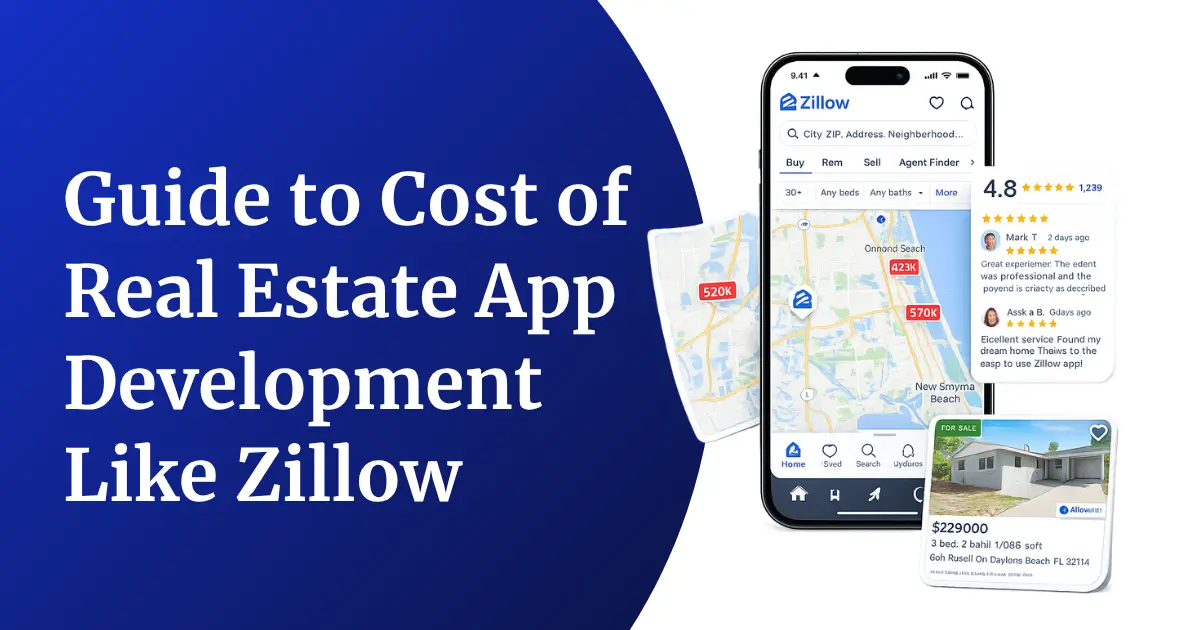
Map-based property browsing is a signature feature of apps like Zillow. Users should be able to view all nearby listings pinned on an interactive map, zoom in and out, and switch between list view and map view effortlessly. Google Maps API or Mapbox integration enables features like neighborhood boundary overlays, proximity to schools and hospitals, crime rate visualization, and commute time estimation. According to Google Maps Platform, location-based features significantly improve user engagement in real estate platforms, making this one of the highest-ROI investments in your app.
Detailed Property Listings with Rich Media
Each property listing should be a comprehensive page that includes high-resolution photos, video walkthroughs, 3D virtual tours, floor plans, property history, tax records, HOA details, and neighborhood statistics. The richer the listing page, the more informed the buyer or renter feels, which reduces decision fatigue and accelerates the conversion process. A well-built listing page is essentially a digital showroom that works 24/7 without needing an agent present.
Virtual Tours and 3D Walkthroughs
Post-pandemic, virtual tours have become a non-negotiable feature for serious real estate apps. Integrating 3D tour technologies like Matterport or custom AR/VR experiences allows potential buyers and renters to walk through a property from the comfort of their home. This feature drastically reduces the number of physical visits needed, saves time for both parties, and dramatically increases the quality of leads that agents receive.
AI-Powered Property Recommendations
Personalization is the backbone of modern digital platforms. Using machine learning algorithms, your app can analyze a user’s browsing behavior, saved properties, search history, and preferences to suggest highly relevant listings they are likely to love. This “Netflix-style” recommendation engine increases time spent in the app, reduces bounce rates, and significantly improves conversion rates for agents and sellers.
Mortgage and EMI Calculator
One of the most-used tools on Zillow is its mortgage calculator. Your app must include an easy-to-use calculator that helps users estimate monthly payments based on home price, down payment, loan term, interest rate, property taxes, and insurance. This feature positions your app as a complete financial planning companion, not just a listing portal, which adds tremendous value to both buyers and sellers.
In-App Messaging and Communication Tools
Seamless communication between buyers, sellers, renters, and agents is essential. Your app should include secure in-app chat, voice call functionality, video call integration, appointment booking for property visits, and automated follow-up notifications. Removing friction from communication accelerates the sales cycle and builds trust between all parties on the platform.
User Profiles for Buyers, Sellers, Agents, and Landlords
A well-designed user management system should support multiple user roles — home buyers, property sellers, real estate agents, landlords, and renters — each with their own customized dashboard, permissions, and tools. Agents should be able to manage their listings, respond to inquiries, and track analytics. Buyers should be able to save favorites, set up alerts, and manage their search preferences. Role-based profiles improve the overall user experience and operational efficiency of the platform.
Property Alerts and Push Notifications
Timely alerts are a game-changer in real estate. Users should be able to set up personalized alerts for when new properties matching their criteria are listed, when prices drop on saved listings, when a property goes under contract, or when market conditions change in a neighborhood they are watching. Push notifications and email alerts keep users coming back to your app daily, which is crucial for long-term retention.
Agent and Agency Directory
A searchable directory of real estate agents and agencies adds a powerful layer of utility to your platform. Users should be able to filter agents by location, specialization, experience, ratings, and reviews. Agent profiles should showcase their listings, transaction history, client testimonials, and contact information. This feature not only helps users find the right professional but also creates a strong monetization opportunity through agent subscription and lead-generation packages.
Saved Searches and Favorites Management
The ability to bookmark favorite properties and save complex search queries is something users expect from day one. A well-organized favorites section with custom folders, comparison tools, and sharing options (to share with a spouse or family member) significantly improves the user experience and encourages repeat visits.
Neighborhood Insights and Lifestyle Data
Beyond the property itself, today’s buyers care deeply about the neighborhood. Your app should integrate data on school ratings, nearby amenities (grocery stores, parks, restaurants), public transportation access, walkability scores, air quality index, and local real estate market trends. This contextual data transforms your app from a simple listing portal into a powerful relocation and investment decision tool.
Secure Login and Multi-Factor Authentication
Security is paramount in any platform dealing with personal information and financial decisions. Your app must support secure login options including email/password, Google and Apple social login, and multi-factor authentication (MFA). Data encryption, GDPR compliance, and secure payment gateways are also non-negotiable elements of a trustworthy real estate platform.
Reviews and Ratings for Properties and Agents
A transparent review and ratings system builds credibility and trust. Buyers and renters should be able to leave honest reviews for properties they have visited or rented, and for agents they have worked with. This social proof mechanism is one of the most powerful drivers of conversions on marketplace platforms.
Technology Stack Required for Building a Property Search App Like Zillow
Choosing the right technology stack is one of the most critical decisions you will make during the development of your real estate app. The stack determines your app’s scalability, performance, security, and the speed at which you can ship new features. Below is a comprehensive breakdown of the technologies typically used in apps like Zillow.
| Layer | Technology Options |
| Frontend (Mobile – iOS) | Swift, Objective-C |
| Frontend (Mobile – Android) | Kotlin, Java |
| Cross-Platform Mobile | React Native, Flutter |
| Frontend (Web) | React.js, Next.js, Vue.js |
| Backend | Node.js, Python (Django/FastAPI), Ruby on Rails, Go |
| Database (Relational) | PostgreSQL, MySQL |
| Database (NoSQL) | MongoDB, Firebase Firestore |
| Real-Time Features | WebSockets, Socket.io, Firebase Realtime DB |
| Cloud Hosting | AWS, Google Cloud Platform, Microsoft Azure |
| Maps & Geolocation | Google Maps API, Mapbox, HERE Maps |
| AI/ML Engine | Python (TensorFlow, PyTorch), AWS SageMaker |
| Search Engine | Elasticsearch, Algolia |
| Payment Gateway | Stripe, Braintree, PayPal |
| Push Notifications | Firebase Cloud Messaging (FCM), OneSignal |
| CDN & Media Storage | AWS S3, Cloudinary, Cloudflare |
| Analytics | Google Analytics, Mixpanel, Amplitude |
| DevOps & CI/CD | Docker, Kubernetes, Jenkins, GitHub Actions |
| Security & Compliance | SSL/TLS, OAuth 2.0, GDPR Tools |
Frontend: React Native and Flutter for Cross-Platform Efficiency
For most real estate startups and growing businesses, React Native or Flutter is the ideal choice for mobile app development because both frameworks allow you to build a single codebase that runs natively on both iOS and Android. This significantly reduces development time and cost while delivering near-native performance. React Native, backed by Meta, has a massive community and extensive library support. Flutter, backed by Google, is known for its exceptional UI rendering and smooth animations — both key differentiators for a premium real estate app experience.
Backend: Node.js or Python for Scalable APIs
The backend of your app is responsible for handling all business logic, data processing, API integrations, and user authentication. Node.js is an excellent choice for real-time features like chat and notifications due to its event-driven, non-blocking architecture. Python (with Django or FastAPI) is the preferred choice when your app requires heavy AI/ML processing, such as property recommendation engines or predictive pricing algorithms. Many enterprise real estate platforms use a microservices architecture, where different services (search, chat, payments, listings) run independently and can be scaled individually.
Cloud Infrastructure: AWS or Google Cloud for Scalability
Hosting your real estate app on a cloud platform like AWS or Google Cloud ensures that your platform can handle millions of concurrent users, massive media files (photos, virtual tours), and complex geospatial queries without downtime. Key services include AWS EC2 for compute power, AWS S3 for storing property images and videos, AWS RDS for relational database management, and AWS CloudFront for content delivery. A cloud-first architecture is essential if you plan to grow your platform nationally or globally.
Elasticsearch for Lightning-Fast Property Search
Real estate platforms involve searching through millions of property records with complex filters. Elasticsearch is the industry-standard solution for this use case. It enables full-text search, faceted filtering, geo-distance queries, and relevance ranking — all at millisecond speeds. Pairing Elasticsearch with a geospatial data layer allows users to instantly find properties within a specific radius, school district, or neighborhood boundary.
Google Maps API for Interactive Property Maps
Map functionality is the heart of a real estate app. Google Maps API offers powerful features including property pin clustering, polygon-based neighborhood search, street view integration, distance matrix calculations, and place autocomplete. While Google Maps API comes with usage-based pricing, its reliability, global coverage, and feature richness make it the top choice for serious real estate platforms. Mapbox is an excellent alternative for teams that want more visual customization and potentially lower costs at scale.
What Is the Real Cost of Building a Real Estate App Like Zillow or Trulia?
This is the question every entrepreneur wants answered. The honest answer is: it depends. The cost of real estate app development like Zillow depends on the complexity of features, the number of platforms (iOS, Android, Web), the development approach (in-house vs. agency vs. freelancers), the geographic location of your development team, and the level of polish and performance you want at launch.
Understanding the cost to build a mobile app thoroughly before committing to a budget is one of the smartest investments you can make before writing a single line of code. Below is a detailed breakdown of development costs across different complexity levels and feature sets.
| Development Phase | Basic App (MVP) | Mid-Level App | Advanced App (Zillow-Level) |
| UI/UX Design | $3,000 – $8,000 | $8,000 – $20,000 | $20,000 – $50,000 |
| Frontend Development (Mobile) | $10,000 – $20,000 | $20,000 – $50,000 | $50,000 – $120,000 |
| Backend Development & APIs | $8,000 – $18,000 | $18,000 – $45,000 | $45,000 – $100,000 |
| Database Architecture | $2,000 – $5,000 | $5,000 – $12,000 | $12,000 – $30,000 |
| Maps & Geolocation Integration | $2,000 – $5,000 | $5,000 – $12,000 | $12,000 – $25,000 |
| AI/ML Recommendation Engine | Not Included | $10,000 – $25,000 | $25,000 – $80,000 |
| Virtual Tours & 3D Integration | Not Included | $8,000 – $20,000 | $20,000 – $60,000 |
| Payment Gateway Integration | $1,500 – $3,000 | $3,000 – $7,000 | $7,000 – $15,000 |
| Push Notifications & Alerts | $1,000 – $2,500 | $2,500 – $5,000 | $5,000 – $12,000 |
| Admin Dashboard & CMS | $3,000 – $6,000 | $6,000 – $15,000 | $15,000 – $40,000 |
| Testing & QA | $3,000 – $6,000 | $6,000 – $15,000 | $15,000 – $35,000 |
| Deployment & DevOps | $1,500 – $3,500 | $3,500 – $8,000 | $8,000 – $20,000 |
| Total Estimated Cost | $35,000 – $77,000 | $92,000 – $229,000 | $234,000 – $587,000+ |
Breaking Down the Cost Further
Basic MVP Real Estate App ($35,000 – $77,000): An MVP-level real estate app includes core features like property listings, basic search and filtering, user registration, property detail pages with photos, a map view, and a contact agent feature. This level is suitable for startups testing product-market fit in a specific geographic niche. Development typically takes 3 to 5 months with a small team.
Mid-Level Real Estate App ($92,000 – $229,000): A mid-tier app adds significantly more depth — AI-based recommendations, in-app messaging, mortgage calculators, agent directories, virtual tour support, advanced map features, and a fully functional admin dashboard. This is the most common entry point for serious real estate businesses aiming to compete with established local portals. Development typically takes 6 to 10 months.
Advanced Real Estate App – Zillow Level ($234,000 – $587,000+): A full-scale, enterprise-grade real estate platform comparable to Zillow includes everything from the mid-tier plus custom AI/ML engines, Zestimate-like property valuation models, comprehensive MLS data integration, multiple market coverage, native iOS and Android apps, a responsive web platform, advanced analytics dashboards for agents and developers, and 24/7 infrastructure monitoring. This is the level for companies with strong funding and national or global ambitions. Development takes 12 to 24 months or more.
Ongoing Maintenance Costs: Don’t forget that app development is not a one-time expense. Post-launch, you should budget 15% to 20% of the initial development cost per year for maintenance, updates, security patches, server costs, and feature additions. For a $200,000 app, this means roughly $30,000 to $40,000 per year in ongoing costs.
Geographic Variations in Development Cost:
- North America / Western Europe: $80 – $200 per hour
- Eastern Europe: $35 – $80 per hour
- South Asia (India, Pakistan): $20 – $50 per hour
- Southeast Asia: $25 – $60 per hour
How to Develop an App Like Zillow or Trulia? Step-by-Step Process
Knowing the cost is important, but understanding the development process is equally critical to ensure your project stays on time, within budget, and delivers a product your users will love. Here is a step-by-step breakdown of how to build a real estate app from scratch.
Step 1: Define Your Vision, Target Audience, and Niche
Before writing a single line of code, spend serious time defining what your app is for, who it serves, and how it is different from existing solutions. Are you building a platform for luxury home buyers? A rental app for college students? A commercial real estate tool for investors? A hyperlocal neighborhood portal? The narrower and more specific your initial niche, the faster you will gain traction and the lower your initial development costs will be. Conduct market research, interview potential users, analyze competitors, and document your findings in a product requirements document (PRD).
Step 2: Conduct Competitive Analysis and Market Research
Analyze Zillow, Trulia, Realtor.com, Redfin, Apartments.com, and other competitors in your target market. Study their feature sets, user reviews (especially negative ones on app stores), pricing models, and user interface patterns. Tools like SimilarWeb, AppFollow, and Sensor Tower can give you invaluable data on competitor traffic, user ratings, and keyword performance. This research will help you identify feature gaps in the market that you can exploit to differentiate your product.
Step 3: Create Detailed Wireframes and UX Prototypes
Work with a UX designer to create low-fidelity wireframes and high-fidelity interactive prototypes of every screen in your app. This visual blueprint allows you to test the user flow, identify usability issues, and get stakeholder approval before development begins — saving enormous amounts of time and money down the line. Tools like Figma, Adobe XD, and InVision are widely used for this purpose. Prototype testing with real users at this stage can prevent costly design mistakes during coding.
Step 4: Plan Your Technical Architecture and Data Strategy
Decide on your technology stack, database architecture, API strategy, and third-party integrations. Plan how you will source property listing data — will you build MLS integration, partner with data providers like CoreLogic or ATTOM Data, allow user-submitted listings, or a combination? Your data strategy is the foundation of your product’s value, so it deserves careful planning. Also plan your cloud infrastructure, security protocols, and data compliance requirements (GDPR, CCPA) at this stage.
Step 5: Build Your MVP with Core Features
Start development with a Minimum Viable Product that includes only the most essential features needed to validate your concept with real users. For a real estate app, this typically means property listings, search with basic filters, a map view, property detail pages, user registration, and a contact/inquiry feature. Building an MVP first allows you to launch quickly, gather user feedback, and iterate rapidly without burning through your entire budget on features that users may not actually want.
Step 6: Integrate Third-Party APIs and Data Sources
Great real estate apps are powered by rich data. During development, integrate the essential third-party APIs that give your platform its intelligence and utility. This includes Google Maps API for mapping, a mortgage calculation API, property data APIs (MLS, ATTOM, Zillow’s own API where permitted), school rating data from GreatSchools, Walk Score for walkability data, and payment gateways like Stripe for subscription and advertising payments. Each integration should be tested thoroughly for accuracy, performance, and edge cases.
Step 7: Develop the Admin Dashboard and Agent Portal
A powerful backend admin dashboard is what makes your real estate platform manageable at scale. Build tools for listing management and moderation, agent verification and onboarding, user management, analytics and reporting, ad management, content management, and customer support workflows. Agents should have their own dedicated portal where they can manage listings, view lead analytics, communicate with prospects, and manage their subscriptions.
Step 8: Conduct Rigorous Testing Across Devices and Scenarios
Before launching, your app must go through multiple rounds of testing — functional testing (does every feature work as designed?), performance testing (does the app handle 10,000 concurrent users?), security testing (is user data protected?), usability testing (do real users find the app intuitive?), and compatibility testing (does the app work flawlessly on all major devices and OS versions?). Skipping or rushing testing is one of the most common and costly mistakes in app development.
Step 9: Launch, Market, and Gather User Feedback
Launch your app on the App Store and Google Play Store, and your web platform simultaneously if applicable. Execute a go-to-market strategy that includes App Store Optimization (ASO), content marketing, social media campaigns, real estate agent partnership programs, and targeted paid advertising. From day one, actively collect user feedback through in-app surveys, ratings prompts, and user interviews. Use analytics tools to track user behavior, identify drop-off points, and measure feature adoption rates.
Step 10: Iterate, Optimize, and Scale
The launch is just the beginning. Use the data and feedback gathered in the first weeks and months to prioritize your product roadmap. Fix bugs rapidly, roll out improvements, and add high-demand features. As your user base grows, invest in scaling your infrastructure, expanding to new markets, and building advanced features like AI-powered valuations, investment analysis tools, and developer/builder portals. Real estate platforms are not one-time builds; they are living products that require constant evolution.
Monetization Models for Your Real Estate Mobile App Development Journey
Building a great app is only half the battle — you also need a sustainable and scalable business model to generate revenue. Zillow generates over a billion dollars annually through a multi-layered monetization strategy, and your app should have a clearly defined plan for how it will make money from day one.
Subscription Plans for Agents and Agencies
The most reliable and predictable revenue model for real estate platforms is a tiered subscription system for real estate agents and agencies. Basic plans might allow agents to list a limited number of properties and receive a set number of leads per month. Premium plans unlock unlimited listings, priority placement, advanced analytics, enhanced profile features, and marketing tools like featured placement in agent directory search results. Enterprise plans for large agencies might include team management tools, custom branding, white-label features, and dedicated account management support. Monthly subscription fees for agents typically range from $50 to $500+ depending on the market, the competitive intensity of the local real estate environment, and the depth of features included. The predictability of subscription revenue makes this the backbone monetization model for most successful real estate platforms, as it provides recurring monthly revenue that investors and stakeholders value highly.
Lead Generation and Pay-Per-Lead Programs
Real estate agents are always hungry for quality leads, and pay-per-lead monetization capitalizes on this persistent demand. Your platform charges agents for every qualified buyer or renter lead delivered to them — typically a lead is defined as a user who has expressed specific interest in a listing or requested more information from an agent. The key to success with this model is delivering genuinely high-quality, well-matched leads — not just raw contact information — because agents will quickly abandon platforms that deliver low-converting, unqualified prospects. Zillow’s Premier Agent program is the most prominent example of this model working at massive scale, generating hundreds of millions of dollars in annual revenue. Leads in competitive real estate markets can be worth anywhere from $20 to $200 each depending on the property price range and market conditions, making this a highly lucrative monetization channel as your platform scales.
Featured Listings and Boosted Placement
Sellers and agents who want maximum visibility for their properties can pay a premium to have their listings featured at the top of search results, displayed on the home screen, highlighted with special badges (like “Featured” or “Hot Listing”), or promoted in email newsletters sent to your subscriber base. This pay-to-play visibility model works exceptionally well in competitive markets where listings compete heavily for buyer attention. Unlike subscription plans that charge a flat monthly fee, featured listing programs can be designed as self-serve advertising products that agents and sellers buy on demand — similar to how Amazon sellers buy sponsored placements. Pricing can be based on a flat fee per listing, a daily or weekly duration, or a performance-based model tied to impressions, views, and inquiries generated.
Display Advertising and Sponsorships
As your platform grows and attracts significant traffic from active property searchers, display advertising becomes a meaningful and largely passive revenue stream. Real estate-adjacent businesses — mortgage lenders, home insurance companies, title companies, moving companies, home improvement services, interior designers, and furniture retailers — are willing to pay a premium CPM (cost per thousand impressions) to reach your highly targeted audience of active home buyers, sellers, and renters. Programmatic advertising through Google AdSense or DoubleClick, or direct sponsorship deals with financial institutions and service providers, can generate substantial revenue as your traffic scales. The key advantage of advertising revenue is that it scales directly with traffic growth, creating a strong incentive to invest in SEO and content marketing as audience-building strategies.
Mortgage and Financial Services Partnerships
One of Zillow’s most lucrative revenue streams is its mortgage marketplace, where competing lenders bid for the chance to offer mortgage quotes to active home buyers at exactly the moment they are researching a property. Your platform can create a similar revenue stream by partnering with banks, credit unions, mortgage brokers, and fintech lenders to offer users a streamlined mortgage pre-qualification or comparison experience embedded directly in the property search flow. Revenue is typically generated through referral fees, lead-sharing agreements, or revenue sharing on originated mortgages. This is a particularly high-value monetization opportunity because mortgage referrals at scale can generate far more revenue per user than agent advertising, and the timing, reaching buyers when they are actively researching, ensures extremely high conversion rates for your lending partners.
Premium User Subscriptions
While most users access core features for free, you can offer a premium user subscription tier that unlocks exclusive features designed for serious buyers, investors, and frequent platform users. Premium features might include early access to new listings before they hit the open market, advanced market intelligence reports with historical price trends and neighborhood analytics, complete property history and transaction records, investment property analytics (rental yield, cap rate, cash-on-cash return), off-market property alerts, an ad-free browsing experience, and priority customer support. Premium user subscriptions typically range from $10 to $30 per month or $100 to $250 per year, and while the individual revenue per user is lower than agent subscriptions, the volume potential across a large consumer user base makes this a significant cumulative revenue stream.
Transaction Fees for Rentals and iBuying
If your platform facilitates end-to-end rental transactions — including digital lease signing, security deposit handling, and rent collection — you can charge a percentage-based transaction fee on completed rental agreements. Similarly, if your platform participates in iBuying (where the platform or a partner purchases homes directly from sellers to resell), a transaction fee on each completed sale can be an extremely high-value revenue event. This high-ticket monetization model requires significant operational infrastructure, robust legal frameworks, and deep user trust built over time, but the revenue per transaction can dwarf all other monetization models combined. Transaction fees in real estate typically range from 1% to 3% of the deal value, meaning a single $500,000 home sale generates $5,000 to $15,000 in platform revenue.
How to Give Your App a Competitive Edge in the Real Estate App Ecosystem
The real estate app market is crowded and highly competitive. Simply building a functional app is not enough. You need to identify and execute on specific strategic differentiators that make your platform the preferred choice for your target users.
Hyperlocal Market Focus
Instead of trying to be a national platform from day one and competing head-to-head with Zillow, dominate a specific city, region, or neighborhood. A hyperlocal platform that offers deeper, more accurate, and more relevant data about a specific market is far more valuable to users in that market than a generic national platform. Once you own a local market, you can expand methodically to adjacent markets.
Superior Data Quality and Listing Accuracy
One of the most common complaints about major real estate portals is inaccurate or outdated listings. Properties that are already sold or rented still showing as available is a major source of user frustration. If your platform earns a reputation for having the most accurate, up-to-date, and comprehensive listing data in your market, that alone is a powerful competitive moat.
AI-Powered Predictive Property Valuation
A proprietary property valuation tool — similar to Zillow’s Zestimate — that uses local market data, comparable sales, property characteristics, and macroeconomic signals to provide accurate estimated values is an enormous differentiator. Property valuation tools drive massive organic traffic as homeowners constantly want to know what their home is worth, and buyers want to validate fair pricing.
Seamless Mobile-First User Experience
With the majority of real estate searches now happening on mobile devices, a mobile-first design philosophy that prioritizes speed, simplicity, and touch-optimized interactions is a significant competitive advantage. Invest heavily in UI/UX design, app performance optimization, and accessibility features to deliver an experience that users genuinely enjoy using.
Strong Agent and Developer Relationships
Real estate platforms live and die by the quality and quantity of their listings. Building strong, mutually beneficial relationships with local real estate agents, builders, and property developers ensures a steady pipeline of fresh, high-quality listings. Offer agents tools that genuinely help their business — not just a place to advertise — and they will become your most loyal and vocal advocates.
Investment-Focused Analytics for Property Investors
Most real estate apps cater to primary home buyers and renters. There is a significant underserved market of property investors who need sophisticated analytics — rental yield calculations, cap rate analysis, market appreciation trends, neighborhood investment scoring, and portfolio management tools. A platform that speaks the language of investors and provides the data they need to make decisions can carve out a valuable and highly monetizable niche.
Key Risks and Challenges of Building a Real Estate Application
No business venture is without risks, and real estate app development comes with a unique set of challenges that you must anticipate and plan for proactively.
Data Accuracy and MLS Integration Complexity
Sourcing accurate, comprehensive, and up-to-date property listing data is one of the biggest technical challenges in real estate app development. MLS (Multiple Listing Service) integration varies significantly by region, often involves licensing fees and data agreements, and the data quality can be inconsistent. Building and maintaining reliable data pipelines from multiple sources requires significant technical expertise and ongoing investment.
Regulatory and Legal Compliance
Real estate is one of the most heavily regulated industries in the world. Fair housing laws, data privacy regulations (GDPR, CCPA), real estate agent licensing requirements, and financial service regulations all create compliance obligations for your platform. Advertising restrictions around protected classes, disclosure requirements, and consumer protection laws must all be carefully navigated. Budget for legal counsel specializing in real estate and technology law from the very beginning.
High Cost of Customer Acquisition
The real estate space is extremely competitive from a marketing standpoint. Established players like Zillow, Redfin, and Realtor.com spend hundreds of millions of dollars annually on marketing. Acquiring users — both consumers and agents — in this environment is expensive and requires a well-funded and creatively differentiated go-to-market strategy. Organic SEO, content marketing, and partnership-driven growth are typically more sustainable than paid advertising for early-stage real estate platforms.
Trust and Credibility Building
Users make some of the largest financial decisions of their lives based on information from real estate platforms. Building the trust necessary for users to rely on your platform for such significant decisions takes time, consistency, and an unwavering commitment to data quality, user privacy, and platform integrity. Fake listings, inaccurate data, or privacy breaches can irreparably damage your brand.
Scaling Infrastructure for Peak Demand
Real estate search has highly volatile traffic patterns — a major interest rate announcement or a viral social media moment can send traffic spiking by orders of magnitude within hours. Your infrastructure must be architected to scale dynamically to handle these peaks without degradation in performance. Cloud-native architecture with auto-scaling capabilities is essential, but it adds complexity and cost to your technical infrastructure.
Intense Competition from Established Players
Competing against Zillow, Redfin, and other well-funded incumbents is genuinely challenging. These companies have network effects, massive datasets, brand recognition, and marketing budgets that are difficult to overcome with a frontal assault. The winning strategy for new entrants is typically to find an underserved niche, geographic market, or user segment and build a laser-focused experience that the big players are too generalist to offer.
Agent and Listing Acquisition (The Chicken-and-Egg Problem)
Real estate platforms are two-sided marketplaces that suffer from the classic chicken-and-egg problem. Buyers come for the listings, but agents won’t list if there are no buyers. Breaking this cycle requires either subsidizing one side of the market initially (offering free listings to agents to build inventory) or focusing on a specific niche where you can quickly achieve critical mass.
How Can GrowRankers Help You Build a Winning Real Estate App?
When it comes to building a real estate app that can genuinely compete in today’s market, choosing the right development and digital growth partner makes all the difference. GrowRankers stands apart from typical app development agencies because we combine deep technical expertise in mobile and web application development with advanced SEO, content marketing, and digital growth strategies — giving you a partner that helps you not just build the product, but also ensures it gets found, used, and loved by your target audience.
Unlike generic software development firms that hand you code and walk away, GrowRankers operates as a full-spectrum growth partner. Our real estate app development services encompass everything from initial product strategy and UX design to full-stack development, MLS data integration, AI feature implementation, and post-launch growth marketing. We have helped real estate businesses of all sizes — from local brokerages launching their first digital platform to funded startups building national portals — successfully bring their vision to market on time and within budget.
What truly sets GrowRankers apart is our proprietary integration of technical development with search engine optimization from day one of the development process. Most development agencies build your app and then hand it off to a separate SEO team, creating fragmentation and lost time. At GrowRankers, our technical and SEO teams work in lockstep — ensuring your app’s architecture, content structure, page speed, schema markup, and URL hierarchy are all built for maximum organic visibility from the first commit. In a market where organic traffic is the most cost-effective and sustainable acquisition channel, this integrated approach gives our clients a measurable competitive advantage from launch day.
Our team has expertise across the full technology stack required for enterprise real estate platforms — React Native, Flutter, Node.js, Python, Elasticsearch, Google Maps API, AWS, and AI/ML integration — combined with a deep understanding of the real estate market’s unique data, compliance, and user experience requirements. Whether you need a complete custom build or want to scale and modernize an existing platform, GrowRankers has the talent, experience, and strategic insight to make it happen.
Frequently Asked Questions About Real Estate App Development Cost Like Zillow
How Much Does It Cost to Build a Real Estate App Like Zillow in 2025?
The cost to build a real estate app like Zillow in 2025 ranges from approximately $35,000 for a basic MVP to over $500,000 for a full-featured, enterprise-grade platform. The exact cost depends on the number of features, platforms targeted (iOS, Android, Web), technology choices, level of AI/ML integration, and the geographic location of your development team. Most mid-tier real estate apps with solid core features cost between $90,000 and $230,000 to develop.
How Long Does It Take to Develop a Real Estate App Like Zillow?
Development timelines vary based on complexity. A basic MVP typically takes 3 to 5 months. A mid-level app with robust features takes 6 to 10 months. A full-scale Zillow-like platform can take 12 to 24 months or more, including discovery, design, development, testing, and launch. Agile development methodologies and phased feature rollouts can help you get to market faster while continuing to build out the platform.
What Is the Most Expensive Part of Building a Real Estate App?
Backend development and API integrations (including MLS data, maps, and search infrastructure) tend to be the most expensive components, followed by frontend mobile development and AI/ML feature implementation. For advanced platforms, the AI/ML recommendation and valuation engine alone can account for 20% to 30% of total development costs.
Do I Need Native iOS and Android Apps or Can I Use a Cross-Platform Framework?
For most real estate apps at the startup or growth stage, a cross-platform framework like React Native or Flutter provides an excellent balance of performance, native-like user experience, and cost efficiency. Native development (Swift for iOS, Kotlin for Android) is generally recommended only for platforms that require extremely high performance, deep device integration (like AR camera features), or have the budget and team to maintain two separate codebases.
How Can I Source Property Listing Data for My Real Estate App?
There are several approaches to sourcing property data. You can integrate with MLS feeds (requires licensing agreements), use third-party real estate data providers like ATTOM Data Solutions, CoreLogic, or Estated, allow agents to manually submit and manage listings on your platform, or combine multiple approaches. The best strategy depends on your geographic focus, budget, and the type of listings you want to feature.
Is It Possible to Build a Real Estate App With a $50,000 Budget?
Yes, with a $50,000 budget you can build a focused, functional MVP real estate app that covers the most essential features — property listings, search, map view, user registration, and agent contact. The key is to be very deliberate about feature prioritization, choose a cross-platform framework to reduce development effort, and work with a development partner who has experience building real estate MVPs efficiently. After validating your concept with the MVP, you can raise additional funding for a full feature buildout.
What Are the Ongoing Costs After Launching a Real Estate App?
Ongoing costs after launch typically include cloud infrastructure and hosting (AWS, GCP, etc.), third-party API usage fees (Google Maps, MLS data, AI services), maintenance and bug fixes, security updates, new feature development, customer support, and marketing. As a rough rule of thumb, budget 15% to 20% of your initial development cost per year for ongoing maintenance and operations, in addition to your marketing and growth budget.
How Does Zillow Make Money and Can My App Use the Same Model?
Zillow generates revenue primarily through its Premier Agent advertising program (where agents pay for leads and visibility), mortgage marketplace referrals, rental listing fees, and display advertising. These are all proven monetization models that you can adapt for your platform, though you should expect that replicating Zillow’s revenue scale requires significant user base, brand trust, and market penetration built over years of operation.
What Security Measures Are Required for a Real Estate App?
Security is critical in real estate apps because they handle sensitive personal information and financial decisions. Essential security measures include SSL/TLS encryption for all data transmission, OAuth 2.0 for secure authentication, multi-factor authentication (MFA), end-to-end encryption for in-app messaging, regular security audits and penetration testing, GDPR and CCPA compliance for data privacy, and secure payment processing through PCI-DSS-compliant gateways.
Can I Integrate AI Features Into My Real Estate App?
Absolutely. AI is increasingly a standard component of competitive real estate apps. Common AI features include personalized property recommendation engines (based on user behavior and preferences), automated property valuation models (similar to Zillow’s Zestimate), predictive market analytics (forecasting price trends), AI-powered chatbots for instant user support, computer vision for automatic photo tagging and quality scoring, and natural language processing for conversational search queries.
What Is MLS Integration and Why Does It Matter?
MLS (Multiple Listing Service) is the authoritative database of property listings maintained by real estate professionals in a given market. Integrating with MLS feeds gives your app access to the most comprehensive and accurate listing data available, including properties that may not be listed anywhere else. MLS integration is a significant technical undertaking that requires data licensing agreements and ongoing technical maintenance, but it is essential for any platform that wants to be taken seriously as a comprehensive real estate marketplace.
How Do I Attract Real Estate Agents to List on My New Platform?
Attracting agents to a new platform requires addressing their core concerns — will this bring me qualified leads? Is it easy to use? Is it affordable? Effective strategies include offering free or heavily discounted listings during your launch phase, providing genuinely useful analytics and lead management tools, partnering with local real estate associations and brokerages for bulk onboarding, creating educational content that helps agents succeed digitally, and showcasing success stories and ROI data from early adopters.
What Is the Difference Between Building an App Like Zillow vs. Redfin?
Zillow operates primarily as a marketplace and advertising platform, connecting buyers and agents while monetizing agent advertising and mortgage referrals. Redfin operates as a tech-enabled real estate brokerage, employing its own agents and taking a share of commissions. These are fundamentally different business models with very different operational requirements, regulatory considerations, and monetization structures. A Zillow-like marketplace model is generally more accessible for technology companies, while a Redfin-like brokerage model requires real estate licensing and agent operations infrastructure.
Should I Build a Web Platform Alongside the Mobile App?
For maximum reach and SEO value, building both a mobile app and a responsive web platform is strongly recommended. A significant portion of real estate searches (especially the initial research phase) happen on desktop browsers, and having a web platform indexed by Google gives you access to organic search traffic that is simply not available through an app-only strategy. Many successful real estate platforms build the web version first (for SEO and organic growth), then layer on mobile apps as user engagement deepens.
How Do I Ensure My Real Estate App Ranks Well on Google?
Strong SEO for a real estate app and its accompanying web platform requires a combination of technical SEO (fast page speeds, proper schema markup, mobile optimization, clean URL structures for property listings), content SEO (neighborhood guides, market reports, buying and renting guides, FAQ pages), and link building from authoritative real estate and local business sources. Each property listing page should be SEO-optimized as a standalone landing page, targeting specific long-tail keywords like “3-bedroom apartments in [city]” to capture high-intent organic search traffic. Working with a partner like GrowRankers that integrates SEO strategy into the development process from day one gives you a significant advantage in organic visibility from the moment your platform launches.
Ready to build a real estate app that stands out in a competitive market? Connect with the GrowRankers team today to discuss your vision, get a tailored development roadmap, and learn how our integrated development and digital growth approach can help you launch faster and grow smarter.