You have a brilliant app idea. You have sketched it out on paper, shared it with a few trusted people, and the response has been genuinely exciting. The concept is solid. The market need is real. But then comes the one question that stops most founders and business owners dead in their tracks: how much is this actually going to cost me?
The internet is absolutely full of vague, conflicting answers. Some say you can build an iOS app for $5,000. Others throw out numbers like $500,000. And the frustrating truth is that both of those numbers can be completely accurate depending on what you are building, who is building it, and where in the world they are located. The range is enormous, and most guides do not help you narrow it down in a meaningful way.
That is exactly what this guide is here to do. We are going to cut through all the noise and give you real, structured, up to date cost data on iOS app development in 2026. We will break down every single factor that affects pricing, give you comparison tables you can actually use for planning, show you where hidden costs come from, and help you understand how to make smart decisions with your budget. Whether you are a first time founder validating a startup idea, a growing business looking to launch a mobile product, or an enterprise team planning a large scale platform, this guide will help you plan smart and invest wisely.
What Is the Real Cost to Develop an iOS App?
Let us be completely straightforward about this. There is no single fixed price for iOS app development, and anyone who gives you a firm number without understanding your project is either guessing or trying to close a sale. The cost depends on a layered combination of factors: what you are building, the depth and breadth of features you need, who is doing the building, and where your development team is located.
The most honest way to think about iOS app development cost is to compare it to construction. Building a small one room studio apartment costs a fraction of what a 20 story commercial tower costs, even if both are built by licensed, experienced professionals using quality materials. The complexity of the design, the number of rooms, the systems being installed, the size of the crew, and the location of the project all drive the final price. iOS app development works exactly the same way.
At the most basic level, a simple utility app with a handful of screens and no backend can cost as little as $5,000 to $15,000. A mid-level app with user accounts, push notifications, third party integrations, and a custom backend typically ranges from $30,000 to $80,000. A fully featured enterprise platform with real-time capabilities, AI-driven features, complex backend infrastructure, and multi-user role management can easily reach $150,000 to $300,000 or well beyond that.
For businesses and startups operating out of India, the cost landscape is dramatically more favorable. Indian development teams consistently deliver world-class iOS applications at 40 to 60 percent lower cost compared to agencies in the US, UK, or Australia, without sacrificing technical quality or design excellence. Working with the best iOS App Development Company in India gives you access to highly experienced Swift developers, skilled UI/UX designers, and rigorous QA professionals at competitive hourly rates that stretch your budget significantly further.
To give you a concrete sense of the Indian market pricing: a basic MVP built by an Indian agency typically falls between INR 3,00,000 and INR 10,00,000. A mid-level app with a solid feature set and integrations can range from INR 10,00,000 to INR 40,00,000. And a complex enterprise-grade iOS application with advanced backend systems, multiple APIs, and extensive testing can cross INR 80,00,000 or more, depending on scope.
The key insight here is that cost is not just a number. It is a reflection of scope, quality, timeline, and strategic decisions. The more clearly you define what you need before development begins, the more accurately any development partner can quote you and the less likely you are to encounter expensive surprises mid-project.
The Formula to Calculate iOS App Development Cost in India
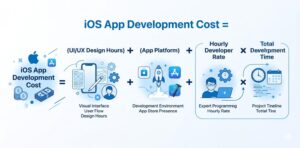
Before we go deep into each factor, here is a practical formula you can use as a starting point to estimate your iOS app development investment:
iOS App Development Cost = UI/UX Design Hours + App Platform + (Hourly Developer Rate x Total Development Time)
This formula gives you a solid baseline to work from. However, as you will see throughout this guide, there are many layers that sit on top of this equation. Design complexity, team location, API integrations, testing requirements, and post-launch maintenance all add real dollars to your final number. Use this formula as a foundation, not a final answer.
Cost Breakdown: 10 Key Factors That Determine iOS App Development Cost
Understanding what drives the cost of your iOS app is the single most important step you can take before hiring any development team. These 10 factors will shape almost every rupee or dollar you spend. Read through each one carefully and think honestly about where your project falls on each spectrum.
1. App Complexity (Features)
App complexity is arguably the most powerful cost driver in the entire equation. It refers to the number of features your app has, how those features interact with each other, and how technically demanding they are to build and maintain.
A simple app might have just a login screen, a user profile page, a few content screens, and a settings menu. That is manageable and affordable. But when you start adding layers such as real-time chat, push notification systems, AI-driven personalization, augmented reality features, live video streaming, payment processing, multi-language support, offline mode functionality, and advanced search capabilities, the development time multiplies rapidly. Every feature is not just one thing to build. It involves front-end design and interface work, back-end logic and data handling, API connections to external services, thorough error handling for edge cases, and multiple rounds of testing across devices and iOS versions. All of that takes substantial time and skill.
The other important consideration is how features interact with each other. A real-time messaging feature in isolation is complex enough. But when that messaging feature needs to integrate with user profiles, push notifications, media uploads, and end-to-end encryption, the complexity compounds exponentially. Good development teams plan for this from the start. Less experienced teams often underestimate integration complexity and deliver over budget or past deadline.
Here is how different complexity levels map to cost and timeline:
| App Complexity | Features Included | Time Required | Average Cost (USD) | Average Cost (INR) |
| Basic | Login, profile, simple navigation, static content | 2 to 4 months | $10,000 to $50,000 | INR 8L to 40L |
| Mid Level | Social features, dashboards, payment integration, APIs | 4 to 8 months | $50,000 to $100,000 | INR 40L to 80L |
| Complex | AI, AR/VR, real-time data, multi-user roles, advanced backend | 8 months or more | $100,000 and above | INR 80L and above |
Key points to understand about complexity:
Every feature you add multiplies development time across design, coding, testing, and maintenance. Third-party integrations add extra complexity even when they appear simple from the outside. Features involving sensitive data types such as health records, financial transactions, or location tracking require additional security layers. Post-launch feature additions are significantly cheaper when the original architecture is built with scalability in mind. Always prioritize features by user value and build the most essential ones in version one.
2. App Size
App size refers to the total scope of your application: how many screens it has, how many distinct user roles it serves, how much data it manages, and how extensive the backend infrastructure needs to be. It is closely related to complexity but distinct in an important way. A simple app can be large in terms of the number of screens, and a complex app can theoretically have few screens but with very deep functionality behind each one.
The most useful way to measure app size is to map out every screen and user flow. Think about every state a screen can be in, not just the happy path. A product detail screen in a shopping app is not just one screen. It has a loading state, an error state, an out-of-stock state, a variation selection state, a reviews section, and a share capability. Each of those states needs to be designed and coded.
| App Size | Number of Screens | User Roles | Backend Complexity | Time Required | Average Cost (USD) | Average Cost (INR) |
| Small | 5 to 10 screens | Single user type | Simple or no backend | 2 to 4 months | $10,000 to $50,000 | INR 8L to 40L |
| Medium | 11 to 25 screens | 1 to 2 user types | Moderate backend with APIs | 4 to 8 months | $50,000 to $100,000 | INR 40L to 80L |
| Large | 25 plus screens | Multiple user roles | Complex backend, scaling infrastructure | 8 months or more | $100,000 and above | INR 80L and above |
Key points to understand about app size:
More screens directly translate to more UI design hours, more front-end development work, and more QA testing cycles. Multiple user roles mean entirely separate flows, permission systems, dashboards, and potentially separate data views, all of which must be individually designed, built, and tested. Large apps require a more robust server infrastructure that can handle concurrent users and peak traffic loads. The bigger the app, the more important good project management and clear documentation become.
3. App Category
The category your app falls into is a fundamental cost driver because different categories come with fundamentally different technical requirements, regulatory demands, and user experience expectations. A gaming app needs a graphics rendering engine, complex physics, and often a multiplayer backend. A healthcare app must comply with HIPAA or similar data privacy laws, adding legal, security, and compliance costs on top of development. A marketplace app needs two separate user systems, a transaction engine, a ratings and reviews framework, and a dispute resolution mechanism. These are not just feature differences. They represent completely different architectural requirements.
Understanding your category helps you budget realistically and identify which specialized skills your development team needs to have.
| App Category | Key Features | Timeline | Average Cost (USD) | Average Cost (INR) |
| Gaming App | Graphics engine, multiplayer, leaderboards, in app purchases | 4 to 20 months | $30,000 to $250,000 | INR 24L to 200L |
| Business App | Dashboards, analytics, CRM integration, reporting tools | 2 to 10 months | $5,000 to $150,000 | INR 4L to 120L |
| Education App | Courses, quizzes, video content, progress tracking, certificates | 2 to 12 months | $10,000 to $80,000 | INR 8L to 64L |
| Entertainment App | Media streaming, subscriptions, personalized recommendations | 3 to 15 months | $15,000 to $100,000 | INR 12L to 80L |
| Travel App | Booking engine, maps, itinerary tools, currency conversion | 2 to 8 months | $5,000 to $50,000 | INR 4L to 40L |
| Shopping App | Product catalog, cart, payment gateway, order tracking, reviews | 3 to 8 months | $5,000 to $50,000 | INR 4L to 40L |
| Social Networking App | Profiles, activity feeds, messaging, stories, notifications | 5 to 8 months | $10,000 to $60,000 | INR 8L to 48L |
| Health and Fitness App | Activity tracking, wearables integration, nutrition, workouts | 1 to 15 months | $10,000 to $250,000 | INR 8L to 200L |
| Medical App | HIPAA compliance, patient records, telemedicine, prescriptions | 2 to 6 months | $30,000 to $90,000 | INR 24L to 72L |
| FinTech App | Banking, lending, investment tracking, KYC, fraud detection | 4 to 12 months | $50,000 to $300,000 | INR 40L to 240L |
Key points to understand about app categories:
Regulated industries like healthcare and fintech carry compliance costs that sit entirely outside standard development budgets. Marketplace apps need significantly more backend logic, moderation systems, and dispute handling than single-sided apps. Entertainment and gaming apps often need expensive third-party licenses and high-performance content delivery networks. Always study the top three or four existing apps in your specific category before finalizing your feature list and budget. Understanding what users already expect from your category sets the baseline for your minimum viable feature set.
4. App Design
Design is not cosmetic. It is functional. It is what determines whether users stay in your app or leave within the first 30 seconds. Poor design results in high uninstall rates, bad App Store reviews, and ultimately a failed product, regardless of how well the underlying code works. Exceptional design, on the other hand, creates habit-forming experiences that drive retention, word of mouth, and long-term revenue.
There are multiple distinct layers of design work in a professional iOS application, and each one carries its own cost:
| Design Component | What It Includes | Average Cost (USD) | Average Cost (INR) |
| Design Research | User research, competitor analysis, persona mapping, journey mapping | $100 to $500 | INR 8,000 to 40,000 |
| UX Design | User flows, wireframes, information architecture, interaction design | $2,000 to $10,000 | INR 1.6L to 8L |
| UI Design | Visual screens, color system, typography, component library | $10,000 to $40,000 | INR 8L to 32L |
| Branding | Logo, brand guidelines, app icon design, splash screen | $5,000 to $20,000 | INR 4L to 16L |
| Animation and Illustrations | Micro animations, loading screens, onboarding illustrations, custom icons | $1,000 to $25,000 | INR 80,000 to 20L |
| Prototype and Testing | Interactive prototype creation, usability testing with real users | $500 to $3,000 | INR 40,000 to 2.4L |
Key points to understand about app design:
Investing in thorough UX design before any code is written is one of the highest-return activities in the entire development process. A well-designed user flow catches costly structural problems early when they are cheap to fix. Custom UI design always costs more than using off-the-shelf templates, but the difference in user retention and brand perception is substantial. Animation and microinteractions can transform a functional app into a genuinely enjoyable one, but they add meaningful time and cost to the project. Apple has strict Human Interface Guidelines (HIG) that all iOS apps must follow, and experienced iOS designers know these deeply. Branding costs are a one-time investment that compounds in value across your app, website, and all marketing materials.
5. API Integration
APIs (Application Programming Interfaces) are the invisible connectors that allow your iOS app to communicate with external services and data sources. Whether it is processing a payment, displaying a map, authenticating a user through Google, sending an email notification, or pulling in real-time weather data, almost every modern iOS app depends on multiple APIs to deliver its core functionality.
The cost of API integration depends on several variables: which APIs you need, how complex the integration is, whether the API requires custom middleware, the licensing model of the service, and how much documentation and support the API provider offers.
Payment Gateway Options and Their Cost Structure:
| Payment Gateway | Transaction Fee | Monthly Fee | Integration Complexity | Best For |
| PayPal | 2.9% plus $0.30 per transaction | None or $30 for PayPal Pro | Medium | Consumer marketplaces |
| Stripe | 2.9% plus $0.30 per transaction | None | Low to Medium | Startups and SaaS |
| Authorize.net | 2.9% plus $0.30 per transaction | $25 | Medium | Established businesses |
| Braintree | 2.9% plus $0.30 (free for first $5,000 processed) | None | Low to Medium | Subscription businesses |
| Apple Pay | 1% plus $0.25 for instant transactions | None | Low (native iOS support) | Premium iOS experiences |
| Razorpay | 2% per transaction | None | Low | Indian market apps |
Third Party Service Integration Costs:
| Third Party Service | Purpose | Average Integration Cost (USD) | Average Integration Cost (INR) |
| Google Maps API | Navigation, geolocation, route calculation | $200 to $500 | INR 16,000 to 40,000 |
| Firebase Authentication | Email, social, and phone login | $200 to $400 | INR 16,000 to 32,000 |
| Travel APIs (Amadeus, Skyscanner) | Flight search and live pricing | $300 to $600 | INR 24,000 to 48,000 |
| Movie and Entertainment APIs | Metadata, ratings, trailers | $200 to $600 | INR 16,000 to 48,000 |
| Accommodation APIs | Hotel search, availability, pricing | $500 to $800 | INR 40,000 to 64,000 |
| Twilio (SMS and Voice) | OTP, SMS notifications, voice calls | $300 to $700 | INR 24,000 to 56,000 |
| SendGrid or Mailchimp | Email notifications and marketing | $100 to $300 | INR 8,000 to 24,000 |
| AWS Rekognition or Google Vision | Image recognition and AI features | $500 to $1,500 | INR 40,000 to 1.2L |
Key points to understand about API integration:
Every API you add requires development time not just for the initial setup but also for error handling, edge case management, fallback behavior, and ongoing monitoring. Many APIs come with recurring usage costs that become a permanent part of your operating expenses once the app is live. Security around payment APIs requires compliance with PCI DSS standards, which involves both development rigor and periodic audits. Poorly integrated APIs are one of the most common causes of app crashes, negative user reviews, and data incidents. Always evaluate the documentation quality, developer support, uptime SLAs, and pricing tiers of any API before committing to it.
6. Hiring Model
How you choose to staff your iOS app development project can be just as impactful on your budget as the complexity of the app itself. There are three primary hiring models, each with distinct advantages, limitations, and cost profiles.
In House Team
Hiring your own full time iOS development staff gives you maximum control, deep product knowledge, and seamless communication. The trade off is that it is the most expensive model, especially in Western markets, and comes with significant overhead in terms of salaries, benefits, office space, equipment, and management time.
| Role | Annual Salary Range (USD) | Annual Salary Range (INR) | Best For |
| iOS Developer (In House) | $90,000 to $130,000 per year | INR 18L to 30L per year | Continuous product development |
| Senior iOS Developer | $120,000 to $180,000 per year | INR 28L to 50L per year | Complex enterprise apps |
| UI/UX Designer | $70,000 to $110,000 per year | INR 12L to 25L per year | Design heavy products |
Freelance Developers
Freelancers offer flexibility and can be cost effective for small, well defined projects. However, they come with significant risks including availability inconsistencies, quality variation, lack of accountability, and challenges with IP ownership and handoffs.
| Project Complexity | Hourly Rate (USD) | Hourly Rate (INR) | Best For |
| Simple Projects | $24 to $79 per hour | INR 2,000 to 6,500 per hour | Small, clearly scoped apps |
| Complex Projects | $20 to $120 per hour | INR 1,600 to 10,000 per hour | Higher risk without strong vetting |
Offshore Development Agency
Offshore development agencies, particularly those based in India, offer the best overall value proposition for most project types. You get a structured team, established development processes, clear communication protocols, and quality deliverables at significantly lower rates than Western alternatives.
| Project Complexity | Hourly Rate (USD) | Hourly Rate (INR) | Best For |
| Simple Projects | $20 to $45 per hour | INR 1,600 to 3,700 per hour | Budget conscious full builds |
| Complex Projects | $45 to $79 per hour | INR 3,700 to 6,500 per hour | Best value for quality output |
Key points to understand about hiring models:
In house teams are the right choice for companies building a core technology product that will be continuously evolved over the years. Freelancers work well for very small, tightly scoped projects but carry genuine risk on anything with moving parts or dependencies. Offshore agencies, especially established ones in India, consistently deliver the best combination of price, quality, and process for startup and SME clients. Always review portfolios thoroughly, speak to previous clients, and conduct a technical assessment before committing to any development partner, regardless of model.
7. Development Location
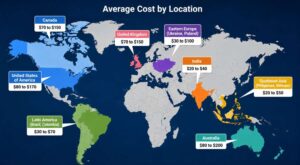
Where your development team is geographically located has a profound impact on your hourly rates, which in turn directly drives your total project cost. A 1,000 hour project costs $20,000 at $20 per hour and $170,000 at $170 per hour. That is an 8.5x difference for the same amount of work.
| Region | Average Hourly Rate (USD) | Average Hourly Rate (INR) | Quality Level | Communication |
| India | $20 to $40 | INR 1,600 to 3,200 | Very High | Strong English proficiency |
| Eastern Europe (Ukraine, Poland) | $30 to $100 | INR 2,400 to 8,000 | Very High | Good English |
| Southeast Asia (Philippines, Vietnam) | $20 to $50 | INR 1,600 to 4,000 | Good | Varies by agency |
| Latin America (Brazil, Colombia) | $30 to $70 | INR 2,400 to 5,600 | Good | Good English |
| United Kingdom | $70 to $150 | INR 5,600 to 12,000 | Very High | Native |
| United States of America | $80 to $170 | INR 6,400 to 13,600 | Very High | Native |
| Australia | $80 to $200 | INR 6,400 to 16,000 | Very High | Native |
| Canada | $70 to $150 | INR 5,600 to 12,000 | High | Native |
Why India stands out specifically: India produces more than 1.5 million engineering graduates annually. The country has a deep and mature iOS development ecosystem built over more than 15 years of global outsourcing experience. Indian developers are highly familiar with Swift, Xcode, Apple Human Interface Guidelines, App Store submission processes, and global coding standards. Many of the world’s largest technology companies including Google, Microsoft, Amazon, and Apple have significant engineering operations in India, which speaks to the quality of the talent pool.
Key points to understand about development location:
The cost savings from choosing an Indian development partner over a US based agency on a $100,000 project can realistically reach $60,000 to $80,000. Time zone differences can be managed effectively with proper planning, daily standups during overlapping hours, and asynchronous communication tools like Slack and project management platforms. Always prioritize agencies with strong English communication skills, proven client portfolios, and established development processes over purely chasing the lowest hourly rate.
8. App Testing
Quality assurance is not optional and it is not just a formality you rush through before launch. Thorough testing is what stands between your app and a wave of one star reviews, data breaches, crash reports, or public embarrassment. Professional iOS app QA covers multiple distinct testing disciplines, each serving a different purpose.
| Testing Type | What It Covers | Average Hours Required | Average Cost (USD) | Average Cost (INR) |
| UX Testing | Usability, navigation flow, user journey validation | 10 to 60 hours | $200 to $1,500 | INR 16,000 to 1.2L |
| Functional Testing | Feature by feature verification against requirements | 50 to 200 hours | $700 to $3,000 | INR 56,000 to 2.4L |
| Performance Testing | Load times, memory usage, battery impact, scalability | 10 to 30 hours | $150 to $500 | INR 12,000 to 40,000 |
| Security Testing | Penetration testing, data encryption, authentication checks | 50 to 200 hours | $800 to $2,000 | INR 64,000 to 1.6L |
| Platform and Device Testing | Compatibility across multiple iPhone models and iOS versions | 10 to 20 hours | $100 to $200 | INR 8,000 to 16,000 |
| Regression Testing | Verifying that new updates have not broken existing features | 20 to 80 hours | $300 to $1,500 | INR 24,000 to 1.2L |
| Beta Testing | Real world user testing before public launch | 10 to 40 hours | $200 to $1,000 | INR 16,000 to 80,000 |
Key points to understand about app testing:
Skipping or rushing QA to save money upfront is one of the most expensive mistakes you can make. Post launch bug fixes cost 3 to 5 times more than catching the same issues during development. Security testing is non negotiable for any app handling payment data, personal health information, or user authentication. Apple’s App Store review process is rigorous. Apps that fail review due to bugs, crashes, or policy violations face delays that can set launch timelines back by weeks. Always budget at least 15 to 20 percent of your total development budget specifically for quality assurance. For regulated industry apps, security and compliance testing may represent an even larger share.
9. Team Size
The composition and size of your development team directly affects both your cost and your delivery timeline. More team members generally means faster delivery but also higher coordination overhead and total cost. Smaller teams are leaner and cheaper but may become a bottleneck on complex projects.
Hourly Rates by Role (Global Averages)
| Role | Hourly Rate (USD) | Hourly Rate (INR) | Key Responsibility |
| iOS Developer | $20 to $100 | INR 1,600 to 8,000 | Core app development in Swift |
| UI/UX Designer | $15 to $50 | INR 1,200 to 4,000 | Interface and experience design |
| Scrum Master | $50 to $150 | INR 4,000 to 12,000 | Agile process management |
| QA Engineer | $12 to $40 | INR 1,000 to 3,200 | Testing and quality assurance |
| Business Analyst | $30 to $70 | INR 2,400 to 5,600 | Requirements and documentation |
| Project Manager | $60 to $180 | INR 4,800 to 14,400 | Timeline, budget, and stakeholder management |
| Backend Developer | $25 to $90 | INR 2,000 to 7,200 | API, database, and server development |
| DevOps Engineer | $40 to $120 | INR 3,200 to 9,600 | Infrastructure, deployment, CI/CD pipelines |
Small Team (2 to 4 Members)
| Average Hourly Rate | Typical Roles | Estimated Project Cost (USD) | Estimated Project Cost (INR) |
| $80 to $120 per hour | 1 iOS Developer, 1 UI/UX Designer, 1 Project Manager | $20,000 to $40,000 | INR 16L to 32L |
Small teams are lean and cost effective for simple applications with clearly defined, limited feature sets. They are ideal for MVPs, proof of concept builds, or apps with a single focused use case. Coordination is easy because there are fewer people to align, and decision making is fast.
Medium Team (5 to 10 Members)
| Average Hourly Rate | Typical Roles | Estimated Project Cost (USD) | Estimated Project Cost (INR) |
| $100 to $150 per hour | 2 to 3 iOS Developers, 1 to 2 UI/UX Designers, 1 Project Manager, 1 QA Specialist, 1 Backend Developer | $40,000 to $100,000 | INR 32L to 80L |
Medium teams are the right fit for apps with moderate complexity, multiple feature sets, and external integrations. They allow for parallel workstreams where design, front end development, and backend development happen simultaneously, which compresses timelines without inflating cost unnecessarily.
Large Team (10 Plus Members)
| Average Hourly Rate | Typical Roles | Estimated Project Cost (USD) | Estimated Project Cost (INR) |
| $150 to $250 per hour | 5 plus iOS Developers, 2 to 3 UI/UX Designers, 1 to 2 Project Managers, 2 QA Specialists, 2 Backend Developers, 1 DevOps Engineer | $100,000 to $250,000 | INR 80L to 200L |
Large teams are built for enterprise level applications with advanced backend infrastructure, extensive feature sets, strict security requirements, and aggressive delivery timelines. They bring specialists for every discipline which reduces risk but significantly increases the total budget.
Key points to understand about team size:
More team members does not automatically mean faster delivery. Poor coordination in a large team can actually slow things down compared to a well organized small team. Match team composition precisely to what your project actually requires rather than defaulting to larger or smaller. A dedicated project manager is worth every penny for any team larger than four people. Ask any potential development partner how they handle communication, daily standups, and progress reporting before signing a contract.
10. App Scale
App scale is the culmination of complexity, size, and feature set rolled into one practical planning framework. Here is how costs break down across three tiers at a granular phase by phase level.
Small Scale App
A small scale iOS app serves a single core purpose with a limited, focused feature set. It is the ideal starting point for startups validating an idea before raising capital or for businesses testing a new service channel.
| Phase | Task | Cost (USD) | Cost (INR) |
| Planning and Design | Wireframing and Prototyping | $500 to $1,000 | INR 40,000 to 80,000 |
| Planning and Design | UI and UX Design | $1,000 to $3,000 | INR 80,000 to 2.4L |
| Development | Front End Development | $2,000 to $5,000 | INR 1.6L to 4L |
| Development | Back End Development | $2,000 to $5,000 | INR 1.6L to 4L |
| Testing and Deployment | QA and Testing | $500 to $1,000 | INR 40,000 to 80,000 |
| Testing and Deployment | App Store Submission | $100 to $300 | INR 8,000 to 24,000 |
Total Estimated Cost: $6,100 to $15,300 (INR 4.9L to 12.3L)
Medium Scale App
A medium scale app offers a richer feature set, typically with external API integrations, user authentication, and a custom backend. It is suited for growing businesses targeting a clearly defined user base with specific needs.
| Phase | Task | Cost (USD) | Cost (INR) |
|---|---|---|---|
| Planning and Design | Wireframing and Prototyping | $1,000 to $2,000 | INR 80,000 to 1.6L |
| Planning and Design | UI and UX Design | $3,000 to $8,000 | INR 2.4L to 6.4L |
| Development | Front End Development | $5,000 to $10,000 | INR 4L to 8L |
| Development | Back End Development | $5,000 to $10,000 | INR 4L to 8L |
| Development | API Integration | $1,000 to $3,000 | INR 80,000 to 2.4L |
| Testing and Deployment | QA and Testing | $1,000 to $2,000 | INR 80,000 to 1.6L |
| Testing and Deployment | App Store Submission | $100 to $300 | INR 8,000 to 24,000 |
Total Estimated Cost: $16,100 to $35,300 (INR 12.9L to 28.2L)
Large Scale App
A large scale iOS application is feature rich, deeply integrated with multiple services, and designed to support significant user volumes and complex business operations. These are the apps built by established companies aiming for comprehensive user experiences.
| Phase | Task | Cost (USD) | Cost (INR) |
| Planning and Design | Wireframing and Prototyping | $2,000 to $5,000 | INR 1.6L to 4L |
| Planning and Design | UI and UX Design | $5,000 to $10,000 | INR 4L to 8L |
| Development | Front End Development | $10,000 to $20,000 | INR 8L to 16L |
| Development | Back End Development | $10,000 to $20,000 | INR 8L to 16L |
| Development | API Integration | $3,000 to $7,000 | INR 2.4L to 5.6L |
| Development | Advanced Features (AI, AR, real time) | $5,000 to $15,000 | INR 4L to 12L |
| Testing and Deployment | QA and Testing | $3,000 to $7,000 | INR 2.4L to 5.6L |
| Testing and Deployment | App Store Submission | $100 to $300 | INR 8,000 to 24,000 |
Total Estimated Cost: $38,100 to $84,300 (INR 30.5L to 67.4L)
Key points to understand about app scale:
Always start with the smallest viable version that genuinely proves your core concept. Every feature you defer to version two is money you keep in your pocket today and invest more strategically tomorrow. Post launch scaling using your real user data is almost always more efficient than building everything speculatively upfront. When planning a large scale app, design the backend architecture for scalability from day one. Retrofitting scalability into a poorly architected backend is one of the most expensive fixes in software development.
Hidden iOS App Development Costs in India
This is the section most guides leave out, and it is where many app budgets fall apart. The visible costs of development, design, and testing are just one part of the picture. There is an entire layer of costs that appear before launch, at launch, and throughout the life of your app that must be planned for in advance.
| Hidden Cost Category | What It Covers | Estimated Monthly Cost (USD) | Estimated Annual Cost (USD) | Estimated Annual Cost (INR) |
| Apple Developer Account | Required annual membership for App Store publishing | N/A | $99 | INR 8,200 |
| App Store Optimization (ASO) | Keyword research, screenshot design, description writing | N/A | $500 to $2,000 | INR 40,000 to 1.6L |
| Server and Hosting Infrastructure | AWS, Google Cloud, or Azure backend hosting | $50 to $2,000 | $600 to $24,000 | INR 48,000 to 19.2L |
| Push Notification Services | Firebase Cloud Messaging, OneSignal, or similar | $0 to $500 | $0 to $6,000 | INR 0 to 4.8L |
| Third Party Software Licenses | Analytics, crash reporters, A/B testing tools | $100 to $500 | $1,200 to $6,000 | INR 96,000 to 4.8L |
| App Maintenance and Updates | Bug fixes, iOS compatibility, minor features | N/A | 15 to 20 percent of original build cost | Scales with build cost |
| Customer Support Tools | In app chat, helpdesk, ticketing system | $50 to $500 | $600 to $6,000 | INR 48,000 to 4.8L |
| Legal and Compliance Costs | Privacy policy, terms of service, GDPR/DPDPA compliance | N/A (one time) | $500 to $5,000 | INR 40,000 to 4L |
| Analytics Platforms | Mixpanel, Amplitude, or Firebase Analytics | $0 to $1,000 | $0 to $12,000 | INR 0 to 9.6L |
| App Redesign or UI Refresh | UI updates driven by user feedback or new iOS design changes | N/A | $5,000 to $30,000 | INR 4L to 24L |
| Content Delivery Network (CDN) | Fast media delivery for global users | $20 to $200 | $240 to $2,400 | INR 19,200 to 1.9L |
Key insights on hidden costs:
App maintenance is the most consistently underestimated budget line in iOS development. Apple releases a major new iOS version every single September, and apps that are not updated for compatibility quickly accumulate negative reviews and lose organic App Store rankings. Server costs are variable and scale with your user base. A sudden spike in traffic without proper infrastructure planning can take your app down and generate emergency engineering costs at the worst possible time. Legal compliance is not optional for apps collecting personal data. India’s Digital Personal Data Protection Act (DPDPA) and global regulations like GDPR impose real obligations on app developers. The cost of getting compliance right upfront is a fraction of the cost of legal exposure after the fact. Build a contingency budget of at least 20 percent of your total development cost to absorb the hidden cost categories above.
iOS App Development Cost vs Android App Development Cost
The iOS versus Android question is one of the most common strategic decisions in mobile product development. Here is a comprehensive comparison to help you make an informed choice:
| Factor | iOS App Development | Android App Development |
| Primary Language | Swift or Objective C | Kotlin or Java |
| Development Time | Generally 10 to 15 percent faster | Slightly longer due to device fragmentation |
| Design Standards | Apple Human Interface Guidelines | Google Material Design Guidelines |
| Testing Complexity | Low to medium (limited device range) | High (hundreds of device and OS combinations) |
| Basic App Cost | $10,000 to $50,000 | $10,000 to $50,000 |
| Mid Level App Cost | $50,000 to $100,000 | $55,000 to $110,000 |
| Complex App Cost | $100,000 and above | $110,000 and above |
| Annual Developer Account Fee | $99 per year | $25 one time fee |
| Review Time (App Store) | 1 to 3 days typically | Hours to 1 day typically |
| Target User Income Level | Higher income urban users | Broader across income levels |
| Average Revenue Per User | Higher | Lower on average |
| Global Market Share | Around 27 to 30 percent | Around 70 to 73 percent |
| Maintenance Cost | Moderate | Higher due to device diversity |
| Cross Platform Possibility | React Native or Flutter | React Native or Flutter |
Key takeaways from this comparison:
iOS development is generally slightly more cost efficient than Android because the device ecosystem is far more standardized and testing complexity is lower. Android’s massive global market share advantage is most relevant for apps targeting tier two and tier three markets where Android dominance is pronounced. For monetization, iOS users historically spend significantly more per app through paid downloads, subscriptions, and in app purchases. A cross platform development approach using React Native or Flutter can reduce total build cost by 30 to 40 percent when both platforms are required and is worth serious consideration for budget conscious projects.
Comparative Analysis: Mobile App Development Cost in India vs Global Markets
| Comparison Point | India | USA | UK | Australia | Eastern Europe |
| Average Hourly Rate | $20 to $40 | $80 to $170 | $70 to $150 | $80 to $200 | $30 to $100 |
| Basic iOS App Cost | $5,000 to $20,000 | $30,000 to $80,000 | $25,000 to $70,000 | $35,000 to $90,000 | $15,000 to $50,000 |
| Mid Level iOS App Cost | $20,000 to $60,000 | $80,000 to $200,000 | $70,000 to $180,000 | $90,000 to $220,000 | $40,000 to $100,000 |
| Complex iOS App Cost | $60,000 to $150,000 | $200,000 plus | $180,000 plus | $200,000 plus | $100,000 plus |
| Time Zone Overlap | Manageable with planning | Same region | Suitable for European clients | Challenging for US clients | Good for European clients |
| English Communication | Strong, widely used in tech | Native | Native | Native | Good, varies by firm |
| Talent Pool Size | Very large | Large | Medium | Small | Medium |
| Post Launch Support Cost | Very competitive | Very high | High | Very high | Moderate |
| Startup Friendliness | Very high | Low (high minimum budgets) | Moderate | Low | Moderate |
| Average NDA and IP Protection | Strong legal frameworks | Strong | Strong | Strong | Good |
The cost savings potential when choosing India over the US for a $100,000 equivalent project is not marginal. It is transformational. The same budget that builds a mid level app in India can potentially deliver a large scale, fully featured enterprise platform compared to what it would buy in the US market. This is why India has consistently been the top offshore destination for iOS development for over a decade and continues to grow in that role.
How Can GrowRankers Help You With iOS App Development?
GrowRankers occupies a unique position in the market because it sits at the intersection of technology, strategy, and growth marketing. This is not a traditional development shop that hands you an app and walks away. GrowRankers is a partner that thinks about your app from a business performance perspective from the very first conversation.
Strategic Discovery Before Any Code Is Written
GrowRankers begins every engagement with a deep discovery process. Before a single screen is designed or a single line of code is written, the team digs into your business model, your target users, the competitive landscape, your revenue strategy, and your long term growth goals. This ensures that the app being built is not just technically excellent but commercially purposeful from day one.
End to End iOS Development Expertise
From the initial wireframes and UI/UX design through Swift development, backend engineering, third party API integration, thorough QA testing, and final App Store submission, GrowRankers manages the complete development lifecycle under one roof. You get a single accountable partner for the entire project, eliminating the coordination overhead and finger pointing that too often derails multi vendor development projects.
Integrated SEO and App Store Optimization
Unlike traditional development agencies, GrowRankers weaves digital marketing strategy, App Store Optimization, and SEO thinking into the development process from the beginning. Your app is not just built to function. It is built to be discovered, downloaded, retained, and talked about. This integration of growth marketing with technical development is what sets GrowRankers apart from development only shops.
Transparent Pricing and Milestone Based Delivery
Cost overruns and scope creep are the two most common complaints in app development engagements. GrowRankers operates on clearly defined project scopes with milestone based delivery schedules and transparent, detailed cost reporting at every stage. You always know exactly what you are paying for, what has been delivered, and what is coming next.
Post Launch Growth Support
The App Store launch is not the finish line. It is the starting gun. GrowRankers provides ongoing performance monitoring, feature iteration support, user feedback analysis, conversion rate optimization, and growth marketing services to help your app grow after it goes live. An app that launches and then stagnates is a missed opportunity. GrowRankers is built to prevent that outcome.
Proven Portfolio Across Industries
GrowRankers has helped startups, fast growing SMEs, and enterprise clients across multiple industries build iOS applications that generate measurable business value. From ecommerce platforms to healthcare tools to on demand service apps to fintech products, the team brings deep domain experience to every new project.
If you are serious about building an iOS app that does not just launch but actually succeeds in the marketplace, GrowRankers is the partner you want in your corner from day one.
Frequently Asked Questions About iOS App Development Cost in 2026
-
How much does it cost to build a basic iOS app in India in 2026?
A basic iOS app in India with simple features like user login, a profile section, and a few core functional screens typically costs between INR 3,00,000 and INR 10,00,000, which is approximately $5,000 to $15,000. The exact cost depends on the number of screens, the depth of design work, whether a backend server is required, and which development agency you partner with. Agencies with stronger portfolios may charge slightly more but typically deliver significantly higher quality output.
-
What is the average iOS app development cost for a startup MVP?
For a startup building a Minimum Viable Product for iOS, the typical investment range in India is INR 5,00,000 to INR 15,00,000, or roughly $8,000 to $20,000. This covers discovery and wireframing, basic but polished UI design, core feature development, basic backend infrastructure, quality assurance testing, and App Store submission. The goal of an MVP is to validate your core concept with real users before investing in the full feature set.
-
Why does iOS app development cost more than Android in some cases?
In markets where Swift developers command premium rates, iOS development can appear more expensive on a per hour basis. However, because the iOS device ecosystem is far more standardized than Android, testing costs are lower, which often makes total iOS project budgets comparable or even slightly below equivalent Android projects. The App Store’s annual developer fee of $99 is also higher than Google Play’s one time $25 fee, though this is a minor factor in the overall budget.
-
How long does it typically take to develop an iOS app?
Development timelines vary significantly based on scope. A simple app takes 2 to 4 months from kickoff to App Store launch. A medium complexity app with multiple feature sets and integrations typically takes 4 to 8 months. A complex enterprise iOS application with advanced features, extensive backend systems, and rigorous testing then android app development can take anywhere from 8 to 18 months. These timelines assume a dedicated team working consistently on the project.
-
What is the cheapest way to build an iOS app without compromising quality?
The most cost effective approach without sacrificing quality is to partner with an experienced, well reviewed iOS development agency in India. Indian agencies offer competitive hourly rates between $20 and $40 while maintaining strong technical standards and professional development processes. Combining this with a carefully scoped MVP first approach and phased feature releases can dramatically reduce initial investment without forcing compromises on the core user experience.
-
Does the App Store charge a fee to publish an iOS app?
Yes. Apple requires all developers to enroll in the Apple Developer Program at a cost of $99 per year, equivalent to approximately INR 8,200. This annual fee is required to submit new apps, update existing apps, and maintain your presence on the App Store regardless of whether your app is free, paid, or subscription based. Enterprise organizations have a separate Apple Developer Enterprise Program at $299 per year for internal distribution.
-
What are the ongoing maintenance costs for an iOS app after launch?
Ongoing annual maintenance typically costs 15 to 20 percent of the original development investment. For a $30,000 app, that means budgeting $4,500 to $6,000 per year for maintenance. This covers compatibility updates for new iOS versions released every September, bug fixes discovered after launch, server cost management, third party API updates, and minor feature improvements driven by user feedback. Neglecting maintenance leads to accumulating technical debt and eventually a costly rebuild.
-
Should I build an iOS app first or an Android app first?
If your primary target audience consists of urban, premium income users in markets like the US, UK, Australia, Canada, or metropolitan India, starting with iOS is strongly recommended. iOS users demonstrate higher app engagement rates, higher spending per app, and stronger early adopter behaviors that are invaluable for a new product. If your target market is broader with significant rural or emerging market coverage, Android may be a better first platform given its dominant global market share.
-
Can I build an iOS and Android app simultaneously to reduce cost?
Yes, and for many projects this is the right strategic approach. Using a cross platform framework like React Native or Flutter allows you to write a single shared codebase that deploys to both iOS and Android. This approach can reduce total development cost by 30 to 40 percent compared to building two fully separate native apps. The trade off is a small reduction in access to the most cutting edge platform specific features and occasionally slightly lower peak performance compared to fully native builds. For most business app use cases, this trade off is entirely acceptable.
-
How do I choose the right iOS app development company in India?
Evaluate potential partners across several dimensions. Review their portfolio of published iOS apps on the App Store to assess design quality and feature depth. Ask for case studies from your specific industry or app category. Speak directly with two or three of their previous clients and ask specific questions about communication quality, deadline adherence, and how they handled problems. Verify that their developers have hands on Swift and Xcode experience and are familiar with Apple Human Interface Guidelines. Assess their project management processes including how they handle scope changes, communicate progress, and report on budget consumption. Finally, make sure they offer post launch support and maintenance services so you are not left without technical support the moment your app goes live.